
The point of a pub walk is the walking. Four routes below link old pubs that are worth going into with streets that are worth crossing, each of them between two and six kilometres, each starting and finishing at a station. Have a half in each pub rather than a pint and all four are comfortable afternoons.
Our guide to historic pubs in London describes the buildings and sorts the documented history from the pub legend; read it first if you want to know which claims to believe. This page is the route sheet: what is between the pubs, how long each leg takes, where to eat halfway, and which stretch to cut if you are running out of afternoon.
If you have never ordered in a British pub, our page on how the bar works takes two minutes to read and saves a small amount of embarrassment at the first stop.
The four routes
- 1. Fleet Street and Holborn
- Blackfriars to Chancery Lane. About 2.5 km, five pubs, lawyers and printers
- 2. Borough and Bankside
- London Bridge to Blackfriars. About 2 km, four pubs, coaching inns and the river
- 3. Wapping to Limehouse
- Tower Hill to Limehouse. About 3.5 km, three pubs, the old docks
- 4. Hampstead to Highgate
- Hampstead to Archway. About 5.5 km, three pubs, the Heath in between
- Best day
- A weekday afternoon. Routes 1 and 2 run through the City fringe, where some pubs keep short weekend hours
- Measures
- Beer is sold in thirds, halves and pints. A half in each pub is the format these routes are built for
- Toilets
- Pub customers only, in almost every case. Plan around the pubs rather than around public facilities
Route 1: Fleet Street and Holborn, the lawyers' quarter
Blackfriars station to Chancery Lane, about 2.5 kilometres, 35 minutes of walking.
Begin at the Blackfriar, the wedge-shaped pub facing the station, and go inside rather than photographing the outside; the interior is the reason it is on the route. Walk north up New Bridge Street and turn left into Fleet Street.
Ye Olde Cheshire Cheese is about 500 metres along on the right, down a passage that is easy to walk past. From there continue west, past St Dunstan-in-the-West, and turn right up Chancery Lane and into Carey Street behind the Royal Courts of Justice. The Seven Stars stands opposite the back of the court building and is one of the smallest pubs on any of these routes.
Carry on north to High Holborn for the Cittie of Yorke, a long hall of a pub with a row of wooden cubicles down one side. It is a Samuel Smith's house: the brewery sells only its own beers, wines and spirits, and its pubs are known for having no music, no televisions and no individual websites, so check nothing online and simply turn up.
Finish at Ye Olde Mitre. It is hidden in Ely Court, a passage you reach either from Hatton Garden or from Ely Place, about 500 metres east. Chancery Lane and Farringdon stations are each a few minutes away.
What is between the pubs. The Inns of Court are the point of this walk: four self-governing legal societies occupying quiet courtyards off the noise of Fleet Street, described in our guide to Temple Church and the Inns of Court. Walk through Middle Temple between the first and second pubs if the gates are open. The whole route runs along the boundary where the City of London gives way to Westminster and Camden.
This route does not work on a Sunday. The pubs on and around Fleet Street serve office workers, and several keep short hours at the weekend or close altogether on Sundays. The Inns of Court gardens and passages are also shut or restricted outside working hours. Do route 2 or route 4 at the weekend and save this one for a weekday afternoon.
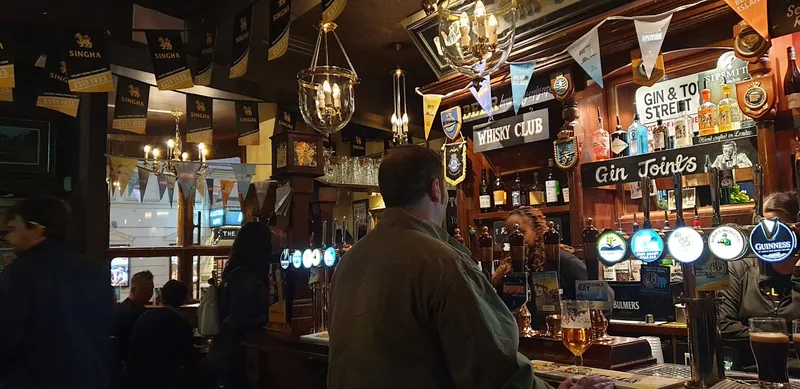
Photo: Thomas Dahlstrøm Nielsen · CC BY-SA 4.0 · Wikimedia Commons · resized
Route 2: Borough and Bankside, the coaching inns and the river
London Bridge station to Blackfriars, about 2 kilometres, 30 minutes of walking.
Come out of London Bridge station onto Borough High Street, walk south for a couple of minutes and turn left into the courtyard where the George Inn stands. No other galleried coaching inn survives in London; the National Trust owns this one and a pub company runs it.
Double back north into Borough Market. The Market Porter, on the corner of Stoney Street, opens early for market workers and is at its busiest at lunchtime; eat here rather than later, because this is the best food on any of the four routes.
Walk past Southwark Cathedral and west along the river to the Anchor on Bankside, which sits against the wall with the City opposite. Continue past Shakespeare's Globe and Tate Modern to the Founders Arms, a modern pub with the best terrace view on the route, and finish at Blackfriars or Southwark station.
What is between the pubs. Roughly a thousand years of Southwark: the inn yards where travellers from Kent stopped, a cathedral that was a priory church, the site of the Globe, and a power station turned into a gallery. It is the densest kilometre of history in London and it is entirely flat.
Route 3: Wapping to Limehouse, the old docks
Tower Hill to Limehouse, about 3.5 kilometres, 50 minutes of walking.
From Tower Hill, walk east past St Katharine Docks and along Wapping High Street. The buildings on both sides are converted warehouses, and the gaps between them are the old stairs down to the river.
The Town of Ramsgate is the first pub, about 1.2 kilometres in, beside Wapping Old Stairs. Wapping station is directly opposite if you want to shorten the walk at either end. Continue east for another ten minutes to the Prospect of Whitby, where you can drink on a terrace at river level or on the balcony above it.
The last leg is the longest and the quietest: east along the river wall, round the top of the old Shadwell Basin, and on to Narrow Street, where the Grapes sits in a terrace of eighteenth-century houses with its back room hanging over the Thames. Limehouse station, on the DLR and on c2c trains, is five minutes away.
What is between the pubs. Dock entrances, swing bridges, warehouse cranes left on the walls, and the stairs where watermen worked. Our guide to Wapping and Rotherhithe covers the area, and our page on riverside pubs explains how the tide changes what you see from each terrace.
Check the tide before route 3, not after. All three pubs on this walk look at the river, and at low water you are looking at gravel and mud rather than at the Thames. Aim to reach the Prospect of Whitby within an hour of high water and the whole route changes character. Tide times for the right stretch of river are published by the Port of London Authority.
Route 4: Hampstead to Highgate, across the Heath
Hampstead station to Archway or Highgate, about 5.5 kilometres, an hour and a half of walking.
This is the long one, and the only one where the walking outweighs the drinking. Start at Hampstead station, the deepest on the Underground, and walk up into the village. The Holly Bush is a few minutes away up a set of steps in Holly Mount, an early stop that most people reach at about the time they realise how steep Hampstead is.
From there cross Hampstead Heath north-east, aiming for Spaniards Road, and come out at the Spaniards Inn, about two kilometres of uneven paths later. It has a large garden and is very busy on a fine weekend.
Walk east past Kenwood House, through the grounds if they are open, and down into Highgate village for the Flask, which has a terrace on the square. Finish at Highgate station down Muswell Hill Road, or walk down the hill to Archway.
What is between the pubs. Eight hundred acres of heath, a Robert Adam house with a Vermeer in it, and one of the strangest cemeteries in Europe; our guide to Highgate Cemetery explains the ticketing, which you must sort out in advance. Our page on Hampstead covers the village.
Take this route in daylight. The Heath has no lighting, the paths are muddy for much of the year, and finding Spaniards Road in the dark is harder than it sounds. Proper shoes, not the ones you wore for the museums.
How many pubs, and how much to drink
Four or five pubs is the natural length of an afternoon. The arithmetic that makes it work is the measure: draught beer is sold legally in thirds, halves, two-thirds and pints, so ordering a half in each pub means five halves rather than five pints over three or four hours.
The routes above are built around that. If you drink a pint in each, route 1 becomes a long evening and route 4 becomes unwise, given that its middle section crosses unlit open ground. Nobody in a British pub thinks less of a person ordering a half, and many order thirds; our guide to what actually happens in a British pub covers the customs around this.
Eat at the midpoint rather than at the end. On route 2 that means Borough Market; on route 1, one of the Fleet Street pubs at about two o'clock; on route 3, before you set out, because the Wapping stretch has very little; on route 4, at the Spaniards or at Kenwood.
Practical points these routes share
- Toilets. Pub facilities are for customers, and there is very little else on routes 1, 3 and 4. Our page on public toilets in London covers the alternatives, of which there are fewer than you would expect.
- Step-free access. These are old buildings. Several of the pubs on route 1 have steps at the door, narrow stairs to the toilets and rooms on different levels. Routes 2 and 3 are flat underfoot; route 4 is not.
- Getting home. Finish before the last trains rather than after: our page on first and last Tube trains has the times, and alcohol may not be carried open on the network.
- Walking times. The figures above are moving time, not including pubs. Add twenty to thirty minutes per stop and the real duration of each route becomes clear. Our guide to walking in London covers pace and distances more generally.
Building your own route
Three rules produce a good walk. Keep the legs between pubs under fifteen minutes, or the group fragments. Make the last pub the best one, because that is where you will stay longest. And start at the far end from home, so that the route runs towards your train rather than away from it.
For finding the pubs themselves, the Campaign for Real Ale keeps a public database compiled by volunteers, with a national inventory of interiors that have survived largely unaltered. That inventory is the single most reliable way to find a genuinely old room rather than a recently panelled one.
If you would rather be led, a number of companies run guided evening routes with pub stops built in, and our page about walking tours sets out how to judge one before booking. A guided version costs money and buys you the history between the stops, which on routes 1 and 3 is most of the value.
Frequently asked questions
How many pubs should a London pub crawl include?
Four or five over an afternoon, with a half-pint in each. That keeps the total to about two and a half pints across three or four hours and leaves you able to walk the route. Beer is sold in thirds and halves as well as pints, and ordering a smaller measure is entirely normal.
Which London pub walk is best for a first visit?
The Borough and Bankside route, from London Bridge to Blackfriars. It is about two kilometres, entirely flat, passes a market, a cathedral, the Globe and Tate Modern, and works at the weekend, which the Fleet Street route does not.
Can you do a historic pub crawl on a Sunday in London?
Yes, but not in the City. Pubs on and around Fleet Street serve office workers and several close or keep short hours at weekends. The Southwark and Hampstead routes are both better on a Sunday, and the Wapping route works on any day.
How long does the Hampstead to Highgate walk take?
About an hour and a half of walking for roughly 5.5 kilometres, plus time in three pubs, so allow four hours in total. The middle section crosses Hampstead Heath on unlit and often muddy paths, so start early enough to finish in daylight and wear proper shoes.
Do the pubs on these routes serve food?
Most do, but kitchens close earlier than bars and some stop serving mid-afternoon. Eat at the midpoint of the route rather than at the end. Borough Market on route 2 is the best food available on any of the four walks.
Sources
- Campaign for Real Ale - Pub database and National Inventory of historic pub interiors (checked September 2026)
- Greene King - The Anchor, Bankside (checked September 2026)
- Town of Ramsgate, Wapping (checked September 2026)
- The Grapes, Limehouse (checked September 2026)
- Samuel Smith's Brewery - pubs (checked September 2026)
- Port of London Authority - Tidal information (checked September 2026)
- GOV.UK - Weights and measures: specified quantities (checked September 2026)