
Dr Johnson's House is the townhouse at 17 Gough Square where Samuel Johnson and a team of paid copyists compiled A Dictionary of the English Language, published in 1755. It costs £10 for an adult, it is closed every Monday, and on Friday afternoons after 2pm the adult ticket drops to £5.
The other opening detail to fix in your head is Sunday: the house opens only from 12pm to 4pm, with the last tickets sold at 3.30pm. Tuesday to Saturday it runs 10am to 5pm, last entry 4.30pm. Turn up on a Monday and you will find a locked door in a very quiet courtyard, which is a wasted journey for the sake of not checking.
The museum does one thing well: it puts you in the rooms, and above all in the attic, where a book that shaped the language was assembled by hand. Our round-up of London's writers' houses and smallest museums ranks it against the rest. What follows is what the ten pounds buys.
Dr Johnson's House: the practical frame
- Address
- 17 Gough Square, London EC4A 3DE
- Open
- Tuesday to Saturday 10am-5pm (last entry 4.30pm); Sunday 12pm-4pm (last entry 3.30pm). Closed Mondays
- Adult
- £10.00 (September 2026)
- Friday from 2pm
- £5.00 for adults
- Children 5-16 / under 5
- £5.00 / free
- Students with ID
- £9.00
- Booking
- Optional: tickets are sold online, and walk-ins are accepted
- Nearest Tube
- Chancery Lane (Central line), a five-minute walk
- Step-free access
- None. Seven steps to the front door and stairs between every floor
- How long
- Three quarters of an hour, or 90 minutes with the audio guide
Finding the door, which is the first obstacle
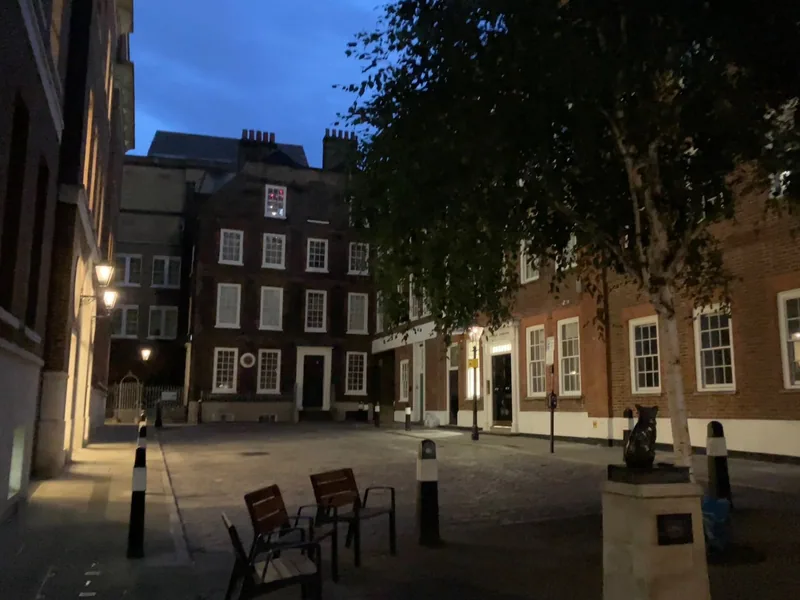
Gough Square is not on Fleet Street. It is one of the small courtyards behind it, reached through an alley, and the house sits on the north side facing a paved yard with a plane tree. There are black-and-white signs pointing the way from both Fleet Street and Fetter Lane; follow them rather than a phone map, which in this warren of courts will send you to the wrong passage.
From Chancery Lane station on the Central line it is barely 400 metres, five minutes down Fetter Lane and left. City Thameslink, Blackfriars and Farringdon are all a similar distance, and the Fleet Street buses are the 11, 15, 23, 26 and 76. Do not drive: the address falls inside the Congestion Charge area and parking is almost nonexistent, although there are two blue badge bays in the square itself.
Gough Square empties out at the weekend. This is an office district, so on a Saturday the courts around the house are silent and most of the sandwich shops are shut. That makes the museum itself more pleasant and lunch harder. Eat before you come, or walk five minutes west to the Strand.
What is actually inside
The house was built at the end of the seventeenth century by Richard Gough, a City wool merchant, and of the houses he put up around the square this is the last one left. Johnson was a tenant, not an owner, and he left in 1759. After him the building was lodgings, a small hotel, a printers' workshop and a store, and by 1911 rain was coming through the roof. It was rescued and restored by Cecil Harmsworth, a Liberal MP, which is why it exists at all.
What survives is the fabric rather than the furniture. Panelling, a fine open staircase, wide floorboards, coal holes, a cellarette cupboard and the original door handles. The eighteenth-century front door still carries its anti-burglary fittings: a heavy chain with a corkscrew latch and a spiked iron bar across the fanlight. You are allowed into every room and, unusually, invited to sit down on the chairs and in the window seats.
The collection is small and specific. First editions of the Dictionary, prints and oils including a rare portrait by Sir Joshua Reynolds's sister Frances, satirical work by Hogarth and Gillray, porcelain from the dinner services of Mrs Thrale, James Boswell and Reynolds, and Johnson's own walking stick, letter case and portrait medallion. Two thousand copies of the first edition were printed; about half are accounted for today, and the house owns two of them.
The garret, and the desk that came back
Climb to the top and you reach the point of the visit. The garret is where Johnson and his amanuenses worked: he underlined words and sentences in books he owned or borrowed, and the assistants copied the marked passages onto slips of paper, which were then alphabetised. His friend John Hawkins noted that borrowed books, if they came back at all, came back "so defaced as to be scarce worth owning". Wartime bombing wrecked the garret, and a new roof had to be built once the war was over.
The current exhibition, Desks, Drudgery and the Dictionary, is included in the admission price and is built around one object: Johnson's dictionary desk, lent back by Pembroke College, Oxford, and standing in the garret for the first time since the book was written there. The museum has not published a closing date, so if this is your reason for going, check before you travel.
Two dates for the contract are worth holding on to. Johnson signed with the bookseller William Strahan and his associates on 18 June 1746 for 1,500 guineas, promising three years' work. It took nine, and the Dictionary appeared in 1755. He lived at seventeen known London addresses in nearly fifty years in the city, and this is the only one left.
Francis Barber, in the basement and on the wall
One portrait in the house stops most visitors: a young Black man, painted by Reynolds's student James Northcote and identified as Francis Barber, Johnson's servant. Barber was born in Jamaica around 1742, into slavery on a sugar plantation, and given the name Quashey. He was brought to England in 1750, baptised and renamed, and joined Johnson's household in April 1752, aged about ten.
He spent four years at Gough Square, probably sleeping in the basement near the kitchen fires, and the museum displays a scrap of paper on which he practised writing his own name over and over. Johnson paid for his schooling, opposed slavery in print, and later had him discharged from the Navy. Barber married Elizabeth Ball in 1773 and stayed in Johnson's service for another twenty-four years. The museum tells this plainly rather than gently, and it is the strongest room in the house.
Hodge outside, and the smallest house in the City
At the bottom of the square there is a bronze cat on a plinth, sitting on a dictionary beside two open oyster shells. This is Hodge, sculpted by Jon Bickley. Boswell recorded that Johnson went out to buy the oysters himself rather than send a servant, on the grounds that a servant sent on errands for a cat might come to resent the animal. Oysters were cheap food in the eighteenth century; what struck people was the errand, not the extravagance. The statue is outside and free, so it is there whatever day you come.
Look right of the museum door and you will see a doll-sized brick house squeezed against it. That is the curator's cottage, purpose-built in 1912 so that a custodian could live on site when the house first opened to the public, and it has had a resident curator ever since. It is said to be the smallest dwelling in the Square Mile.
The stairs, and who will find this hard
Be clear-eyed about the access here, because the museum is. There are seven steps up from the courtyard to the front door, with a handrail, and then a staircase between each floor of a tall, narrow house. There is no lift and no step-free route at all. The lavatories are reached down a steep flight.
Against that, the museum has put handrails on both sides of the staircases and a chair or window seat in every room, so it is manageable in stages if stairs are slow rather than impossible. A carer accompanying a disabled visitor goes in free. If the stairs rule it out, our guide to step-free and accessible travel in London has the alternatives, and Sir John Soane's Museum ten minutes away is a better bet on the ground floor.
How long it takes, and the cheapest way to see it
Forty-five minutes is enough to walk the house. An hour and a half is right if you use the free audio guide, which plays on your own phone and opens each room with Johnson's own dictionary definition of it, and if you stop to read the exhibition captions in the garret. There is no café and nothing on sale to drink, only a shop, a children's guide and a rack for coats and small bags.
The money answer is the Friday Afternoon Special: between 2pm and 5pm on Fridays an adult pays £5 rather than £10, and the house is at its quietest as the offices around it wind down. A family of two adults and two children aged 5 to 16 pays £30 at the normal rate and £20 on a Friday afternoon. American Express is not accepted, so bring another card.
Two Christmas gaps to plan around. The museum closes early on Wednesday 2 December 2026, at 1pm, and then shuts completely from Thursday 24 December 2026 until Friday 1 January 2027, reopening at 10am on Saturday 2 January. It also closes occasionally for private functions, which it posts on its own website.
What to put either side of it
An hour in Gough Square is not a day out on its own, and the surrounding streets are the point. Ten minutes north-west, on Lincoln's Inn Fields, the Hunterian Museum and the Soane are both free, which makes a Friday afternoon of three collections for £5. South of Fleet Street are the courts and gardens of Temple Church and the Inns of Court, and on Fleet Street itself the Victorian gothic pile of the Royal Courts of Justice and the churches of Fleet Street, Wren's St Bride's among them.
Ye Olde Cheshire Cheese, rebuilt after the Great Fire, is through a passage a minute away and rated 5 by the food hygiene inspectors at its last visit in January 2025; it appears in our guide to London's historic pubs, which is where the Fleet Street drinking belongs. St Paul's Cathedral is about ten minutes east on foot, and from 28 November 2026 the London Museum opens its new home at West Smithfield, fifteen minutes north.
If you are building a wet afternoon out of small indoor places, what to do in London when it rains and our list of free museums both cover this corner of the City. For the other London house museums with the same atmosphere, see the Charles Dickens Museum in Bloomsbury.
Frequently asked questions
Is Dr Johnson's House open on Mondays?
No. It opens Tuesday to Saturday from 10am to 5pm, with last entry at 4.30pm, and on Sunday from 12pm to 4pm with last entry at 3.30pm. It is closed all day every Monday, and it also closes early or entirely for occasional private functions and over the Christmas and New Year holidays.
How much does Dr Johnson's House cost?
An adult ticket was £10.00 in September 2026, with students at £9.00 on production of a valid student ID, children aged 5 to 16 at £5.00, and under-5s and the carer of a disabled visitor free. On Friday afternoons from 2pm to 5pm the adult price is £5.00. American Express cards are not accepted.
Do you need to book Dr Johnson's House in advance?
No. The museum sells tickets online but states that you can also simply come along. It is a small house with limited capacity, so a weekday morning or a Friday afternoon is the most comfortable time. Booking is worth doing if you are travelling specifically for the current garret exhibition.
Where is the statue of Johnson's cat?
At the bottom of Gough Square, facing the house. The bronze by Jon Bickley shows Hodge sitting on a copy of the Dictionary next to a pair of opened oyster shells, a reference to Johnson going out to buy oysters for the cat himself. The statue stands in a public courtyard and costs nothing to see at any hour.
Is Dr Johnson's House suitable for wheelchair users?
No. The museum states that there is no step-free access. Seven steps with a handrail lead up to the front door, there is a staircase between every floor and no lift, and the lavatories are down a steep flight. Handrails run along both sides of the stairs and every room has seating, which helps visitors who manage stairs slowly.
Sources
- Food Standards Agency - food hygiene rating, Ye Olde Cheshire Cheese, 145 Fleet Street (checked September 2026)
- Transport for London - Chancery Lane Underground Station (checked September 2026)
- Transport for London - Congestion Charge (checked September 2026)
- Transport for London - Step-free access (checked September 2026)