
Temple Church is a round Norman church built by the Knights Templar, tucked into a quiet walled quarter between Fleet Street and the river. Sightseeing costs £5, or £3 for concessions, and children go free. The lanes and gardens around it belong to two of the four Inns of Court, and walking through them is free, provided you know which gates are open and when.
Almost nobody finds this place by accident. It sits behind a row of buildings on Fleet Street, reached through narrow archways that look private, and the whole quarter has the air of an Oxford college that has been dropped into the middle of London. Ten thousand people an hour walk along the Strand a hundred metres away and never turn in.
The Temple is technically inside the City of London, but it is looked after by the Inner Temple and the Middle Temple rather than by the Corporation, which is one of the constitutional oddities described in our guide to how the City governs itself.
Temple Church at a glance
- Address
- The Temple, London EC4Y 7BB
- Sightseeing admission
- £5, or £3 concessions (September 2026)
- Free entry for
- Children, members of the Inns, Inns' and Chambers' staff and their guests
- Opening hours
- Change from day to day around services and events; check the church's What's On before travelling
- Services
- Free to attend, including choral services
- Nearest stations
- Temple and Blackfriars (Circle and District lines)
- Evening and weekend access
- On foot via the Tudor Street gate only, after 8.30pm on weekdays and all weekend
- Inner Temple Garden
- Free; weekdays 12.30pm to 3pm, not on bank holidays
Why the church is round
The Knights Templar were founded in Jerusalem in 1118 or 1119 by Hugh of Payns, a knight from Champagne, who took the monastic vows of poverty, chastity and obedience and added a fourth: to protect pilgrims in the Holy Land. Their headquarters was the Aqsa Mosque on the Temple Mount, which the crusaders believed to be the Temple of Solomon. That is where the name comes from.
Round churches copied the rotunda of the Church of the Holy Sepulchre, built over what Constantine's workmen believed to be the grave of Christ. For the medieval mind, Jerusalem was the centre of the world and the Sepulchre the centre of the centre. Standing in the Round at Temple was meant to put you there.
The Templars had a house in London by the 1140s, a mile to the north. The present Round was in use by 1163 and the church was consecrated in 1185. A long rectangular chancel was added in the 13th century, which is why the plan looks like a circle with a hall stuck onto it. William Marshal, the regent who reissued Magna Carta in 1216 and 1217, is buried in the Round, and his son after him.
The order was suppressed in 1312 and the property eventually passed to the lawyers. James I granted the Temple to the two Inns by royal charter in 1608, on condition that they maintain the church in perpetuity, which they still do. A German incendiary bomb gutted the building in 1941, and what you see inside is largely post-war restoration on medieval stone.
The stone knights on the floor of the Round are the reason most people come. They are effigies, not tombs, and they were badly damaged in the 1941 fire. Look at the crossed legs and the worn faces, then look up at the arcade of intersecting arches above them, which is the part of the building that survived best.
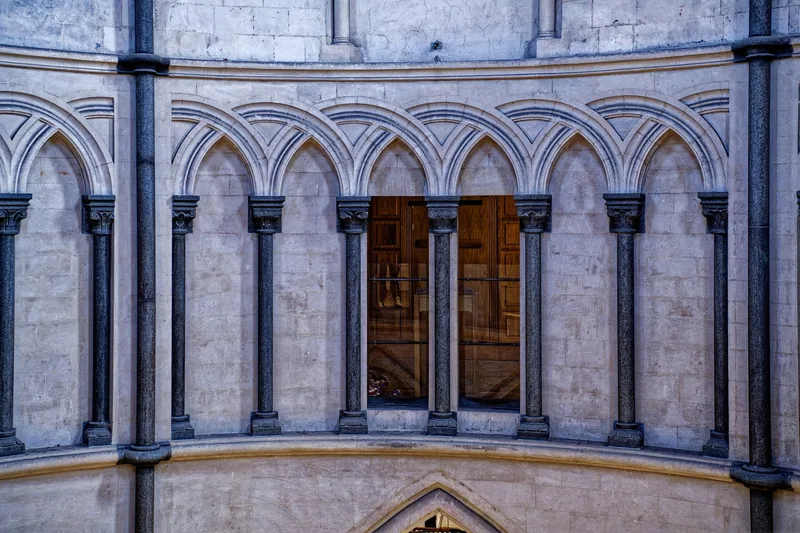
Photo: Tilman2007 · CC BY-SA 4.0 · Wikimedia Commons · resized
Getting in, and the hours problem
Temple Church publishes no fixed weekly timetable. Hours move around services, weddings, funerals, recitals and legal-term ceremonies, and they are posted a few days at a time on the church's own What's On page. Turning up without checking is the single most common way to waste the journey.
Sightseeing costs £5 for an adult and £3 concessions (September 2026). Children go free, as do members of the Inns, their staff and guests. You pay at the door; there is no advance ticket.
Services are free to everyone, and this is the better way in if the timing suits. The choir is a professional one with a long history, including the arrival of an organ built for the Battle of the Organs, a contest staged between rival builders in the 1680s in which Christopher Wren had a hand. Choral services resume with the new Master of the Temple, the Revd Dr Andrew Bowyer, at Choral Evensong on Wednesday 30 September 2026 at 6pm.
After 8.30pm on weekdays and all weekend, there is only one way in on foot. The Temple's gates close, and pedestrian access is through the Tudor Street gate on the south-west side. If you are coming for an evening service or a recital and arrive at the Fleet Street archways expecting to walk through, you will find them shut.
What the Inns of Court actually are
England has four Inns of Court: Inner Temple, Middle Temple, Lincoln's Inn and Gray's Inn. Every barrister in England and Wales must belong to one. They are not law firms and not colleges, but professional societies that call members to the Bar, run training, keep libraries and own large amounts of central London.
Two of them, Inner and Middle Temple, share the Temple. Lincoln's Inn lies ten minutes north, beyond the Royal Courts of Justice, and Gray's Inn is further north again, off Holborn. Together they form a band of gardens, squares and Georgian brick running across central London that most visitors never enter.
Inner Temple Garden
The best of the gardens, and it is free. It opens to the public on weekdays from 12.30pm to 3pm, excluding bank holidays, and you go in through the main gate opposite the Treasury Office on Crown Office Row. It slopes down towards the Embankment, with long herbaceous borders and a lawn that City workers colonise the moment the sun appears.
Two and a half hours a day is a narrow window. Set an alarm; a picnic bought in Fleet Street and eaten here at one o'clock is one of the better free lunches in London. The Inn also opens the garden for a handful of special open days through the year.
Middle Temple
Middle Temple Hall, with its Elizabethan interior, is the grandest room in the quarter, and its hammerbeam roof is one of the finest in England. It is a working dining hall for the Inn rather than a visitor attraction, and access is limited to particular times and arranged visits, so check the Inn's own website before you plan around it. The lanes, fountain court and staircases outside are open to walk through during the day.
Lincoln's Inn
Ten minutes' walk north, Lincoln's Inn is the largest and most college-like of the four. The gates are open from 8am to 7pm on weekdays, with pedestrian entrances on Chancery Lane and Carey Street, and the paths and benches of the North Gardens are open through those hours. From April to September the main lawn is opened for picnicking between noon and 2.30pm, which is worth timing a walk around.
The Inn runs scheduled guided tours, bookable in advance through its website. Its chapel, consecrated in 1623, has been closed to the public since 24 July 2026 while a £220,000 restoration of the historic east window is carried out, with reopening planned for 30 September 2026. Check before you go if the chapel is the reason for your visit.
Lincoln's Inn Fields makes the whole detour worthwhile. The square on the west side of the Inn is one of the largest in London and it has two remarkable free museums on its north side: Sir John Soane's Museum and the Hunterian Museum. Neither charges, and both are five minutes from Temple Church.
A ninety-minute walk through the legal quarter
Start at Temple station on the Embankment. Walk up through the Temple gardens into Kings Bench Walk, a row of plain brick chambers that has barely changed since the 17th century, then into the courtyard of the church itself.
Leave by the passage onto Fleet Street and turn west. Within two minutes you pass the point where Fleet Street becomes the Strand, marked by the memorial pillar with a dragon on it that replaced the old Temple Bar gateway, and the Royal Courts of Justice open on your right. Anyone may walk in and sit in on a civil case there, free of charge, as the guide linked above explains.
Cross Carey Street into Lincoln's Inn, come out on the west side into Lincoln's Inn Fields, and finish at Soane's Museum. That is roughly ninety minutes at a walking pace, and the only money you will have spent is the £5 at the church door. Our guide to walking in London covers when this beats the Tube, which in this part of town is almost always.
When to come, and when not to
Weekdays in the legal terms, roughly October to July, are when the quarter is alive: barristers in court dress crossing the courtyards, the gardens full at lunchtime, the church open more often. In August the Inns are quiet and many gates are shut.
Weekends are the opposite of what you would expect. The Temple is at its emptiest and prettiest on a Sunday morning, but access is restricted to the Tudor Street gate, the gardens are closed and so is most of what is worth seeing. If you have only one chance, take a weekday lunchtime.
During the Open House Festival in September, buildings in the Inns that are never normally open admit visitors free, and that is by some distance the best week of the year for this walk.
What to put around it
The Courtauld Gallery and Somerset House are five minutes west along the Strand, and Covent Garden ten minutes beyond that. East along Fleet Street you are into the Square Mile, with the free churches covered in our guide to All Hallows and the City churches, and the public galleries of the Old Bailey fifteen minutes on.
Fleet Street's old pubs, several of which have served lawyers and journalists for three centuries, are listed in our guide to historic pubs in London. For more corners like this one, see London's secret gardens and our list of free things to do in London.
Frequently asked questions
How much does it cost to go into Temple Church?
£5 for an adult and £3 for concessions (September 2026), paid at the door. Children enter free, as do members of the Inner and Middle Temple, their staff and guests. Attending a service, including choral services, is free for everyone.
When is Temple Church open to visitors?
There is no fixed weekly timetable. Sightseeing hours change day by day around services, weddings, funerals and legal ceremonies, and the church posts them a few days ahead on its own What's On page. Always check before travelling, and note that evening and weekend access to the Temple is through the Tudor Street gate only.
Can the public walk through the Inns of Court?
Yes, during the day. The lanes, courtyards and passages of the Temple and Lincoln's Inn are open to walk through, and Lincoln's Inn keeps its gates open from 8am to 7pm on weekdays. Buildings such as Middle Temple Hall and the chapels have their own limited visiting arrangements, and the gardens have set opening times.
When is the Inner Temple Garden open?
Weekdays from 12.30pm to 3pm, excluding bank holidays, free of charge. Entry is through the main gate opposite the Treasury Office on Crown Office Row. The Inn also holds several open days through the year, which it announces on its own website.
Is Temple Church the one from The Da Vinci Code?
Yes, the round church and its knight effigies appear in the novel and the film, which is why visitor numbers rose sharply after 2003. The building is a working church of the Inner and Middle Temple, not a film set, and the effigies are memorials rather than graves.
Sources
- Temple Church - Opening Times and Admission Charges (checked September 2026)
- Temple Church - Map and Directions (checked September 2026)
- Temple Church - History: the 12th century (checked September 2026)
- The Inner Temple - Visiting the Garden (checked September 2026)
- Lincoln's Inn - Visit Us (checked September 2026)
- Lincoln's Inn - The Chapel (checked September 2026)