
Temple Bar is the only one of the City of London's eight gates still standing, and it is not where it was built. The Portland stone arch, completed in 1672 and attributed to Christopher Wren, stood where Fleet Street meets the Strand until 1878, spent the next century in a Hertfordshire park, and was rebuilt stone by stone in Paternoster Square beside St Paul's in 2004. It is free to walk through, at any hour.
The spot it left is marked by something else: a tall stone memorial of 1880, in the middle of the road where Fleet Street becomes the Strand, with a bronze creature on top that everybody calls a griffin. The two objects are a fifteen-minute walk apart, and between them they explain where the City of London begins and why a reigning monarch has traditionally paused at that line.
Our guide to the City of London explained covers what the Corporation is, where the boundary runs and how to spot it on the ground. This page is about the gate.
Two places, one gate
- Temple Bar itself
- Paternoster Square, EC4M, beside St Paul's Cathedral. Free, outdoors, always accessible on foot
- The memorial pillar
- Where Fleet Street becomes the Strand, in front of the Royal Courts of Justice. Designed by Horace Jones, 1880
- Walk between them
- About 15 minutes along Fleet Street and up Ludgate Hill
- Nearest stations
- St Paul's (Central) for Paternoster Square; Temple or Chancery Lane for the pillar
- Annual ceremony
- The Oiling of the Gates, staged by Temple Bar Trust at the arch; free to watch. It was held on Friday 22 May 2026 at 11am
- How long
- Five minutes at each, or an hour for the walk with the Fleet Street churches added
What stood at Fleet Street before Wren
Temple Bar takes its name from the Temple, the legal quarter immediately south of the road, and the barrier goes back to the thirteenth century. The City Corporation's own account is refreshingly unromantic about the early versions: the first bar was probably no more than a chain across the road, later replaced by a timber gatehouse that also contained a prison.
That gatehouse was badly damaged in the Great Fire of 1666. The replacement, built between 1669 and 1672 by Thomas Knight, the City Mason, and Joshua Marshall, Master of the Masons' Company, to a design the Trust and the Corporation both attribute to Wren, was an altogether grander object: a Portland stone arch with niches on both flanks of the opening on both faces, filled with statues of James I and Anne of Denmark on one side and Charles I and Charles II on the other. Those four figures are still in place, and they are the easiest thing to look at when you find the arch today.
The other thing that was once on top is not. Through the eighteenth century a row of iron spikes stood above the main arch, and the heads of executed traitors were displayed on them. That is the City Corporation's own description of its own gateway, and it is worth remembering while you stand under the arch in a square full of office workers eating lunch.
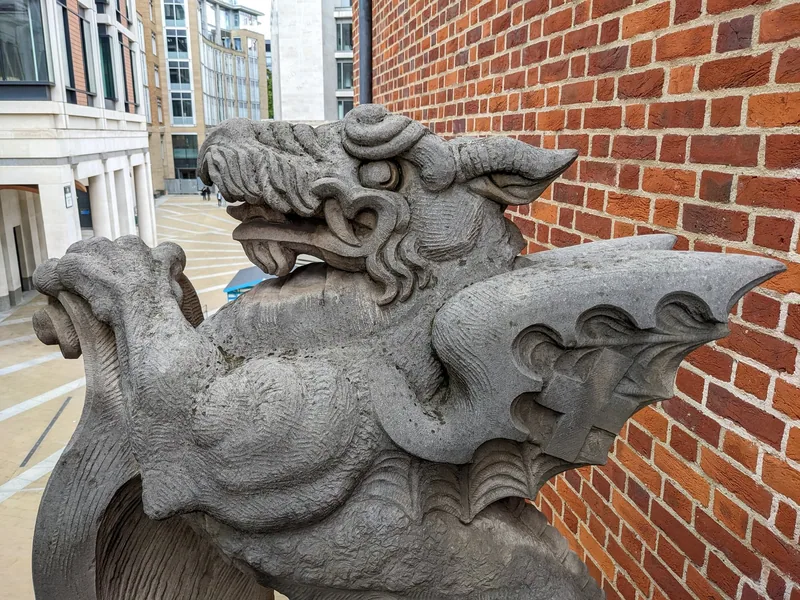
Photo: The wub · CC BY-SA 4.0 · Wikimedia Commons · resized
Why it was taken away, and where it went
By the 1870s the arch was a traffic obstruction, and the new Royal Courts of Justice needed the room. It was dismantled in 1878, each stone numbered, and re-erected at Theobalds Park in Hertfordshire, where Lady Meux used the chamber above the archway to entertain guests including Edward VII and Winston Churchill.
Getting it back took a long time. Sir Hugh Wontner, a former Lord Mayor, set up the Temple Bar Trust in 1976 with the aim of returning the arch; the Trust became its owner in 1984 and was given permission to remove it from Theobalds Park; the rebuilding was finished in 2004, as part of Mitsubishi Estates' redevelopment of Paternoster Square. The gate that once controlled the western boundary of the City now stands well inside it, beside the cathedral.
It is also, unexpectedly, in use. The chamber above the archway and the adjoining Paternoster Lodge are the home of the Worshipful Company of Chartered Architects, which makes this the smallest livery hall in the City. The Trust describes both rooms as fully accessible, hires them out for meetings and dinners, and runs an education programme and architectural walking tours from them. There is no general admission, so you cannot simply climb the stairs, but the building is not an empty monument.
The arch is in the wrong place on purpose, and that is the point of visiting it. Do not expect it to mark anything. What you are looking at is a 350-year-old gateway that has been taken apart and reassembled twice, and the joints between the numbered stones are visible if you stand close to the piers.
The creature on the pillar is not a griffin
Back at Fleet Street, the 1880 memorial by Horace Jones, the Corporation's own architect, stands in the roadway in front of the law courts. It is the thing most visitors mean when they say Temple Bar, and the bronze beast on the top is almost always called a griffin.
It is not one. A griffin has the head, forelegs and wings of an eagle; this animal has neither the beak nor the talons. It is the City's dragon, the same creature that holds a shield on the cast-iron boundary markers described in our City guide. Once you have seen a dragon at the Fleet Street line and another on the Victoria Embankment, you start noticing them at every road into the Square Mile.
The pillar stands on an island in a road that carries buses in both directions, which makes it easier to look at than to photograph. Cross at the lights by the law courts rather than stepping out to the middle of Fleet Street for a better angle.
Why the monarch stops at the line
The City of London Corporation puts it in one clause: Temple Bar is where the Lord Mayor would traditionally greet the monarch on their entrance into the City. That is the whole of it, and it is worth being precise about what it is and is not.
It is not a legal prohibition. No statute forbids the sovereign from entering the City, and nothing bad happens if a royal car drives down Fleet Street. What survives is a ceremony of welcome at the boundary, in which the Lord Mayor meets the monarch at the line and offers the City's sword, which is touched and returned - a piece of theatre asserting that the Corporation governs its own square mile and that the monarch enters as a guest. It happens only on state occasions, so it is not something a visitor can plan to see.
The ceremony you can watch is about oiling hinges. Temple Bar Trust stages a free annual event at the arch called the Oiling of the Gates, in which the Master of the Gates applies an oversized oil can to the hinges and declares them in good working order, watched by the Honourable Artillery Company's Pikemen and Musketeers and livery companies in full dress. In 2026 it was held on Friday 22 May at 11am. It is a modern invention, and it is very good value for nothing.
The other seven gates, and what is left of them
The City had eight gates in its wall. Seven of them - Aldgate, Aldersgate, Bishopsgate, Cripplegate, Ludgate, Moorgate and Newgate - had all been demolished by the end of the eighteenth century, which is why their names survive only as street names, Tube stations and a certain amount of confusion for visitors. Temple Bar is the sole survivor, and it was not even part of the wall: it was a bar across a road outside it.
For the wall itself, and the stretches you can still put your hand on, see our guide to Roman London and what is still standing. Newgate's site is now occupied by the Old Bailey, where you can sit in the public gallery for nothing.
Paternoster Square, and what else is in it
The square the arch now opens onto was rebuilt in its present form in 2003, to a design by John Simpson, between St Paul's and the London Stock Exchange. It is open to the public on foot, and there are three things in it worth a minute each.
- The column. Twenty-three metres, topped by an urn of golden flames, and often mistaken for a small version of the Monument. It is modelled on Inigo Jones's Corinthian columns for the old west portico of St Paul's, and the flames commemorate the two fires that destroyed this district, in 1666 and 1940.
- Shepherd and Sheep by Elisabeth Frink. The sheep refer to Newgate Meat Market, which stood on this site from the late seventeenth century until Smithfield took over in 1868, and also nod to the cathedral next door.
- The view of the dome. The square's north-west corner, through the arch, gives one of the better free framings of St Paul's in the City.
The walk that joins the two ends
Start at Temple station and walk east. Within two minutes you reach the memorial pillar and the Gothic front of the Royal Courts of Justice, where any member of the public may sit in on a civil case free of charge - our guide to the Royal Courts of Justice explains how. Turn south through the gateways into the legal quarter if you have time; Temple Church and the Inns of Court is the guide to that.
Otherwise keep going east along Fleet Street. St Bride's and the Fleet Street churches are free and on the left; Ludgate Circus follows, then the climb up Ludgate Hill with the dome ahead of you. Paternoster Square opens off the north side of the cathedral churchyard, and the arch is at its far corner. Fifteen minutes end to end, twenty-five if you cross the road properly at Ludgate Circus.
From the arch you are five minutes from St Mary-le-Bow down Cheapside and ten from Guildhall. The same stretch of road is the best section of a bus ride our guide to bus routes worth riding recommends, if your legs have had enough. In November the Lord Mayor's Show processes along part of it, and in September the Open House Festival opens City buildings that are shut the rest of the year.
Frequently asked questions
Where is Temple Bar now?
In Paternoster Square, immediately north-west of St Paul's Cathedral, where it forms the entrance to the square. It was rebuilt there in 2004 after 126 years at Theobalds Park in Hertfordshire. It is outdoors, free and accessible on foot at any time.
Why is there a monument in the middle of Fleet Street?
Because the gateway that stood there was removed in 1878. Horace Jones, the City of London's architect, designed a memorial in 1880 to mark the spot, and it still stands in the roadway in front of the Royal Courts of Justice, carrying statues of Queen Victoria and the Prince of Wales.
Is the creature on top a griffin or a dragon?
A dragon. Griffins have an eagle's head, beak and forelegs; this one has none of them. It is the City of London's heraldic dragon, the same beast that appears on the cast-iron boundary markers at the roads into the Square Mile.
Does the King need permission to enter the City of London?
No. There is no law preventing the monarch from entering, and no permission is sought. What survives is a ceremony of welcome at the boundary on state occasions, at which the Lord Mayor offers the City's sword to the sovereign, who touches and returns it. It is a courtesy with symbolic weight rather than a legal requirement.
Can you see the Oiling of the Gates ceremony?
Yes. It is a free public event staged by Temple Bar Trust at the arch in Paternoster Square, and it was held on Friday 22 May 2026 at 11am. It involves the Master of the Gates oiling the hinges with an oversized can while pikemen and liverymen look on. Check the date each year, because it is a recent tradition rather than a fixed one.
Sources
- City of London Corporation - Temple Bar (history, statues, the move, the eight gates) (checked September 2026)
- City of London Corporation newsroom - Oil can and pikemen to star in City gate ceremony, 19 May 2026 (checked September 2026)
- City of London Corporation - Paternoster Square (checked September 2026)
- Temple Bar Trust (checked September 2026)