
The bronze group at the north end of Westminster Bridge shows Boudica and two daughters in a chariot pulled by two horses. Thomas Thornycroft modelled it in the 1850s, but it was not put up until 1902, on a pedestal designed by Sir Thomas Graham Jackson. Historic England lists it, under the older spelling Boadicea, at Grade II.
Walk east from it and you pass roughly two dozen more listed memorials in about twenty minutes. Almost all of them are free, outdoors and ignored. Among them are a soldier on a camel, a mourning Belgian mother, a wall tablet to the engineer who built the ground you are walking on, and a mythical beast from Burma that people regularly describe as an elephant.
Our guide to Cleopatra's Needle and the Victoria Embankment owns the obelisk, the York Water Gate and the engineering under the road, and it is the page to read for how this strip of land came to exist. This one is about the figures standing on it.
The Embankment memorials at a glance
- Price
- Nothing, anywhere on the route: public pavement and public gardens throughout
- Route
- Westminster Bridge to Temple, about 1.5 km, twenty to forty minutes
- Stations
- Westminster at the west end; Embankment in the middle; Temple at the east end
- Gardens
- Victoria Embankment Gardens, open daily from 8am, closing with the season
- Best light
- Morning for the Westminster Bridge end, late afternoon for the gardens
Boudica: what the statue actually is
The statutory description is worth having in your head, because the group is usually described loosely. It is a bronze group of three figures in a two-horse chariot, a dramatic Beaux Arts Romantic composition on a granite pedestal, set at the head of the abutment steps of Westminster Bridge.
The dates are the interesting part. Thornycroft worked on it in the 1850s; the group was not erected on this spot until 1902, long after his death, and the architect of the pedestal, Thomas Graham Jackson, was of a later generation altogether. So the thing you are looking at is a mid-Victorian sculpture in an Edwardian setting, put up at a moment when Britain wanted an imperial origin story rather than at the moment it was made.
The other thing to notice is where she is pointing. Boudica led the revolt that destroyed Roman London, and she has been placed at the foot of the Palace of Westminster, under the Elizabeth Tower, looking towards the city she burned. What is left of that Roman town is set out in our page on Roman London and what is still standing, and the best day trip on the same story is Colchester, which she also destroyed.
There is no elephant on the Embankment. Travel writing repeats one, and we could not find it in any listed monument between Westminster Bridge and Temple. The animals here are a camel, on the Imperial Camel Corps Memorial, and a chinthe, the Burmese temple beast on top of the Chindits Memorial. A chinthe is lion-like, not elephantine, and the memorial's own inscription explains what it is.
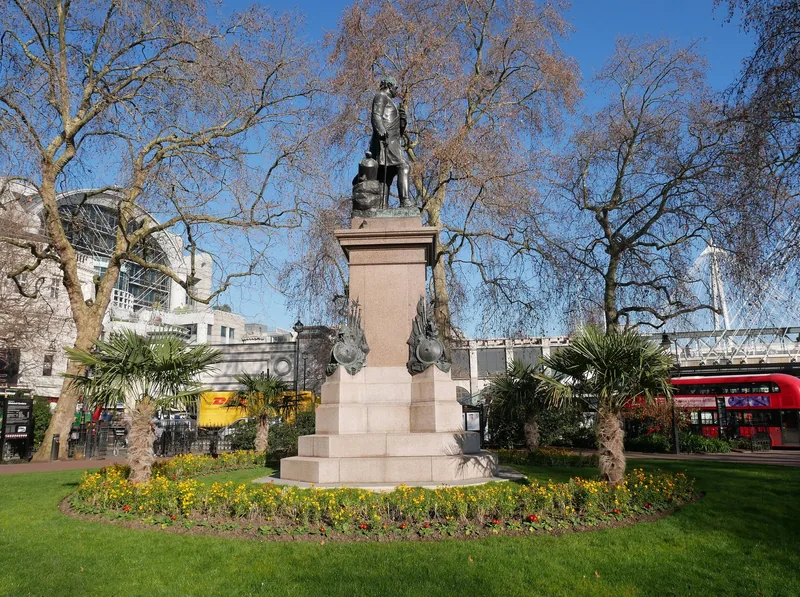
Photo: Doyle of London · CC BY-SA 4.0 · Wikimedia Commons · resized
The camel, and the beast that is not an elephant
The Imperial Camel Corps Memorial stands in Victoria Embankment Gardens. It is small: a bronze statuette of a figure mounted on a camel, on a Portland stone pedestal with a bronze relief panel, made in 1920 by Cecil Brown, and listed at Grade II. It is at eye level, which is why it works. Walk round it and read the campaign names on the base.
The other animal is on the roadside side of the gardens, near the Ministry of Defence. The Chindits Memorial was unveiled in 1990 and listed at Grade II in 2020: a four-metre tapering Portland stone plinth on three red granite steps, with a bronze chinthe on top. The inscription on the front spells out what the creature is, in capitals cut into the stone: the Chindit badge portrays a chinthe, a mythical beast, guardian of Burmese temples, from which the name Chindits was derived. The memorial commemorates the two Chindit expeditions into north Burma in 1943 and 1944 and lists the countries the force was drawn from.
The man who built the pavement, on a wall
Just upstream of Hungerford Bridge, fixed to a granite block in the river wall rather than standing on the pavement, is the memorial to Sir Joseph Bazalgette. It is a white marble pedimented tabernacle in early Renaissance style, holding a bronze portrait bust in a roundel and a bronze cartouche. It dates from 1890, and Bazalgette died the following year.
It is the easiest memorial in London to walk past, because it is at the height of the parapet and faces the traffic. It is also the one that explains the whole walk: the road, the gardens and the pavement you are standing on are his. The far end of the same sewer system is at Crossness Pumping Station, which opens on a handful of days a year.
Two men remembered for deaths at sea
Samuel Plimsoll's memorial sits on the edge of Victoria Embankment Gardens: a bronze portrait bust of 1929 by F V Blundstone on a granite pedestal with two bronze supporting figures and an inscribed cartouche. Plimsoll is the reason merchant ships carry a load line painted on the hull, and it is still called the Plimsoll line.
At the far, eastern end of the walk, fixed to the upstream roadside pier of Temple Pier, is a bronze tablet to the journalist W T Stead, with a portrait relief and two small figures of Fortitude and Sympathy. It was made in 1913 by Sir George Frampton, the year after Stead was lost in the Titanic. Frampton is the sculptor of the Peter Pan statue in Kensington Gardens, which went up the year before this one.
Grief, leaning on a pedestal
The best single sculpture in the gardens is the Sir Arthur Sullivan Memorial of 1903 by W Goscombe John: a bronze bust on a high granite pedestal with a bronze figure of Grief leaning against it, which Historic England describes as leaning disconsolately, "a la Père Lachaise". It is theatrical, it is very good, and it is about two minutes from a memorial to Sullivan's collaborator W S Gilbert, which is separately listed. The two men, who could not work together at the end, are commemorated a couple of hundred metres apart.
Nearby is a quieter one that deserves a look for who made it. The Henry Fawcett Memorial of 1886 is a granite mural fountain with a bronze panel and a medallion portrait above the basin, designed by Basil Champneys with the sculpture by Mary Grant, a woman working on a public London monument in the 1880s.
A Lutyens wall people sit on without noticing
The Cheylesmore Memorial, in the Villiers Street section of the gardens, is a Portland stone decorative screen wall with seats and a pond, dating from about 1930, and it is by Sir Edwin Lutyens. Most people treat it as somewhere to eat a sandwich, which is more or less what it is for. Lutyens designed the Cenotaph five minutes' walk inland, and the contrast between the two is the most instructive five minutes on this route.
The Belgian monument, and what is wearing away
Near the Villiers Street end stands the Belgian Monument to the British Nation, unveiled in October 1920 and the only memorial in the gardens listed at Grade II*. The bronze group is by Victor Rousseau and the classical stone screen behind it by Sir Reginald Blomfield.
The sculptor explained it himself, and the list entry quotes him: Belgium is the woman draped in mourning, telling her children that Belgians will never forget their debt to Great Britain, and the garlands the children carry stand for the wealth of the nine Belgian provinces. On the screen, a relief of Justice holds the 1837 Treaty of London that guaranteed Belgian neutrality, matched on the other side by Honour as St George. Historic England recorded both reliefs as seriously eroded when the monument was inspected in 2014, so look at them now rather than assuming they will be legible later. There is a seat built into the back.
How to tell a real Embankment lamp from a replica
The lamp standards along Victoria Embankment are listed too, thirty-four of them in a single entry, and they carry the best small detail on the walk. Thirty-two are from about 1900 by Walter MacFarlane and Company of the Saracen Foundry in Glasgow; the final pair, one on each side of the road where the Embankment meets Westminster Bridge, are from about 1929 by the Carron Company of Stirlingshire.
Each has a rectangular base with four decorated panels and four dolphins whose tails appear to hold up the shaft. The panel facing the road carries the date 1900 and a female figure, presumably Britannia, holding two shields with the arms of the cities of London and Westminster. The panel facing the pavement has an Art Nouveau flowering rose tree dissolving into a ribbon frieze; the other two have oak sprigs and acorns. They are painted black, gold and red.
Look for the vertical seam. Twenty-eight of the thirty-four originals stand between Westminster Bridge and Hungerford Bridge, and six more are further east among modern copies. An original is a single casting with a maker's mark on the base, usually buried under paint; a replica is made in two pieces designed to wrap around a steel post, and has a clear vertical join. Once you have seen one you cannot stop checking.
The route, west to east
| Stage | Minutes | What you stop for |
|---|---|---|
| Westminster Bridge north end | 5 | Boudica, and the Carron lamp standards of 1929 either side of the road |
| North along Victoria Embankment | 8 | The Chindits Memorial, Queen Mary's Steps, the statues of Tyndale and Gordon |
| Hungerford Bridge | 3 | The Bazalgette tablet in the river wall, just upstream |
| Victoria Embankment Gardens | 15 | Plimsoll, the camel, the Belgian monument, Sullivan and Grief, Fawcett's fountain, the Lutyens wall |
| On to Temple | 8 | The Stead tablet on Temple Pier, then Temple station |
Forty minutes if you stop at everything, twenty if you walk it. It is flat and step-free along the pavement, though the water gate in the gardens involves steps, and it is one of the routes where walking beats the Tube outright. From Temple you are two minutes from the lanes covered in our guide to Temple Church and the Inns of Court, and the whole route appears in our list of free things to do in London. For a piece of public sculpture that changes every two years rather than standing still for a century, see the Fourth Plinth.
Frequently asked questions
Where is the Boudica statue in London?
At the north-west end of Westminster Bridge, on the corner where the bridge meets Victoria Embankment, beside Big Ben and opposite the London Eye. It is free, outdoors and visible at any hour. Historic England lists it as the Boadicea (Boudicca) Statuary Group at Grade II.
Who made the Boudica statue and when?
Thomas Thornycroft modelled it in the 1850s, and it was unveiled on this site in 1902 to designs by Sir Thomas Graham Jackson, who made the granite pedestal. The gap of half a century between modelling and erection is the most unusual thing about it.
Is there an elephant among the Embankment statues?
No. The animals are a camel, on the Imperial Camel Corps Memorial of 1920 in Victoria Embankment Gardens, and a chinthe on the Chindits Memorial, which is a Burmese temple guardian beast of lion-like form. The memorial's own carved inscription says so.
How long does the Embankment statue walk take?
Twenty minutes at a steady pace from Westminster Bridge to Temple, or about forty if you stop at a dozen of the memorials. The gardens in the middle are the part worth slowing down for, and they open daily from 8am.
Is any of it free?
All of it. Every monument named here stands on public pavement or in public gardens, with no ticket, no gate and no opening hour on the pavement sections.
Sources
- Historic England - Boadicea (Boudicca) Statuary Group, list entry 1237737, Grade II (Internet Archive copy, 3 May 2025) (checked September 2026)
- Historic England - Imperial Camel Corps Memorial, list entry 1238057, Grade II (Internet Archive copy, 19 January 2025) (checked September 2026)
- Historic England - Chindits Memorial, list entry 1470017, Grade II (Internet Archive copy, 4 February 2026) (checked September 2026)
- Historic England - Memorial to Sir J Bazalgette, list entry 1357347, Grade II (Internet Archive copy, 31 December 2025) (checked September 2026)
- Historic England - Belgian Monument to the British Nation, list entry 1066168, Grade II* (Internet Archive copy, 21 June 2026) (checked September 2026)
- Historic England - Thirty-four catenary lamp standards, Victoria Embankment, list entry 1392513, Grade II (Internet Archive copy, 24 February 2026) (checked September 2026)
- Westminster City Council - Victoria Embankment Gardens (checked September 2026)