
Trinity Buoy Wharf is a free arts yard at the point where the River Lea runs into the Thames, and it holds London's only lighthouse, built in 1864 to test lamps rather than to guide ships. The wharf is open every day except Christmas Day, but the lighthouse itself, where a thousand-year piece of music called Longplayer has been playing since the last day of 1999, opens only on Saturdays and Sundays.
That weekend rule is the one fact to get right. On a weekday you can walk the wharf and see the container buildings and the boats, but the lighthouse door is shut. On a Saturday or Sunday you can climb to the lantern room and sit with the music as long as you like, free.
Our guide to Poplar and Blackwall puts the wharf in its neighbourhood, with the market, the churches and the walking routes from the stations. This page is about the lighthouse, Longplayer and what else on the site is worth your time.
Trinity Buoy Wharf at a glance
- Address
- 64 Orchard Place, London E14 0JW
- Wharf
- Open daily except Christmas Day, 7am to 7pm. Free
- Lighthouse and Longplayer
- Saturdays and Sundays only. April to September 11am to 5pm; October to March 11am to 4pm. Free, donations welcome
- Lighthouse capacity
- No more than six people on the stairs at a time; no step-free access
- Nearest stations
- Canning Town (Jubilee line and DLR), about 11 minutes' walk; East India (DLR), about 14 minutes
- Boat
- The wharf's own boat from North Greenwich Pier is out of service until further notice (checked November 2026)
- Time needed
- An hour, or two if you stay with Longplayer
A lighthouse built to test lights, not to warn ships
Trinity House, the body that received its charter from Henry VIII in 1514 and still looks after England's lighthouses, buoys and lightships, set up this wharf as its Thames-side workshop in 1803. Wooden buoys and sea marks were made and stored here, and the Trinity House yacht moored alongside to carry them out to the estuary. The brick river wall along the Lea dates from 1822 and is the oldest structure on the site.
The lighthouse you see today was designed by James Douglass, Trinity House's chief engineer, and built in 1864 as part of the Chain and Buoy Store, a long brick shed for iron mooring chains and buoys. The octagonal tower is built into the east gable, nearest the river. It never guided a ship. Its job was to try out lamps, lenses and colours for lighthouses around the coast, and the lights were shone across the river towards Shooters Hill and Charlton, where observers measured how far and how clearly they carried.
A second, older lantern of 1854 stood on the south-west gable until it was taken down in the 1920s, so for most of the Victorian period the wharf had two lighthouses side by side. In 1869 the two were used together to test coloured light for the Wolf Rock lighthouse off Cornwall: white from one lantern, red from the other. After the Second World War the surviving tower was used to train lighthouse keepers. The whole building is listed Grade II under the name Trinity House Chain Locker and Lighthouse Block.
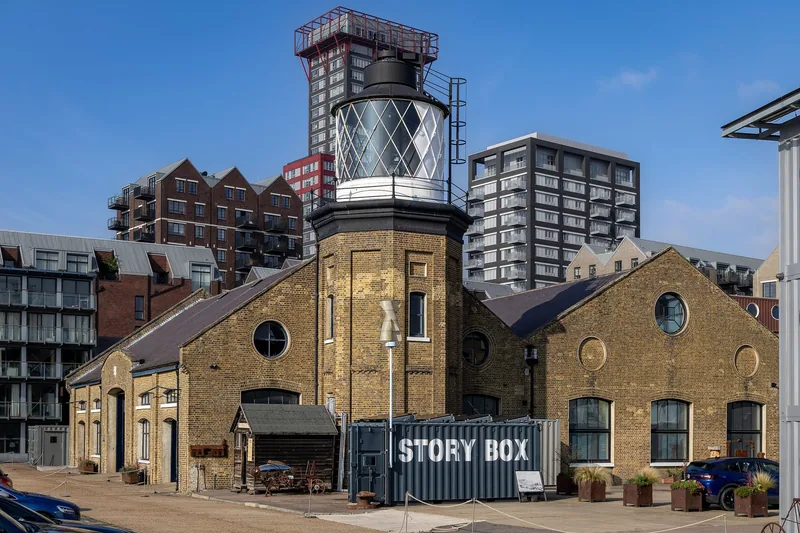
Photo: Superbass · CC BY-SA 4.0 · Wikimedia Commons · resized
What Michael Faraday did here, and what the wharf overstates
Michael Faraday was scientific adviser to Trinity House for nearly thirty years from 1836, and he ran electric lighting trials at this wharf in the 1850s. Those trials led in 1858 to the first electric light in a working British lighthouse, at South Foreland near Dover. When the 1864 store was being designed, Faraday asked for a room with a rigid iron floor to examine optical equipment, and Douglass moved the lantern into a half-tower at the east end to make space for it.
The wharf's own pages are not entirely consistent here. One says Faraday did his optical experiments "in the Experimental Lighthouse", which is the 1864 tower; another, more carefully, places his electric trials in the earlier 1854 lantern. The second version fits the dates. Faraday's room in the roof does not survive.
Next to the lighthouse is a small installation called The Faraday Effect, a recreation of a Victorian scientist's workshop filled with antiques, found objects, sound and documents. It is open year round, free, and very small: there is no step-free access because of the size of the space. Faraday's real laboratory and his apparatus are in Mayfair, at the Faraday Museum in the Royal Institution.
Longplayer: music that will not repeat until 2999
Longplayer is a composition by the musician and artist Jem Finer, commissioned by the arts organisation Artangel and now looked after by the Longplayer Trust. It is written to last exactly one thousand years. It started at midnight on the International Date Line, which was midday on 31 December 1999 in London, and it will not repeat any combination of its parts until the last moment of 2999. Then it starts again.
The sound comes from Tibetan singing bowls, recorded and played by computer. Six short pieces of source music play at the same time, at different speeds, and simple rules decide which section of each is heard. The result changes from hour to hour. Nobody alive will hear the same passage twice, and nobody can hear the whole thing.
The listening post is in the lantern room at the top of the lighthouse, with the river on three sides. Downstairs, 234 singing bowls are displayed on a tiered steel stand, six rings of 39, the instrument used when Longplayer is performed live by people instead of machines. The sound system was renewed in December 2024.
Events downstairs can be heard on the lighthouse's lower floor. The space under the lighthouse is hired out, and on some weekend afternoons set-up and performance noise carries into the ground floor. Longplayer stays clear in the lantern room. The Longplayer website lists the affected dates and times each season, so check it before a special trip.
Climbing the lighthouse: what it is like
The stair to the lantern is narrow and fairly steep, and only six visitors are allowed on it at a time. On a busy Sunday that means a short wait at the bottom, nothing more. There is no lift and no step-free route, so a wheelchair user or anyone who cannot manage steep steps can reach the ground floor and the bowl display but not the lantern room.
Volunteer invigilators look after the room. You do not need to book. People stay ten minutes or an hour; bring a layer in winter, because the lantern room is mostly glass.
The other reward is the view: across the Thames to the O2, up the curve of the Lea, and back towards Canary Wharf.
Container City, the lightship and the boats
Since 1998 the rest of the wharf has been run by Urban Space Management on a long lease from a charitable trust, and around 750 people work here in studios, offices, two schools and rehearsal rooms. Most of it is workspace, which you see from outside.
The stacked, brightly painted blocks are Container City, a building system made from old shipping containers joined into steel modules. Container City 1 went up in 2001, three storeys and twelve studios, with a fourth floor added in 2003; Container City 2 followed in 2002.
Moored at the wharf is Lightship LV95, built in 1939 for Trinity House and stationed for years on the South Goodwin sands. It was the first British light vessel converted to solar power and served until 2003; it is now a private recording studio and not open to visitors. The SS Robin, launched in 1890 just 300 metres away at Orchard Wharf, is described by the wharf as the only complete Victorian steam coaster left with its original engine and boiler. Look out too for Marcus Vergette's Time and Tide Bell on the Thames side of the river wall, rung by the water at high tide.
Go if
- You can come on a Saturday or Sunday, when the lighthouse is open
- You like small, strange places with a real story behind them
- You want a free hour combined with the cable car, the O2 or Canary Wharf
Skip it if
- You can only come on a weekday and the lighthouse is the reason
- You need step-free access to every part of a visit
- You expect a museum with displays and staff on every floor
Getting there on foot from Canning Town or East India
There is no public parking on site, and the wharf's boat from North Greenwich Pier, the Predator, is out of service until further notice (checked November 2026). Do not plan a river arrival. The two station walks are both straightforward once you know which exit to use.
- From Canning Town (Jubilee line and DLR): on the ticket hall level, take the first exit on the left after the barriers, go through the double doors and up the spiral stairs towards Bow Creek and City Island. Cross the red footbridge, walk through City Island to Orchard Place, continue under the flyover to the end of the street, and follow the blue signs. TfL's journey planner gives about 11 minutes.
- From East India (DLR): do not use the footbridge at the station. Go down the stairs on the river side, turn left, and follow the blue signs (marked for the wharf or for the Bird Sanctuary) past the old dock basin until you reach Orchard Place; turn right there. About 14 minutes.
- By bus: route D3 runs from Canary Wharf to a stop in Orchard Place, a short walk from the gate. The 277 stops by East India station.
Canning Town is about 15 minutes by DLR from Bank, or two stops east of Canary Wharf on the Jubilee line, and our guides to the Jubilee line and to the DLR cover the fares and step-free stations. Both walking routes include stairs.
The river bus does not stop at the wharf. The Longplayer trust's own directions suggest taking a river bus to the QE2 Pier at North Greenwich, on the opposite bank, and then the Jubilee line one stop to Canning Town. That works, and it is a pleasant way to arrive from central London, but it is not a direct boat. Our page on the Uber Boat river bus has the routes and fares.
Food, and what to pair it with
The Orchard Café sits in a shipping container on the wharf, open 8am to 4pm on weekdays and 9am to 4pm at weekends (read on the wharf's site, November 2026). The Food Standards Agency register lists it as The Orchard, rated 3 at its last inspection in March 2025.
Trinity Buoy Wharf works best as part of a half-day in the east. The cable car across the river leaves from Royal Victoria, one DLR stop from Canning Town. London Museum Docklands, in a Georgian sugar warehouse at West India Quay, tells the story of the docks this wharf served. And the southern end of the Lee Valley Regional Park starts at the East India Dock Basin, on your walk in from East India.
If you collect lighthouses, the coast has the working kind: our day trip to Dungeness and the Romney Marsh railway reaches two of them. For the body that runs the tidal Thames today, see our page on the Port of London Authority. And if small free places are your kind of day out, our list of free things to do in London has more, while Boston Manor House in Brentford is another building that costs nothing and almost nobody visits.
Frequently asked questions
Is there a lighthouse in London?
Yes, one: the Experimental Lighthouse at Trinity Buoy Wharf in Leamouth, east London, built by Trinity House in 1864 to test lamps and lenses. It never guided shipping. It is open to visitors free of charge on Saturdays and Sundays, 11am to 5pm in summer and 11am to 4pm from October to March.
When can you hear Longplayer at Trinity Buoy Wharf?
Longplayer plays non-stop, but the lighthouse that houses its listening post opens only at weekends, from 11am to 5pm between April and September and 11am to 4pm from October to March. No booking is needed, and there is also a live stream on the Longplayer website.
How long is Longplayer and when does it end?
Longplayer is one thousand years long. It began at midday London time on 31 December 1999, which was midnight on the International Date Line, and will not repeat itself until the end of 2999. At that point it completes its cycle and begins again.
Can you get a boat to Trinity Buoy Wharf?
Not at the moment. The wharf's own boat from North Greenwich Pier is out of service until further notice (checked November 2026). You can take a river bus to North Greenwich, then the Jubilee line one stop to Canning Town and walk about 11 minutes.
Is Trinity Buoy Wharf free?
Yes. The wharf, the lighthouse, Longplayer and the small Faraday Effect installation are all free to visit. The Longplayer Trust welcomes donations, and the café charges for food and drink in the normal way.
Sources
- Trinity Buoy Wharf - Visit: opening hours, directions and accessibility (checked November 2026)
- Trinity Buoy Wharf - About: history of the wharf and the trust (checked November 2026)
- Trinity Buoy Wharf - The Chain and Buoy Store and the 1854 lantern (checked November 2026)
- Trinity Buoy Wharf - Lightship LV95 (checked November 2026)
- Longplayer - Where to find Longplayer: opening hours and access (checked November 2026)
- Longplayer - Overview of Longplayer (checked November 2026)
- Historic England - Trinity House Chain Locker and Lighthouse Block, list entry 1242382 (checked November 2026)
- Food Standards Agency - Food hygiene ratings search: The Orchard, Orchard Place E14 0JW (checked November 2026)