
Boston Manor House in Brentford is a Jacobean house finished in 1623, run by Hounslow Council, free to enter and open all year from Tuesday to Sunday, noon to 5pm. Its great treasure is the plaster ceiling of the State Drawing Room, dated 1623, with panels showing the Five Senses, the Four Elements, Peace and War. It is about ten minutes' walk from Boston Manor station on the Piccadilly line's Heathrow branch.
Very few visitors to London have heard of it, which is the main reason it is worth the trip. You get a seventeenth-century interior of real quality with almost nobody else in the room, and it costs nothing. The house reopened in July 2023 after a five-year restoration, so it is in better condition now than it has been for decades.
Our guide to Brentford and Isleworth places the house in its neighbourhood, with the canal, the river and the other sights. This page goes inside: the woman who built it, the ceiling, the rooms, and how to fit it in, including from Heathrow.
Boston Manor House at a glance
- Address
- Boston Manor Road, Brentford TW8 9JX
- Opening
- Tuesday to Sunday, noon to 5pm, all year. Open on the May and August bank holiday Mondays
- Closed
- Mondays, Christmas Day, Boxing Day and the Boxing Day bank holiday, New Year's Day, Good Friday and Easter Sunday
- Cost
- Free
- December 2026
- From 3 to 31 December the Library hosts a Christmas play and is often closed to other visitors (checked November 2026)
- Café
- The Manor Kitchen, Tuesday to Saturday 10.30am to 4pm
- Getting there
- Boston Manor (Piccadilly line), about 8 to 10 minutes' walk; buses 195 and E8 stop outside
- Access
- Level entry from the café terrace; a lift serves every floor, and all historic rooms are wheelchair accessible
Mary Reade's house, 1622 to 1623
The house was built for Lady Mary Reade. Her husband, Sir William Reade, had inherited the manor of Boston, together with neighbouring Osterley, from his mother, the widow of the Tudor financier Sir Thomas Gresham. When William died in 1621, Mary set about building a new house. Three lead rainwater heads carry her initials and the date 1622, and the great ceiling is dated 1623. The Historic England list entry, which gives the house Grade I, dates it 1622 to 1623.
From the 1670s the house belonged to the Clitherow family, who kept it until the 1920s and enlarged it considerably, including a north wing of the eighteenth century. In 1923 Brentford Urban District Council bought the house and about 20 acres, and the grounds opened as a public park in 1924. The house was damaged in the Second World War, restored, and reopened in 1963.
From the front you can still read the original house: the two gables on the left, as the house's own guide points out, are the 1623 building. It is three storeys of red brick with stone window surrounds, with a heavy stone porch and entrance gates added in the nineteenth century.
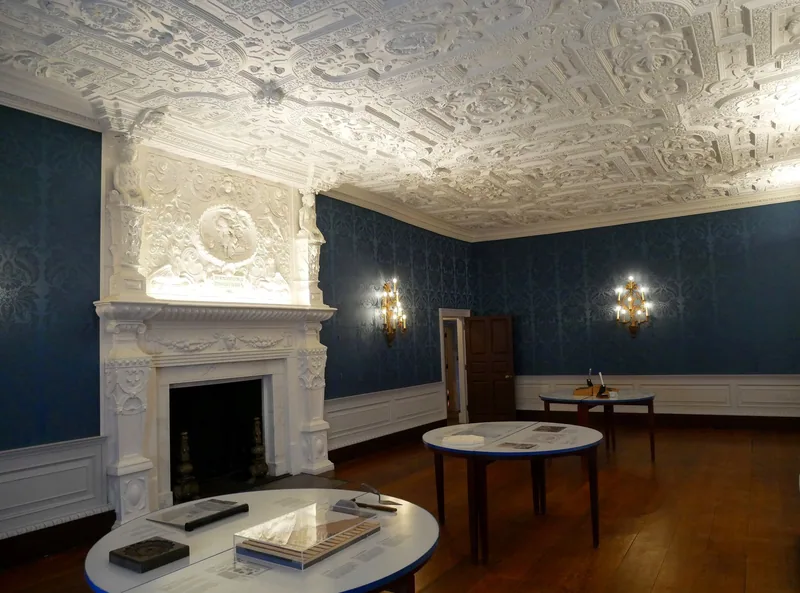
Photo: Doyle of London · CC BY-SA 4.0 · Wikimedia Commons · resized
The State Drawing Room ceiling
The first-floor State Drawing Room was the great chamber of Mary Reade's house, the room where she received important visitors, and its ceiling is the reason to come. Moulded ribs divide it into oblong and square fields, and inside them are strapwork, cartouches and medallions with allegorical figures. Country Life's architectural account lists Peace and War, the five Senses, the four Elements, the Theological Virtues of Faith, Hope and Charity, Time and Plenty. It carries the date 1623 and Mary Reade's initials.
The designs were not invented on site. The Four Elements were taken from sixteenth-century Flemish prints by Gheeraerts, and other motifs from the work of the Antwerp artist Frans Floris. The chimneypiece below follows a set of engravings of the life of Perseus by Abraham de Bruyn, though its central scene was swapped for the Sacrifice of Isaac. The same engravings were used for overmantels at Charlton House in Greenwich, a slightly earlier Jacobean house, which makes the two a good pair for anyone interested in the period.
The house's own programme names the plasterer as Edward Stanyon, a craftsman of humble origins who rose to be one of the leading plasterers of his day. Other accounts are more cautious about the attribution, so treat it as the house's view.
Use the window seats to look at the ceiling properly. The figures are small and high, and craning your neck in the middle of the room is tiring. There are window-sill seats and a sofa in the State Drawing Room, and folding chairs are kept there for visitors. Sit, take your time, and work round the panels one by one.
The ceiling has been repainted several times. In 1847 the mouldings were picked out in red, with the Latin names of the subjects in gilt letters; the 1960s scheme was also brightly coloured. The latest restoration has returned it to off-white.
The other rooms, and why they do not match
The restoration did not return the whole house to one date. Each room shows the period for which the best evidence survives, so you move from seventeenth-century rooms to eighteenth- and nineteenth-century ones as you go round. That can be confusing at first, but it tells the house's real story better than a single invented period would.
- The State Bedchamber, behind the drawing room, has another fine ribbed ceiling with pendants and a medallion of Hope, and a bed frame of early seventeenth-century type.
- The main staircase is the original carved Jacobean one, and its balustrade is copied in trompe l'oeil painting on the wall opposite. The list entry also notes fine eighteenth-century wallpaper on the upper stair.
- The Dining Room on the ground floor has been redecorated in its vivid Victorian colours.
- The entrance hall has a plaster ceiling in a convincing Jacobean style that is in fact nineteenth-century.
There are also two community exhibition galleries and a small shop by reception. A free digital guide is available through the Bloomberg Connects app.
The Heathrow line, and a few hours before a flight
Boston Manor station is on the Heathrow branch of the Piccadilly line, so every train between central London and the airport stops there. TfL's journey planner gives about 17 minutes from Heathrow Terminals 2 and 3 to Boston Manor and about 29 minutes from Green Park, with no change in either direction (November 2026). Our Piccadilly line guide covers the trains and the branches.
That makes this the easiest Jacobean interior to reach from Heathrow. If you land in the morning with time to kill before a hotel check-in, or have a long gap before an evening flight, an hour here is a far better use of it than a terminal café. Remember that it does not open until noon and is closed on Mondays. Our page on a long layover at Heathrow explains when leaving the airport makes sense, and our guide to staying near Heathrow covers the hotels.
Boston Manor station has no step-free route. TfL's station data records no lift or ramp there, so a wheelchair user or anyone with heavy luggage will find the station harder than the house, which has a lift to every floor. The 195 and E8 buses, which stop outside the house, are the step-free alternative.
The station itself is worth a look on the way: it is a listed building, and our page on Charles Holden's Underground stations explains why. From the station, follow Boston Manor Road to the house gates. Trains from Waterloo also stop at Brentford, about ten minutes' walk away.
Boston Manor Park and the two cafés
The house stands in Boston Manor Park, 34 acres of lawn, woodland, meadow and an ornamental lake with old cedars and oaks, sloping down to the River Brent and the Grand Union Canal. It has a playground with a zip line, a restored walled garden and a newer park café in the Park Hub building. A limited number of paid parking spaces are available in the park car park, with a four-hour limit on weekdays.
The Manor Kitchen café in the house opens Tuesday to Saturday from 10.30am to 4pm, so on a Sunday bring your own or use the park café. The Food Standards Agency register lists Boston Manor House Cafe at TW8 9JX with a rating of 5 from its inspection in July 2026.
Worth it for
- One of the finest Jacobean plaster ceilings in London, free
- A quiet afternoon with almost no queue anywhere
- A stop on the Heathrow line that needs no change of train
Think twice if
- You can only come on a Monday or before noon
- You want a grand estate with formal gardens; Osterley or Syon fit that better
- You are visiting in December and the Library matters to you
Osterley, Syon and the rest of west London
Brentford has more for a full afternoon. Osterley Park, part of the same Gresham inheritance in Mary Reade's day, and Syon House are grander and charge admission. The Museum of Water and Steam is by Kew Bridge, and Gunnersbury Park and its museum are a short bus ride north-east. For another west London house in a single afternoon, Hogarth's House in Chiswick is small and free, and Marble Hill House in Twickenham is free from April to October.
Frequently asked questions
Is Boston Manor House free?
Yes. Hounslow Council, which owns and runs the house, charges nothing to see the historic rooms. Some events, talks and performances are ticketed, and the café charges as normal. The house is open Tuesday to Sunday from noon to 5pm all year, apart from a few public holidays.
How far is Boston Manor House from the station?
About 8 to 10 minutes on foot from Boston Manor station on the Piccadilly line: TfL's journey planner gives 8 minutes and the house says 10. Brentford railway station is also about 10 minutes away, and buses 195 and E8 stop outside the house.
What is on the ceiling at Boston Manor House?
The State Drawing Room ceiling, dated 1623 with Mary Reade's initials, shows allegorical figures of Peace and War, the Five Senses, the Four Elements, Faith, Hope and Charity, Time and Plenty, set in panels divided by moulded ribs. Several of the designs were copied from Flemish prints of the sixteenth century.
Can I visit Boston Manor House from Heathrow?
Yes, easily. Piccadilly line trains from Heathrow stop at Boston Manor without a change, about 17 minutes from Terminals 2 and 3, then it is a walk of under ten minutes. The house opens at noon and is closed on Mondays, so plan round that.
Sources
- London Borough of Hounslow - Boston Manor House (checked November 2026)
- Boston Manor House - Visit us: opening times, closures, transport and café (checked November 2026)
- Boston Manor House - About the house and its history (checked November 2026)
- Boston Manor House - Access (checked November 2026)
- Historic England - Boston Manor House, list entry 1079603 (checked November 2026)
- Country Life - Boston Manor House: renewal and recovery (checked November 2026)
- Transport for London - Journey planner (Heathrow and Green Park to Boston Manor; walking times) (checked November 2026)
- Food Standards Agency - Food hygiene ratings search: Boston Manor House Cafe, TW8 9JX (checked November 2026)