
The Jubilee line is the grey one, and it is the line to choose if you are pushing a pram, using a wheelchair or dragging a suitcase: every one of the eleven stations from Westminster eastwards to Stratford is step-free from the street to the train. It runs 27 stations from Stanmore in the north-west to Stratford in the east, it is the second coolest of the seven deep lines, and it is the only line that touches Wembley Park, the O2 and the Olympic Park.
It is also the newest line on the Tube map. The western half is Victorian railway taken over in 1979; the eastern half was built in the 1990s to modern standards, with lifts, wide platforms and glass doors along the platform edge. That split explains almost everything about how the line behaves. Fares, the map and how to touch in are in our guide to the Underground.
The Jubilee line in brief
- Colour on the map
- Grey
- Stations
- 27, Stanmore (Zone 5) to Stratford (Zones 2 and 3)
- Branches
- None. One route end to end
- Step-free from street to platform
- 17 of 27, including every station from Westminster to Stratford
- Trains through Green Park at the morning peak
- 27 an hour, about one every 130 seconds
- Air conditioning
- None in service in September 2026
- Platform temperature, August 2024 evening peak
- 26.2 °C, second coolest of the seven deep lines
- Night Tube
- Friday and Saturday nights, the whole line with no gaps
Where it goes, and why the eastern half feels different
From Stanmore the line runs through Canons Park, Queensbury, Kingsbury and Wembley Park, then Neasden, Dollis Hill, Willesden Green, Kilburn, West Hampstead, Finchley Road, Swiss Cottage and St John's Wood to Baker Street. It crosses the West End at Bond Street and Green Park, then turns east.
From Green Park it goes Westminster, Waterloo, Southwark, London Bridge, Bermondsey, Canada Water, Canary Wharf, North Greenwich, Canning Town, West Ham and Stratford. That eastern section opened in 1999 and was the last major piece of deep tunnel built under London before the Elizabeth line. It was designed for crowds, and it shows: the platforms are wide, the ticket halls are big enough to queue in, and glass doors along the platform edge open only when a train is there.
There are no branches, which on this line is a real advantage. Every train goes the whole way, so there is no destination to check and no wrong train to board.
The most step-free deep line on the network
Working through TfL's detailed station data, 17 of the 27 stations have a step-free route from the street to a platform. That is about two thirds of the line, against roughly two fifths on the Piccadilly line and under a third on the Central.
The pattern is what matters. Every station from Westminster eastwards is step-free: Westminster, Waterloo, Southwark, London Bridge, Bermondsey, Canada Water, Canary Wharf, North Greenwich, Canning Town, West Ham and Stratford. In the north the step-free stations are Stanmore, Kingsbury, Wembley Park and Kilburn, plus Bond Street and Green Park in the centre.
The gap is the old section between Baker Street and Willesden Green. Baker Street, St John's Wood, Swiss Cottage, Finchley Road, West Hampstead and Willesden Green all have stairs somewhere, and so do Dollis Hill, Neasden, Queensbury and Canons Park. St John's Wood is the one that hurts, because it is the station for Lord's and for the walk to the Abbey Road crossing; the alternatives are discussed in our guide to St John's Wood and Maida Vale.
With a pram, plan your London days along the Jubilee line. Westminster for Parliament, Waterloo and Southwark for the South Bank, London Bridge for Borough Market, North Greenwich for the O2, Stratford for the Olympic Park: eleven consecutive stations, all with lifts from street to train, no stairs and no ramp to arrange. Our guide to getting around London with a pushchair has the rest of the network.
Step-free is not the same as easy, and the line has one long accessible route worth knowing about. TfL measures the step-free interchange at London Bridge between the Jubilee and Northern line platforms at 410 metres, the longest it publishes anywhere. At Green Park the step-free route from the Jubilee platforms is 220 metres to the Piccadilly line and 380 metres to the Victoria line. None of that is a problem if you know it in advance and a real one if you are running for a train. Assistance, which needs no booking, is covered in step-free and accessible transport in London and in more detail in using London transport in a wheelchair.
The trains, and why it is cooler down there
The Jubilee line runs a fleet delivered in the mid-1990s and lengthened with a seventh carriage in 2005 and 2006. The carriages have no walk-through gangways, but they do have next-station screens, and the trains have been driven automatically since 2011, which is why they accelerate hard out of stations.
There is no air conditioning. What there is instead is ventilation, on a scale the older lines never got: the extension tunnels were built with mechanical ventilation shafts, and the platform-edge doors keep the hot tunnel air away from the platform. The effect is measurable. On TfL's platform temperature data for the evening peak in August 2024, the Jubilee line averaged 26.2 °C against 31.1 °C on the Victoria line and 30.6 °C on the Central, and in January it averaged 17.4 °C, which is the closest any deep line gets to a comfortable temperature. Only the Waterloo & City line, which has two stations and runs on weekdays only, is cooler. The figures for every line are in which Tube lines have air conditioning.
Two cross-platform changes, and one line that overtakes it
At Baker Street the Jubilee and Bakerloo platforms share the same level in both directions, so it is a step-across change rather than a walk. That makes Baker Street the sensible place to swap onto the Bakerloo line for Oxford Circus, Piccadilly Circus and Marylebone.
At Finchley Road the same thing happens with the Metropolitan line, and here it is worth doing deliberately. The Jubilee and Metropolitan lines run side by side from Finchley Road to Wembley Park. The Jubilee calls at West Hampstead, Kilburn, Willesden Green, Dollis Hill and Neasden. The Metropolitan calls at none of them and covers the same distance in seven minutes. If you are going to Wembley Park, Harrow or anywhere further out, change at Finchley Road onto the fast train, which is exactly what TfL's own journey planner does: Westminster to Wembley Park comes out at about 21 minutes that way. Our guide to the Metropolitan and Hammersmith & City lines explains which trains stop where.
Going east, the Jubilee is the line the others feed into. Canning Town and Stratford are cross-network interchanges with the DLR, Canada Water connects to the Overground's Windrush line, and Canary Wharf is a short signed walk from the Elizabeth line station of the same name.
Weekends and closures
Because the Jubilee has no branches and modern signalling, it suffers fewer weekend closures than the lines currently being rebuilt. When work does happen it usually closes a block in the middle, most often between Waterloo and Canning Town, which is the section carrying the most passengers and therefore the one worth doing overnight and at weekends.
The alternatives are unusually good. Waterloo to London Bridge is a Thameslink train or a twenty-minute walk across the river; London Bridge to Canary Wharf is the Elizabeth line via Whitechapel; and North Greenwich is reachable from Greenwich and Cutty Sark on the DLR with a bus at the end. TfL's live status page publishes the work weeks ahead, and checking it on the Friday is worth two minutes.
Night Tube: the only line with no gaps
On Friday and Saturday nights the Jubilee line runs through the night along its whole length, Stanmore to Stratford, with no missing branch and no station left out. It is the only Night Tube line where that is true; the Central, Northern and Piccadilly lines all drop sections, as our guide to the Night Tube sets out.
That makes the Jubilee the most reliable way home from a late event. After a concert at the O2 you can take a train from North Greenwich at three in the morning on a Saturday, and after a night in Soho you can walk to Green Park or Bond Street and get one. Night fares are off-peak and count towards the daily cap, so if you have already capped during the day the ride home costs nothing.
The journey the line owns: an architecture tour for the price of a single fare
The eastern half of the Jubilee line was designed by a different architect at almost every station, and the result is the best piece of public architecture built in London in the 1990s. You can see all of it on one journey, going down and back up at each stop, for the cost of a day's travel.
| Station | What to look at |
|---|---|
| Westminster | A concrete box 39 metres deep with escalators crossing over each other between raw grey props. The most photographed station interior in London |
| Southwark | A curved blue glass wall above the intermediate concourse, lit from behind |
| Canada Water | A glass drum over the ticket hall that drops daylight all the way down to the platforms |
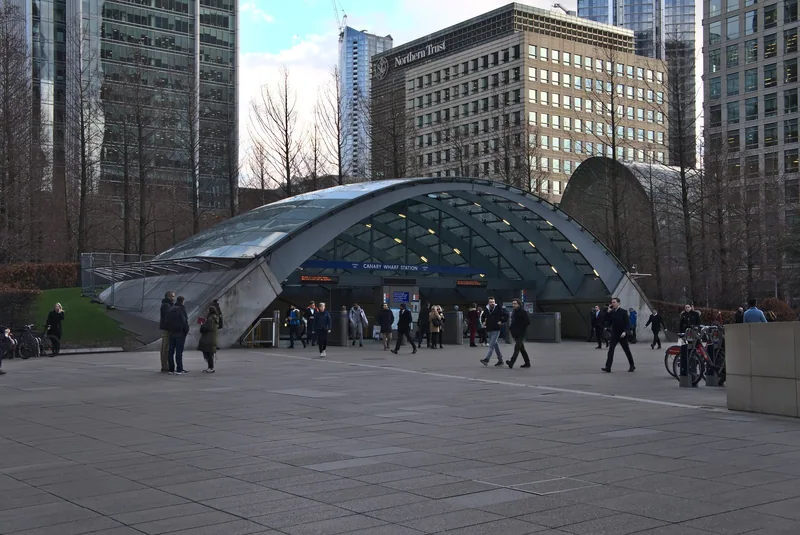
| Canary Wharf | A single vast curved hall under Jubilee Park, 300 metres long, with three entrances and no columns in the middle |
| North Greenwich | Deep blue tiling and huge angled columns, built to empty an arena in twenty minutes |
Westminster to Canary Wharf takes about 11 minutes and Westminster to North Greenwich about 13, so the whole tour fits in a morning. It pairs naturally with our guides to Canary Wharf and Southwark and Bankside, and if concrete is your thing, brutalist London covers the generation before it.
The two big venues, and how the line copes
North Greenwich and Wembley Park are both event stations, and both are built for it: wide platforms, multiple exits and queuing systems that appear out of nowhere when 20,000 people leave at once. On event nights TfL runs extra trains and staff hold crowds in the ticket hall in batches, which feels slow and moves faster than the alternative.
Getting to each of them, including the buses and the river, is covered properly in our guides to reaching The O2 and getting to Wembley Stadium. What the line page can add is the arithmetic of leaving: if you can bear to wait twenty minutes after the last song, you will get a seat, and if you leave three songs early you will get a seat as well.
Frequently asked questions
Is the Jubilee line step-free?
Mostly, and completely on its eastern half. Seventeen of the 27 stations are step-free from street to platform, including every station from Westminster to Stratford: Westminster, Waterloo, Southwark, London Bridge, Bermondsey, Canada Water, Canary Wharf, North Greenwich, Canning Town, West Ham and Stratford. Baker Street, St John's Wood, Swiss Cottage, Finchley Road, West Hampstead and Willesden Green are not step-free.
Does the Jubilee line have air conditioning?
No train on the line is air-conditioned in September 2026. The tunnels on the eastern half are mechanically ventilated and the platform-edge doors keep hot air off the platform, and the effect shows in TfL's own figures: the Jubilee averaged 26.2 °C during the August 2024 evening peak, against 31.1 °C on the Victoria line.
Is the Jubilee line the fastest way to Wembley Park?
Not from central London. The Metropolitan line runs Finchley Road to Wembley Park non-stop in seven minutes while the Jubilee calls at five stations in between. Change at Finchley Road, where the two lines share the same platform level in both directions. TfL's journey planner puts Westminster to Wembley Park at about 21 minutes that way.
Does the Jubilee line run all night at weekends?
Yes, along its whole length from Stanmore to Stratford on Friday and Saturday nights, with no branches or stations left out. It is the only Night Tube line with no gaps. Fares are charged at the off-peak rate and count towards the daily cap.
How long does the Jubilee line take from Westminster to Canary Wharf?
About 11 minutes, with no change, calling at Waterloo, Southwark, London Bridge, Bermondsey and Canada Water. North Greenwich, for the O2, is about 13 minutes from Westminster. Both stations are step-free from street to train.
Sources
- Transport for London - Stations, platforms, lifts and step-free interchange data (feed of 3 August 2026) (checked September 2026)
- Transport for London - Jubilee line route data (checked September 2026)
- Transport for London - Jubilee line timetable at Green Park (checked September 2026)
- Transport for London - The Night Tube (checked September 2026)
- Transport for London - Step-free access (checked September 2026)
- London Datastore - London Underground average monthly temperatures (checked September 2026)