
Polish food in London is cheap, filling and easy to find once you know where to look: Hammersmith and Ealing in the west, Balham and Streatham in the south, and a deli on almost every long high street in between. A plate of pierogi and a bowl of soup costs less than a sandwich in the City.
Two migrations built it. Polish servicemen and their families settled in Britain after the Second World War, many of them in west London, and they founded the clubs, churches and cultural institutions that are still there. A much larger wave arrived after Poland joined the European Union in 2004, and with it came the delis, bakeries and supermarkets that spread across the whole city.
Alongside them sit Lithuanian, Latvian, Romanian, Bulgarian, Ukrainian and Russian shops, often sharing a shelf. The food overlaps more than the borders do, and a Polish deli will usually sell you Lithuanian bread and Romanian cheese without comment.
Where to look
- Hammersmith
- King Street and the Polish cultural centre at 238-246 King Street, W6 0RF. Hammersmith, Zone 2
- Ealing
- Ealing Broadway and South Ealing, Zone 3. Delis, butchers and bakeries along the high streets
- Balham and Streatham
- South London's Polish shops, on the main roads rather than in a single cluster
- Waterloo
- A Polish restaurant and bar off Lower Marsh, useful if you are near the South Bank
- Everywhere else
- Small Eastern European delis on most outer high streets. Look for the word "delikatesy"
- What to spend
- Delis and milk-bar style canteens are among the cheapest hot food in London
Hammersmith: the institutional centre
The Polish Social and Cultural Association, known by its Polish initials POSK, occupies a large modern building at 238-246 King Street in Hammersmith. It houses a library, a theatre, a gallery and a restaurant, and it is the centre of organised Polish life in Britain rather than a tourist attraction. The concerts and film screenings are listed on its own website and are open to anyone.
Eating there is the most straightforward way to try the food properly without knowing what to order: the restaurant serves a standard Polish menu, and the clientele is overwhelmingly Polish. King Street around it has delis and bakeries, and Hammersmith station sits in Zone 2 on four Underground lines.
Our guide to Ealing and west London covers the wider area, including the stretch of Ealing where the Polish shops are thickest.
What a milk bar is, and why it matters
A bar mleczny, literally a milk bar, is a Polish canteen: a counter, a board of dishes, a tray, and a very low bill. They began as state-subsidised cafeterias in communist Poland, serving dairy and flour-based food because meat was scarce. They survive in Poland and a handful of London restaurants use the format, serving soup, pierogi and a cutlet from a counter rather than a menu.
Mamuśka! at 9 Addington Street, SE1 7RY, near Waterloo, is the best-known London version and works exactly this way. It opens from midday, until 22:00 on Sundays to Tuesdays and 23:00 from Wednesday to Saturday. Very few places near the South Bank serve a full hot meal for less than the price of a round of drinks.
Soup is not a starter here. A bowl of zurek or barszcz with a piece of bread is a light meal in its own right, and in canteen-style places it costs very little. If you want to eat cheaply and well for one evening in central London, a bowl of soup, a plate of pierogi and a glass of kompot will do it. Our page on eating cheaply in London sets it against the alternatives.
The dishes, explained
| Dish | What arrives |
|---|---|
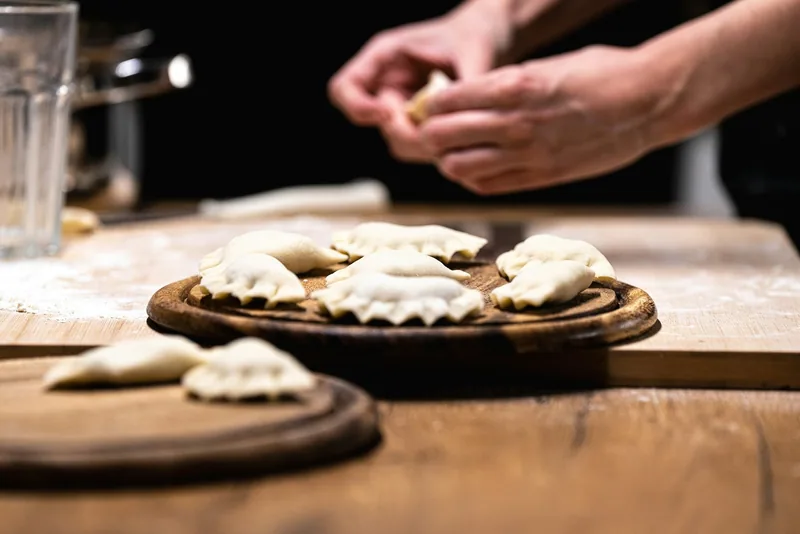
| Pierogi | Half-moon dumplings, boiled or fried after boiling. Fillings: potato and curd cheese (ruskie), minced meat, cabbage and mushroom, or sweet with fruit |
| Barszcz | Clear beetroot soup, deep red, sour and hot. Sometimes served with tiny dumplings floating in it |
| Zurek | Sour rye soup with sausage and a boiled egg. Cloudy, savoury and unlike anything in British cooking |
| Bigos | Hunter's stew: sauerkraut and fresh cabbage cooked for a long time with several meats and dried mushrooms |
| Golabki | Cabbage leaves rolled around rice and minced meat, baked in tomato sauce |
| Kotlet schabowy | A breaded pork cutlet, beaten thin and fried. Served with potato and shredded beetroot or cucumber salad |
| Placki ziemniaczane | Potato pancakes, fried crisp, eaten with sour cream or with goulash on top |
| Sledz | Herring in oil with onion, or in soured cream. A starter with vodka |
| Paczki | A filled doughnut, traditionally with rose petal jam, eaten in quantity on the Thursday before Lent |
| Sernik and makowiec | Baked curd cheesecake and poppy seed roll, the two standard cakes |
To drink, kompot is fruit stewed with water and served cold, and it appears on most canteen counters. Polish beer is widely available and Polish delis stock a wide range of it, as well as vodka in quantities that surprise visitors. Our page on alcohol laws in London covers what you can buy and where you can drink it.
How to use a Polish deli
The shops are the real story, and they are open on most high streets in outer London. A delikatesy is laid out the same way almost everywhere.
- The counter. Cured meats and sausage, sliced to order. Kabanos are thin dried sticks, kielbasa comes fresh or smoked, and there will be several kinds of ham.
- The bread. Dense rye and sourdough loaves, sold whole, much darker and heavier than British bread. Often baked locally.
- The chiller. Twarog, a fresh curd cheese, soured cream, kefir, and tubs of ready-made pierogi you boil at home for a few minutes.
- The shelves. Pickled cucumbers in brine rather than vinegar, jars of beetroot, sour cherry preserve, buckwheat, and the dried mushrooms that go into bigos.
- The sweets. Wafer bars, plum jam, and chocolate-covered prunes that are better than they sound.
Staff will slice, weigh and advise. Prices are marked per 100 grams on the counter, which catches people out: a price that looks low is for a small quantity. Our guide to London's food markets covers the other end of the food-shopping scale.
Two pierogi fillings are worth knowing before you order. Ruskie are filled with potato and a mild fresh curd cheese, and are the ones to start with. Sweet pierogi filled with blueberries or plums are a dessert, served with cream and sugar, and ordering them as a main course by mistake is a common visitor error. Ask which fillings are on that day; most places make a handful.
The other Eastern European shops
Poland is the largest community but not the only one, and the shops often sit side by side.
- Lithuanian and Latvian. Cold beetroot soup in summer, smoked cheese, dark rye bread and kvass, a fermented bread drink.
- Romanian and Bulgarian. Sheep's cheese in brine, mici or kebapche, which are small grilled minced meat rolls, and thick yoghurt.
- Ukrainian. Varenyky, close cousins of pierogi, borshch, and salo, cured pork fat eaten in thin slices on black bread.
- Russian and Georgian. Georgian cooking in particular has spread in London over the past decade, with khachapuri, a boat of bread filled with cheese and egg, as the dish that converts people.
These shops cluster where the communities live: parts of north-east London, Walthamstow, Hounslow and the outer suburbs. Our Walthamstow guide covers one of them.
Christmas, Easter and the days that matter
Two moments transform Polish delis. Before Christmas the shops fill with carp, dried mushrooms and poppy seed for Wigilia, the meatless Christmas Eve supper of twelve dishes, and queues form on 23 and 24 December. Before Easter the bakeries make mazurek, a flat decorated tart, and delis sell white sausage for the Easter breakfast.
Fat Thursday, the Thursday before Lent, is the doughnut day: Polish bakeries in London sell paczki by the hundred and often run out by lunchtime. The date moves with Easter each year. Our guide to Christmas in London covers the season more broadly, and bank holidays and opening hours explains what is shut when.
What a Polish meal costs, and how to order one
The price gap between a Polish canteen and a central London restaurant is large enough to change how you plan a day. A bowl of soup, a plate of pierogi and a soft drink is a complete meal at a fraction of what the same hunger would cost on the South Bank, and portions err on the generous side.
Ordering is straightforward once you know that most menus are organised the Polish way: soups first, then dumplings and pancakes, then the meat plates, then cakes. A common visitor mistake is to order a main course each and a shared starter, which produces far too much food. Two people are better served by one soup each and one plate of pierogi to share, with a cutlet added only if you are genuinely hungry.
Service is usually at the counter rather than at the table, and there is often no service charge at all. Where there is table service, the same discretionary rules apply as anywhere else in Britain.
Vegetarians, allergies and children
Polish food is meat-heavy but not uniformly so. Ruskie pierogi, potato pancakes, barszcz in its meatless form and several salads contain none, and the Christmas Eve tradition is entirely meat-free. Dairy is everywhere, in soured cream, curd cheese and butter, and rye bread makes this a difficult cuisine for anyone avoiding gluten. See vegan and vegetarian London and gluten-free eating in London.
For children, this is easy food: dumplings, pancakes, breaded cutlets, nothing spicy and generous portions. See London with kids.
If you like this kind of cooking, the closest equivalents in London are the Greek and Cypriot tavernas of north London and the eel and pie houses in our guide to pie and mash. All three are working-class food that became a tradition, and all three are cheaper than they ought to be.
Frequently asked questions
Where can I eat Polish food in London?
Hammersmith has the Polish cultural centre on King Street with a restaurant attached, Ealing has a concentration of delis and bakeries, and there are Polish shops on most outer high streets. Near the South Bank, Mamuska! on Addington Street serves canteen-style Polish food from midday.
What is a Polish milk bar?
A bar mleczny is a canteen where you order from a board at a counter, carry a tray to a table and pay very little. The format began as subsidised workers' cafeterias in communist Poland, serving dairy and flour-based dishes. A few London restaurants use the same model for soup, pierogi and cutlets.
What should I order if I have never eaten Polish food?
Start with ruskie pierogi, filled with potato and mild curd cheese, and a bowl of barszcz or zurek. If you want one plate rather than several, order kotlet schabowy, a breaded pork cutlet with potatoes and salad. Finish with sernik, a baked curd cheesecake.
Are Polish delis expensive?
No, and they are among the cheapest places in London to buy cured meat, bread and cheese. Prices at the counter are usually shown per 100 grams rather than per kilogram, so check before ordering a large quantity. Ready-made pierogi from the chiller cook in a few minutes at home.
Is Polish food suitable for vegetarians?
Partly. Potato and cheese pierogi, potato pancakes and several soups contain no meat, and the traditional Christmas Eve supper is meat-free by design. Stocks are often meat-based even where the dish is not, so ask. Anyone avoiding gluten will find rye bread, dumplings and breadcrumbed cutlets difficult.
Sources
- Polish Social and Cultural Association (POSK), 238-246 King Street, Hammersmith (checked September 2026)
- Mamuska!, 9 Addington Street, London SE1 7RY - address and opening hours (checked September 2026)
- Food Standards Agency - Food allergy and intolerance advice for consumers (checked September 2026)
- Food Standards Agency - Food hygiene ratings search (checked September 2026)
- GOV.UK - Alcohol and young people: the law (checked September 2026)