
The Phoenix Garden is a small volunteer-run community garden at 21 Stacey Street, WC2H 8DG, behind the Phoenix Theatre and a short walk east of Charing Cross Road. It is free, it opens from dawn until dusk every day, and it is fighting a development next door that its trustees say will take away its sunlight.
Our guide to London's secret gardens introduces the Phoenix Garden alongside four others and explains where the gate is. This page is about what is actually in the garden, who built it and how, what lives there, and the parish church round the corner that gives the district its name.
Both places are free. Together they make a proper half-hour stop rather than a detour, and they sit in the one part of the West End where almost nobody looks up from the pavement.
The Phoenix Garden and St Giles-in-the-Fields
- Phoenix Garden
- 21 Stacey Street, WC2H 8DG, off St Giles Passage. Free, daily, dawn to dusk
- Established
- Opened to the public in June 1984 on a car park that had been a 1940 bomb site
- Run by
- The Phoenix Garden CIO, registered charity 1178847, formerly the Covent Garden Open Spaces Association
- St Giles-in-the-Fields
- 60 St Giles High Street, WC2H 8LG. Free. Monday to Friday 8.15am to 5pm; closed Saturday; Sunday for services only
- Church built
- 1731–33 by Henry Flitcroft. Grade I listed, 24 October 1951
- Nearest stations
- Tottenham Court Road (Central, Northern, Elizabeth line) and Leicester Square (Northern, Piccadilly), both a few minutes on foot
The gate, and why dawn to dusk is not a timetable
The entrance is on Stacey Street, a short cut-through between Shaftesbury Avenue and New Compton Street, with a second way in from St Giles Passage. Neither looks like the way into a garden, which is most of the reason people miss it.
The garden states its hours as dawn to dusk, seven days a week, and adds that these are standard hours which are subject to change. Treat that literally. In late June the gate is open past nine in the evening; in December it will be locked before four. There is no published closing clock, because the closing time is the light. If you are planning an evening visit between November and February, come at lunchtime instead.
The garden also takes bookings for weddings and community events, and the community building can be hired, so an occasional afternoon is given over to a private function. There is no way to check this from outside; if the gate is shut on a bright day, that is usually why.
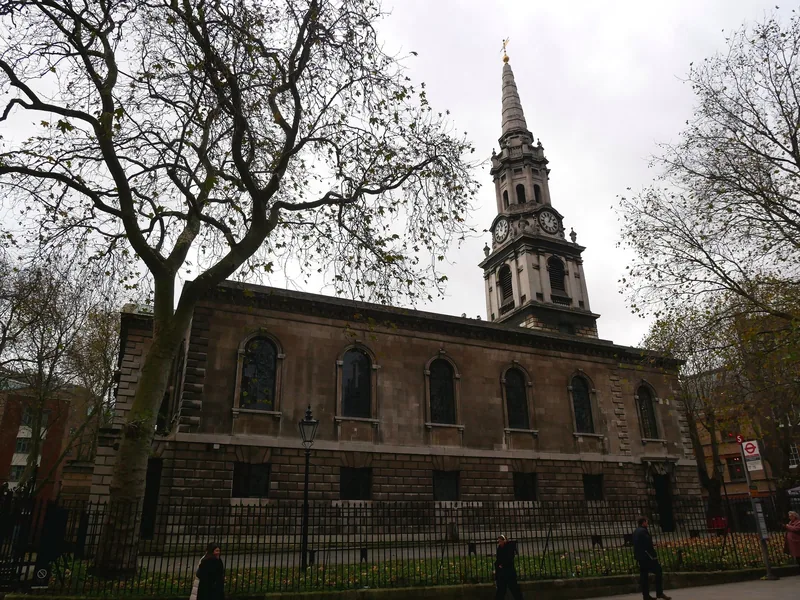
Photo: Doyle of London · CC BY-SA 4.0 · Wikimedia Commons · resized
The building that paid for the paths
For thirty years the charity ran the garden out of a concrete block shed that was meant to last five years and had begun to collapse after twenty-five. It had no drainage, no toilets and a hosepipe strapped to the water main.
The replacement is the small timber-clad building you see on the west side, designed by the architect Gurmeet Sian to sit on the footprint of the old shed. Construction ran from October 2015 to October 2016, and the charity raised just over half a million pounds for the project, including a £300,000 grant. It has two toilets, one of them accessible, a small kitchen and a tool store, a biodiverse brown roof, a rooftop propagation area and rainwater collection, and it is heated by an air-source heat pump. The brief was a building that formed part of the garden rather than a building placed in it.
The interesting part is what happened next. Relandscaping the construction site meant digging out tons of brick and concrete rubble. Rather than pay to remove it, volunteers put more than 25 tons of it through a mini-crusher by hand and used the result to build the raised beds and the paths. Those paths are the reason a pushchair or a wheelchair can get round the garden: they were laid deliberately smooth and firm, on a site where the alternative would have been gravel. The accessible toilet is in the building, and there is no step at the Stacey Street gate.
The garden sits on rubble-filled cellars, and that dictates the planting. The soil is thin, the site is sheltered and warm because of the urban heat island, and hard frost is rare. The gardeners choose plants that cope with drought, look presentable all year and feed insects, which is why the borders look more like a dry meadow than a West End flowerbed and why they still look like something in February.
What actually lives in a third of an acre
The garden is managed for wildlife first. Its own three working rules are that there are no weeds, no pests and no waste, which in practice means very little is cut back, dug over or carted away.
The species list is worth knowing before you go, because it changes what you look at. The developer's own ecological assessment for the neighbouring site, quoted by the garden, records ground-dwelling insects, bees, butterflies, moths and hoverflies, and foraging bats. Bats hunting insects over a garden between Soho and Covent Garden is the fact that surprises people most, and dusk in May or June is when you would see it.
Solitary bees, carder bees and bumblebees are the pollinators the garden names as the ones it would lose. Forty years of undisturbed ground is what produced all of it; this is not a planted display that could be moved.
Pétanque runs Tuesday to Saturday, and the benches are scattered through the planting rather than lined up along a path. If you want to eat something you have bought elsewhere, this is a far better bench than anything in Soho or on the Covent Garden piazza, and our guide to picnic supplies in London covers what to buy nearby.
The development at 135 Shaftesbury Avenue
This belongs near the top of any honest description of the garden. On 28 April 2025 Camden Council's planning committee voted to approve the redevelopment of 135 Shaftesbury Avenue, the Grade II listed former Saville Theatre, which later became a cinema and stands immediately south of the garden. The decision went to the Mayor of London for review.
The garden's trustees call it an existential threat and have run a campaign under the name Keep the Light. Their case is about sunlight: they say the approved scheme takes the garden below the Building Research Establishment's guidance that at least half of an amenity area should get two hours of direct sun on 21 March, down to around 30 per cent, and that a construction phase of at least three years would make the garden unusable in the meantime. An earlier and smaller scheme for the same site was refused in 2019. The garden says Historic England and the Theatres Trust both objected.
Check the garden's own pages before you build a visit round it. Nothing had changed on the ground when we read the campaign page in September 2026, and the garden was open as usual. But a three-year building site next door would change the experience completely, and the site hoardings would go up before any announcement reached a travel guide.
St Giles-in-the-Fields, and the churchyard nobody reads
Walk north out of the garden, cross Shaftesbury Avenue and you are at the church that named the district. St Giles-in-the-Fields is Grade I listed, built in 1731–33 by Henry Flitcroft, whose name is carved on the entablature above the west door as H FLITCROFT ARCHITECTUS. Portland stone, copper roof, and a steeple that rises through a rusticated base, a columned lantern and a spire with a gilded ball weathervane.
It is open to visitors Monday to Friday from 8.15am to 5pm. It is closed on Saturdays, and on Sundays it is open for worship rather than sightseeing. That Saturday closure catches people out, because Saturday is exactly when a visitor has time for a church.
Three things inside are worth the walk. The organ, built by Father Smith in 1671, in a case probably of about 1734. The inlaid mahogany pulpit of 1676. And a carved monument of 1634 to George Chapman, the first translator of Homer into English, which Historic England records as probably designed by Inigo Jones. There is level wheelchair access to the church and an accessible toilet, a hearing loop and braille service material.
Outside, the gate in front of the west door is the piece most people walk past. It was built by William Leverton around 1810 and it carries a wooden relief of the Resurrection of the Dead, carved in 1686–87. Separately listed at Grade II are the lych gate west of the church and the vestry rooms with their attached wall and lamp to the south-west.
A burial ground, not a lawn
The ground around the church is a churchyard, and it is worth saying plainly what that means for a visitor. The grass and paved areas are a former burial ground with bodies still under them, and the benches are in use by a congregation, by office workers and by people the church's own hardship and homelessness work serves. The parish gave its name to a great deal of London's poverty writing, and the church runs its programme accordingly.
So: sit, eat a sandwich, read the inscriptions, and behave as you would in any working cemetery. Our page on the Magnificent Seven cemeteries sets out the same etiquette at greater length, and Bunhill Fields is the other central London burial ground that has become an everyday public space.
Where this fits in a West End afternoon
The garden takes fifteen minutes to walk round and half an hour to sit in. The church takes twenty minutes. Neither is a destination on its own, and both are worth building into a walk you were going to make anyway.
Going west, it is four minutes to Soho Square and about eight to the lanes around Seven Dials and Neal's Yard. Going north, Bedford Square and the rest of Bloomsbury begins about six minutes up Bloomsbury Street. Going east, the pubs and courts of the City start at Chancery Lane.
Both places belong on our list of free things to do in London. If gardens are the point of your trip rather than a break in it, the June weekend covered in our guide to London Open Gardens opens dozens of gates that are shut the rest of the year, and the Culpeper Community Garden in Islington is the other community garden in central London that is open almost every day and run by the people who dug it.
Frequently asked questions
Is the Phoenix Garden free to enter?
Yes. There is no admission charge, no ticket and no booking. It is run as a charity, the Phoenix Garden CIO, and it relies on donations, membership, room hire and weddings. A donation box and a membership scheme exist if you want to leave something.
What time does the Phoenix Garden close?
At dusk, every day. That means shortly before four in midwinter and after nine around midsummer, and the garden describes these as standard hours subject to change. There is no fixed closing time published, so in the darker months plan a daytime visit rather than an evening one.
Can you get into the Phoenix Garden with a wheelchair or a pushchair?
Yes. The paths were rebuilt in 2016–17 from crushed rubble specifically to be wheelchair and pram friendly, and the garden building has an accessible toilet. It is a small site on one level, so there is no climb once you are through the gate.
When is St Giles-in-the-Fields open to visitors?
Monday to Friday, 8.15am to 5pm. The church is closed on Saturdays and is open on Sundays for services rather than for sightseeing, with Sung Holy Communion at 11am and Choral Evensong at 6.30pm. Entry is free at all times.
Is the Phoenix Garden going to be built on?
The garden itself is not part of the development. The approved scheme is on the neighbouring site at 135 Shaftesbury Avenue, and the garden's objection is that the new building's height will cut the sunlight reaching the planting. Camden approved it in April 2025 and the garden was still open and unchanged in September 2026.
Sources
- The Phoenix Garden – opening hours, location and charity status (checked September 2026)
- The Phoenix Garden – history, the new building, the architect and the crushed-rubble paths (checked September 2026)
- The Phoenix Garden – soil, climate and planting policy (checked September 2026)
- The Phoenix Garden – #Keep_the_light campaign and the 135 Shaftesbury Avenue decision (checked September 2026)
- St Giles-in-the-Fields – opening hours, service times and accessibility (checked September 2026)
- Historic England – National Heritage List for England open data (list entries 1245864, 1245865, 1245866, 1242926, 1271631) (checked September 2026)