
Both squares are free, both open at 8am every day of the year, and both are locked at a closing time that Westminster City Council changes roughly every fortnight: 7.30pm in late September, 9.30pm at midsummer, 4.30pm from the end of October to the middle of February. Dogs are not allowed in either of them.
Soho Square and Golden Square sit about five minutes apart on foot, one at the northern edge of Soho and the other just west of Brewer Street. They are small, flat, walled in by buildings, and they are the only patches of grass in the area. At one o'clock on a weekday in summer every bench and most of the lawn is taken; by mid-evening the gates are shut and the squares are empty because nobody can get in.
Our guide to Soho covers the district around them. This page is about the two gardens themselves: the hours, the trees, the listed structures, and the thing underneath the grass in Soho Square that almost nobody knows is there.
Soho Square and Golden Square at a glance
- Cost
- Free, no ticket, no booking
- Opening
- 8am, seven days a week, both squares
- Closing
- Set by season, from 4.30pm in deep winter to 9.30pm from mid-May to the end of July
- Dogs
- Not permitted in either square
- Step-free
- Both listed by the council as having disabled access
- Addresses
- Soho Square W1D 3QP; Golden Square W1F, off Brewer Street
- Time needed
- Ten minutes each, twenty-five if you walk between them slowly
The closing times, which change every fortnight
Westminster does not run its gardens on dusk. It runs them on a published calendar that steps up and down in half-hour increments through the year, and it applies to both these squares and to every other council garden in the borough. This is the table nobody puts on a tourist page, and it is the single most useful thing to know before planning an early evening in Soho.
| Period | Gates close |
|---|---|
| End of British Summer Time to 15 February | 4.30pm |
| 16 to 28 or 29 February | 5.30pm |
| 1 March to the start of British Summer Time | 6pm |
| Start of British Summer Time to 31 March | 7.30pm |
| 1 to 15 April | 8pm |
| 16 to 30 April | 8.30pm |
| 1 to 15 May | 9pm |
| 16 May to 31 July | 9.30pm |
| 1 to 15 August | 9pm |
| 16 to 31 August | 8.30pm |
| 1 to 15 September | 8pm |
| 16 to 30 September | 7.30pm |
| 1 to 15 October | 6.30pm |
| 16 October to the end of British Summer Time | 6pm |
The clocks went back on Sunday 25 October 2026, so the 6pm closing lasted about ten days and then dropped straight to 4.30pm, where it stays until 15 February. From the end of October a Soho square is a lunchtime place and nothing else, because it is dark and locked before most people leave work.
Both squares open at 8am, which is the useful end of the day. A coffee on a bench in Soho Square at eight on a weekday morning is the quietest the centre of London gets, and it is free. The council's only later opening in the borough is Lower Grosvenor Gardens at 10am.
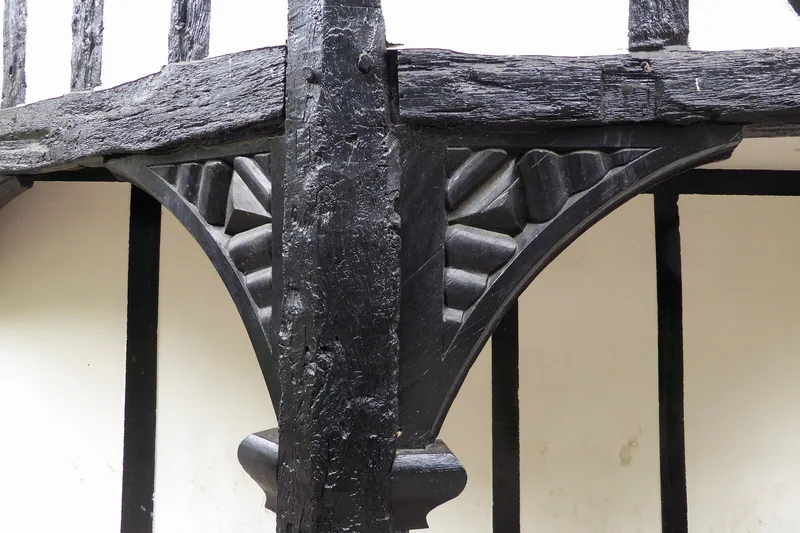
Photo: Ethan Doyle White · CC BY-SA 4.0 · Wikimedia Commons · resized
The mock-Tudor hut, and the substation underneath it
The black-and-white timbered building in the middle of Soho Square looks like a survival from the sixteenth century and is nothing of the kind. Historic England lists it as a garden arbour and tool shed, Grade II since 26 February 1992, and its list entry explains exactly what it is for: it was "built to appear as an octagonal market cross building" as a disguise for an electricity substation.
The detail in the entry is better than the joke. The hut was put up for the Charing Cross Electricity Company by Messrs J. Strutt and Co of 27 Endell Street. Its core is brick and breezeblock. The timber frame is made of re-used seventeenth and eighteenth-century floor beams, and the four-centred arch over the south door may be older still. The roof is a cone of clay peg tiles with projecting eaves on shaped brackets, there are gabled dormers with shaped bargeboards to north and south, and the overhanging first floor sits on round-arched arcading with carved spandrels. The first-floor windows have three lights and the gables four, all with carved timber trefoil heads.
So the answer to what is under the grass in the middle of Soho Square is: transformers. It is one of two celebrated London gardens built to hide an electricity substation, and the other is in Mayfair, which we come to on our page about Berkeley Square and the Mayfair squares.
Two official sources, two different dates
There is a straightforward contradiction here and it is worth setting out rather than picking a side. Westminster City Council's own page on the square says the half-timbered building in the centre "was built in 1895 and refurbished in 2009". Historic England's statutory list entry dates it to about 1925 or 1926 and names the builder and the client.
Thirty years apart, from two public bodies, about the same shed. The list entry is the statutory document and gives the more circumstantial account, which is why we would lean towards the 1920s; but we are not going to pretend that settles it, and if you see the 1895 date elsewhere, that is where it comes from.
What is listed around the edge of Soho Square
The square is more architecturally serious than its lunchtime crowd suggests. The statue of Charles II in the garden has been listed at Grade II since 24 February 1958. Around the edges:
- The House of St Barnabas, on the corner of Greek Street, is Grade I, listed in 1958. It is the only Grade I building on the square.
- The French Protestant Church on the north side and St Patrick's Roman Catholic Church on the east are both Grade II*, listed in February 1970.
- Numbers 13 and 26 are Grade II*, and numbers 2, 15, 21, 36, 37 and 38 are Grade II.
Neither Soho Square nor Golden Square appears on Historic England's register of parks and gardens, unlike the Bloomsbury and Mayfair squares. The buildings are protected; the gardens themselves are not.
Golden Square: Wren, four hornbeams and a mournful statue
Golden Square is the quieter of the two and the more formal. Westminster's own account says the square, originally known as Goldring Square, is thought to have been laid out to plans by Sir Christopher Wren in about the 1670s. Note the "thought to be": this is an attribution, not a documented commission, and the council words it carefully.
What is there now is seating, bedding, shrub and rose beds and a grass verge, and the feature the council singles out is four mature hornbeams, which are at their best when the leaves turn. Hornbeams are unusual in central London, where the plane tree dominates almost everything, and these four are the reason Golden Square looks different from every other square around it.
The statue in the centre is Grade II listed and Historic England identifies it as George II, listed on 14 January 1970. Dickens described it as a little wilderness of shrubs watched over by a mournful statue, a line the council still quotes on its own page. The statue is very worn and the description has held up.
Round the edge, number 11 Golden Square is Grade II* and so is the church of Our Lady of the Assumption on Warwick Street, just off the south-west corner. Both were listed in 1958.
Walking between them, and what is on the way
The direct route is about five minutes and dull: down Greek Street, right along Old Compton Street, then Brewer Street. Take the longer one instead, which is about twelve minutes and better.
From the south-west corner of Soho Square, go down Dean Street, right into Meard Street, and out onto Wardour Street. Cross into Broadwick Street, which brings you past the market stalls of Berwick Street, then drop down from Beak Street into the north side of Golden Square. That way you see the two oldest residential fragments of Soho and the market between them, and you arrive at Golden Square from the side with the benches.
If you are heading on afterwards, Carnaby Street is two minutes north of Golden Square and Regent Street is at the end of Beak Street.
Lunchtime, and how to get a bench
Both squares fill between about half past twelve and two on any dry weekday, and Soho Square fills first because it has lawn and Golden Square mostly does not. If you want to sit down in Soho Square in July you need to be there before noon or after half past two.
Golden Square is the better bet at one o'clock precisely because it is all benches and beds: less romantic, more likely to have a seat. It is also quieter at weekends, when Soho Square is busy with people who have come into the area to shop.
For what to bring, our page on picnic supplies and self-catering covers the supermarkets, and where to eat near Oxford Street has the sit-down options five minutes north. Both squares appear in Pride in London weekend, when the area is closed to traffic and the gardens are as full as they ever get.
Two more central gardens are worth knowing if both of these are packed: the Phoenix Garden, four minutes east behind Shaftesbury Avenue, and the small gardens of the City if you are heading east. Our list of free things to do in London has more that costs nothing, and our page on the Bloomsbury squares covers the other great cluster of London garden squares, fifteen minutes north.
Frequently asked questions
What time does Soho Square close?
It depends on the fortnight. Westminster City Council closes its gardens at 4.30pm from the end of British Summer Time to 15 February, and at 9.30pm from 16 May to 31 July, with a dozen steps in between. In late September the gates shut at 7.30pm; in the first half of October, at 6.30pm.
What is the little Tudor building in Soho Square?
A garden arbour and tool shed built in the 1920s to disguise an electricity substation, listed Grade II since 1992. Historic England's entry says it was made to look like an octagonal market cross, and that its timber frame uses re-used seventeenth and eighteenth-century floor beams. Westminster's own page dates it to 1895 instead.
Can you take a dog into Soho Square or Golden Square?
No. All Westminster gardens are dog friendly except for a short list, and both of these squares are on it. If you are walking a dog in the West End, the nearest council gardens that do allow them are Cavendish Square and Berkeley Square, both about fifteen minutes away.
Who laid out Golden Square?
Westminster City Council says the square, originally Goldring Square, is thought to have been laid out to plans by Sir Christopher Wren in about the 1670s. That is an attribution rather than a documented fact, and the council's own wording keeps it at arm's length, so treat it as tradition.
Are the Soho squares good for a picnic?
Soho Square is, because it has lawn you are allowed to sit on, and it is the only one in the immediate area that does. Expect it to be full between half past twelve and two on any dry weekday. Golden Square has benches and planting rather than grass, and is the better choice if you want a seat at one o'clock.
Sources
- Westminster City Council - Square gardens (checked September 2026)
- Westminster City Council - Opening hours, disabled access and dog friendly parks (checked September 2026)
- Historic England - Central timber framed arbour/tool shed, Soho Square, list entry 1249910 (checked September 2026)
- Historic England - Statue of George II, Golden Square, list entry 1289197 (checked September 2026)
- Historic England - Statue of Charles II, Soho Square garden, list entry 1236305 (checked September 2026)
- Historic England - House of St Barnabas, list entry 1066753 (checked September 2026)
- GOV.UK - When do the clocks change (checked September 2026)