
Teddington and Hampton are two riverside villages in the far south-west of London, about 35 to 45 minutes by train from Waterloo. Teddington has the lock where the Thames stops being tidal; Hampton has Garrick's Temple to Shakespeare, a small Georgian garden building that opens only on Sunday afternoons from April to October. Bushy Park lies between them.
Neither place has a big sight of its own, and Hampton Court Palace, just upstream, takes most of the visitors. What they offer is the river at its quietest, a walk of a couple of hours from one village to the other through the edge of Bushy Park, and a few things nobody else on the route will show you: the point where the tide ends, a tunnel built for an actor, and a church full of monuments older than the building around them.
The park itself has its own page, our guide to Bushy Park, which covers the deer, the Diana Fountain and the gates. The palace next door is covered on our Hampton Court Palace page. This page is about the two villages and the river between them.
Teddington and Hampton at a glance
- Where
- Borough of Richmond upon Thames, on the Middlesex (north) bank of the Thames
- Trains
- Waterloo to Teddington 33 to 40 minutes; Waterloo to Hampton 43 minutes, direct, South Western Railway (National Rail, checked November 2026). Both in zone 6; contactless and Oyster accepted
- Teddington Lock
- Free to walk across at any time; the locks are staffed round the clock
- Garrick's Temple
- Free. Closed in winter; open Sunday afternoons 14:00 to 17:00 from 4 April to 31 October 2027 (Garrick's Temple to Shakespeare Trust, checked November 2026). The lawn is open daily
- Time needed
- Half a day for both villages on foot (our estimate)
Teddington Lock, where the tide gives up
Below Teddington, the Thames rises and falls with the sea twice a day, all the way to the estuary. Above it, the river is fed by rain and held level by a chain of locks and weirs. Teddington Lock is the dividing line, and it is also the boundary between two authorities: the Port of London Authority looks after the tidal river below, and the Environment Agency runs the river above, including this lock. Our page on the Port of London Authority explains the split.
It is not one lock but three, side by side: a large barge lock, a smaller launch lock, and a tiny skiff lock for rowing boats and canoes. The Environment Agency lists all three with their own grid references, and the lock is staffed 24 hours a day. Beside them, the weir is where you see the difference in water level most clearly.
You cross by two footbridges from Ferry Road on the Teddington side, a suspension bridge to the lock island and a girder bridge on to the Ham bank, both dating from 1888. Our page on the Upper Thames crossings has the engineering and the listing details, so we will not repeat them here.
Come two hours either side of low tide to see the difference. At high tide the water on both sides of the weir can look almost level, and the boundary is invisible. At low water the tidal river below has drained away to mud banks while the reach above stays full. The PLA publishes tide times for Richmond, just downstream.
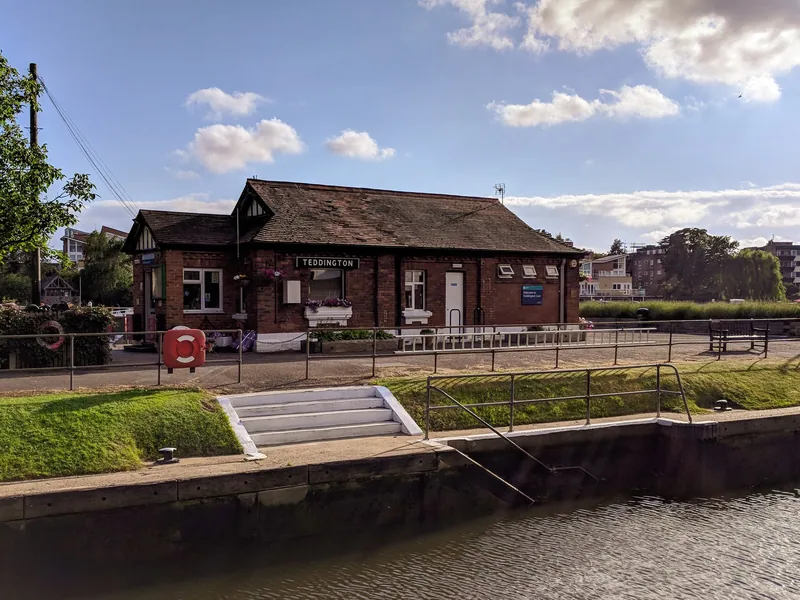
Photo: The wub · CC BY-SA 4.0 · Wikimedia Commons · resized
Teddington itself: the High Street, science and a playwright
From the lock it is about ten minutes up Ferry Road to Teddington's centre, a small suburban town centred on the High Street and Broad Street. It is pleasant rather than remarkable, and most visitors pass through on the way to the river or the park.
Two facts are worth knowing as you walk. Teddington is the home of the National Physical Laboratory, the UK's national measurement institute, which was founded in 1900 at Bushy House on the edge of the park; the site is not open to the public. And the playwright and composer Noël Coward was born here in 1899.
The Teddington gate into Bushy Park is a short walk from the station. In autumn, the stags in the park are at their most active and least approachable, which our page on the deer rut in Richmond and Bushy parks covers.
Through Bushy Park to Hampton: the walk
The obvious way between the two villages is across Bushy Park, about two and a half miles from the Teddington gate to Hampton (our estimate). The park is flat and open, and the gates are open around the clock for most of the year.
- Start at Teddington station, walk down to Teddington Lock and back (25 minutes there and back).
- Enter Bushy Park at the Teddington gate and head south-west across the grass towards the Diana Fountain and Chestnut Avenue.
- Follow Chestnut Avenue south to Hampton Court Gate, opposite the palace.
- From Hampton Court, walk west along Hampton Court Road beside the river, past the waterworks, to Garrick's Lawn and St Mary's Church.
- Finish at Hampton station, a short walk inland from the church.
Saturday morning is the one time to expect crowds in the park. The free weekly 5km run called parkrun began here, with 13 runners, on 2 October 2004, and the original event still runs in Bushy Park every Saturday morning; the details are on our Bushy Park page. Plan your walk for the afternoon if you want the paths to yourself.
Garrick's Temple and Garrick's Lawn
David Garrick was the most famous actor of 18th-century London, and the man who did most to turn Shakespeare into a national hero. He bought a house at Hampton beside the river, and in its grounds he put up a small temple in honour of Shakespeare. The Garrick's Temple to Shakespeare Trust, which runs it, says Garrick commissioned it in 1756; Historic England's listing dates it to about 1765. We give both because the sources disagree.
The building is an octagon of brick with a lead dome and an Ionic portico facing the river, listed at Grade I. It was built to hold a life-size statue of Shakespeare by the sculptor Louis-François Roubiliac. The original left long ago for the national collections; Richmond Council says the statue in the temple today is a replica supplied by the British Museum. Inside there is a small free exhibition about Garrick.
The opening hours are what catch people out. The exhibition opens only on Sunday afternoons, from 14:00 to 17:00, between early April and the end of October, with longer hours on Open House Sundays in September. In November you will find it locked. The lawn around it, between Hampton Court Road and the river, is a public garden open daily (it is locked at night), and the temple is worth seeing from outside at any time of year.
The temple is shut from November to March. The trust's 2027 season runs from Sunday 4 April to Sunday 31 October, Sunday afternoons only. Outside those dates you can walk round the outside and sit on the lawn, but not go in. Groups can ask the trust about visits at other times.
Garrick's Villa and the tunnel under the road
Across the main road from the lawn stands Garrick's Villa, the house Garrick enlarged with the architect Robert Adam in the 1750s and 1770s. It is listed at Grade I and is not open to visitors; you see it from the pavement.
The road separates the house from the lawn, and a tunnel runs under Hampton Court Road near its junction with Hogarth Way. Historic England dates it to the mid or late 18th century, suggests it was built to link the villa with the temple, says it may be by Capability Brown, and describes flint-faced sides and a southern end treated as the mouth of a picturesque grotto. It is listed at Grade II in its own right. It is one of the odder survivals in this corner of London.
St Mary's Church and old Hampton
A few steps west of the lawn, St Mary's Church stands above the river on Thames Street. The building is newer than it looks: it was rebuilt in 1829 to 1831 by the architect Edward Lapidge in yellow stock brick, with lancet windows, a plain west tower and a galleried interior, and a sanctuary was added in 1888. Inside are monuments brought over from the earlier church, including one to Sybil Penn, who died in 1562 and was nurse to the young Edward VI.
Behind the church, Thames Street, Church Street and the High Street hold a cluster of listed 18th-century houses, which make up old Hampton village. To the west along Upper Sunbury Road are the Victorian engine houses of the Hampton waterworks, several of them listed, part of a working water-supply site that you see from the road only.
Further inland, Carlisle Park on Wensleydale Road is the local park rather than a sight: tennis courts, a bowling green, cricket and a play area that includes wheelchair-accessible equipment. It is useful if you have children who need to run about, but not worth a detour on its own.
Hampton Court by river, and the Thames Path
Both villages sit on the Thames Path, and the stretch from Teddington Lock upstream through Kingston to Hampton Court is one of the gentlest on the whole route. On the Surrey bank opposite, the towpath runs between the river and Hampton Court's park walls.
From spring to autumn, passenger boats run between Richmond, Kingston and Hampton Court, and can be combined with a walk. Our page on getting to Hampton Court by boat has the operators and the season. If you would rather be on the water yourself, kayaking and paddleboarding on the Thames explains where it is allowed.
Who should come, and what to combine it with
Come if you like quiet riverside walks, if you are already going to Hampton Court and want to see something nobody else on the train will, or if you are a theatre lover who wants to see Garrick's Temple on a summer Sunday. Do not come for shopping or nightlife, and do not come specially for the temple between November and March.
Downstream, Twickenham and the Richmond riverside continue the same kind of walk, with Marble Hill and Strawberry Hill House. If you have only one day for this part of London, our comparison of Hampton Court and Windsor Castle may help you choose.
Getting there and getting back
Teddington and Hampton are both on South Western Railway from London Waterloo, on different lines. Teddington is on the Kingston loop, with direct trains taking 33 to 40 minutes in our check of a November weekday morning; some services change at Richmond. Hampton is on the Shepperton line, with direct trains taking about 43 minutes, every half hour. National Rail gave pay-as-you-go fares from £5.20 for Waterloo to Teddington (November 2026). There is no Underground station anywhere near.
There is no simple direct train between the two villages, so for the walk above take the train out to Teddington and back from Hampton, or the other way round; contactless pay-as-you-go handles that without a special ticket. Buses 111, 216 and R68 serve Garrick's Lawn. Our explanation of London's travel zones covers fares out to zone 6.
Frequently asked questions
Where does the Thames stop being tidal?
At Teddington Lock in south-west London. Below it the river rises and falls with the tide all the way to the sea and is managed by the Port of London Authority; above it the river is non-tidal and the Environment Agency runs the locks.
When is Garrick's Temple open?
On Sunday afternoons from 14:00 to 17:00, from early April to the end of October; the 2027 season runs from 4 April to 31 October. Entry to the small exhibition is free. The surrounding lawn is a public garden open daily, so you can see the outside at any time.
Can you walk across Teddington Lock?
Yes. Two public footbridges cross from Ferry Road in Teddington, via the lock island, to the Ham bank on the other side, and they are free to use. From the Ham side you can follow the towpath downstream to Ham House and Richmond.
How do you get from Teddington to Hampton?
The pleasant way is on foot across Bushy Park, roughly two and a half miles and about an hour without stops. There is no simple direct train between the two, because they are on different South Western Railway lines from Waterloo.
Is Teddington worth visiting?
As part of a day with Bushy Park or Hampton Court, yes. On its own it is a quiet suburban town with a famous lock and not much else for a visitor, so it is best treated as the start or end of a river walk.
Sources
- GOV.UK (Environment Agency) - River Thames: locks and facilities for boaters (checked November 2026)
- Garrick's Temple to Shakespeare Trust - visiting and opening times (checked November 2026)
- Richmond Council - Garricks Lawn (checked November 2026)
- Richmond Council - Carlisle Park (checked November 2026)
- Historic England - Garrick's Shakespeare Temple, list entry 1065456, Grade I (checked November 2026)
- Historic England - Tunnel under Hampton Court Road, list entry 1193495, Grade II (checked November 2026)
- Historic England - Church of St Mary, Hampton, list entry 1252976, Grade II (checked November 2026)
- parkrun - Our story (checked November 2026)