
Tower Hamlets Cemetery Park is free, open 24 hours a day every day of the year, and about four minutes' walk from Mile End station. An estimated 350,000 people are buried in it, more than in any other of London's seven great Victorian cemeteries, and most of them have no gravestone at all. What grows over them now is a local nature reserve.
The Friends who run it call it London's most central woodland, and on the ground that is what it feels like: a kilometre-long circuit through meadows, glades and tree cover, with five wildlife ponds and headstones leaning out of the undergrowth. It is the least tidy and the least grand of the seven, and for a lot of visitors it is the most interesting, because nothing here has been smartened up for you.
Our guide to the Magnificent Seven cemeteries covers the group and the courtesies that apply in all of them. This page is the practical detail: the gates, the paths, the fact that there is no lavatory, and what is actually worth walking to.
Tower Hamlets Cemetery Park: the basics
- Cost
- Free, with no ticket and no booking
- Open
- Accessible 24 hours a day, every day of the year
- Main gates
- Southern Grove, E3 4PX, usually open dawn to dusk
- Gates open all night
- Hamlets Way and Cantrell Road (pedestrian, cycle and wheelchair)
- Nearest stations
- Mile End (Central, District, Hammersmith & City), about four minutes; Bow Road; Bow Church on the DLR. All Zone 2
- Toilets
- None public. Facilities are opened for people attending the Friends' events
- Circuit
- About 1 km, one steeper slope, two places with steps that have step-free alternatives
- Dogs
- Welcome, cleaned up after, on a lead where signs ask
Why the gates matter less here than anywhere else
Almost every Victorian cemetery in London locks up at dusk and some lock early enough to catch you out. This one does not work that way. The original Victorian gates on Southern Grove are usually open from dawn until dusk, but the pedestrian, bicycle and wheelchair gates on Hamlets Way and Cantrell Road stay open around the clock, so the park is described by the Friends as accessible 24 hours a day, every day of the year.
In practical terms that means you can walk in before work, or after dinner in June, and you will not find yourself shut in. It also means there is nobody on the gate. The Friends' staff are on site Monday to Friday from 9am to 4.30pm and run evening and weekend events, but outside those hours the park is unsupervised, and the usual judgement about an unlit wood at night applies.
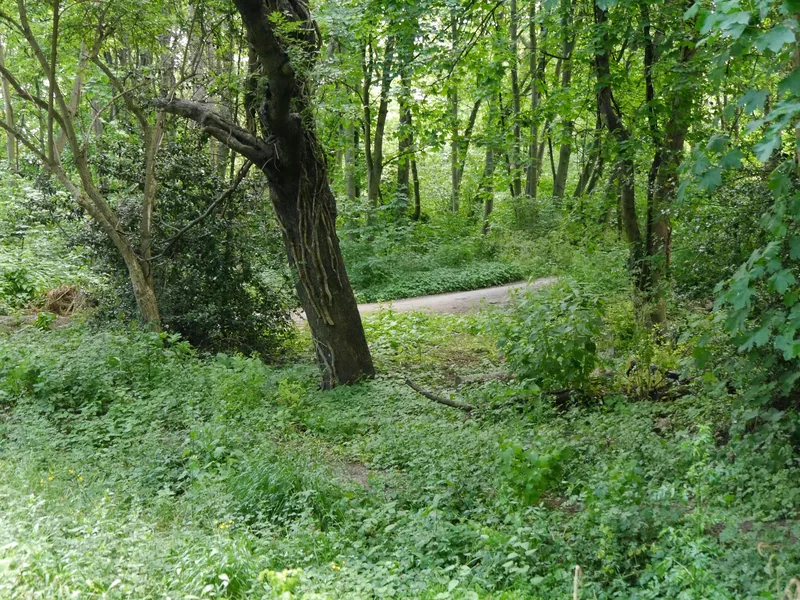
Photo: Edwardx · CC BY-SA 4.0 · Wikimedia Commons · resized
350,000 burials and hardly any headstones
The cemetery opened in 1841 as the City of London and Tower Hamlets Cemetery, the last of the seven, and it was underfunded from the start: a £20,000 share subscription against the £75,000 raised for West Norwood. It is the second smallest of the seven by area and it holds by far the most burials.
The reason is grim and it explains the whole place. This was the cemetery of the East End poor. By 1889 roughly 247,000 people had been buried here. In 1882 a local grievance committee alleged that more than eighty bodies had been put in a single grave; Parliament responded by capping graves at eight adults or fourteen children, and the Friends' own archival research suggests the cap was frequently ignored.
Most of those graves never had a marker, or had a cheap stone that has since eroded away. So this is not a cemetery you visit to find famous names. It is one you visit to understand what a working-class Victorian death looked like, and the Friends' Hidden Histories research and heritage trail are the way in. If you want monuments and celebrity graves instead, Highgate is the opposite end of the same story and charges accordingly.
Families still tend graves here, even where the stones have gone. The Friends describe the park as an important site for reflection and remembrance and say many visitors still attend graves. Treat the woodland as a burial ground rather than a park: stay off the plots, keep dogs out of the undergrowth where signs ask, and leave people alone.
Meadows, ponds and the bluebells
About a third of the nature reserve is flower-rich meadow rather than wood, which is unusual in inner London and is the reason the insect life here is taken seriously by researchers. Among the trees, the Friends have built up a groundcover of grasses, bulbs and shrubs, and the bluebells that come up between the gravestones in late April are the single most photographed thing in the park.
There are five wildlife ponds, three of them with dipping platforms used for school groups and survey work. The Chalk Meadow is the oddest habitat: Scrapyard Meadow and the neighbouring Ackroyd Drive Green Link were housing until they were destroyed in the Second World War, and after the ground was decontaminated in 2007 chalky soil was brought in to recreate the conditions of a chalk grassland, which is a rare habitat in Britain and non-existent in east London otherwise.
The Ackroyd Drive Green Link is worth knowing about because it extends the walk. It is a separate strip of nature reserve running off the cemetery, and together the two make up one of only two local nature reserves in the borough. The site as a whole is a Metropolitan Site of Importance for Nature Conservation and holds a Green Flag Award.
Picking anything needs written permission first, and it is enforced. The Friends require every forager to apply by email before picking so much as wild garlic, allow up to three working days to reply, and patrol for it. Permission is for personal use only: commercial foraging is refused outright, with a possible £5,000 fine behind it. The same applies to cameras. Any photography, filming or audio recording in the park, at any scale, needs permission from the Tower Hamlets Film Office.
The paths, the slope and what you can do on wheels
This is one of the better-documented accessible sites in this part of London, and the Friends are specific about it. The Southern Grove entrance is wide and opens onto a flat area. The main paths are one to two metres wide, flat or gently sloping, and surfaced either with crushed concrete fines, which stay firm in wet weather, or with bare earth. Paths towards the centre of the park are rougher and turn muddy after rain.
The circular route is about a kilometre, with one steeper slope and some gentle inclines. Two sections have steps, and both have step-free alternatives. Benches with backrests are set at regular intervals, which matters more than it sounds if you are pacing yourself. The Soanes Field Centre and the Cemetery Park Lodge, both by the Southern Grove gates, have ramp access and accessible lavatories, but those are opened for event participants rather than kept open for passing visitors.
There are no public toilets in the park at all. Plan for that before you arrive, particularly with children; our page on finding a public toilet in London explains what is available in practice. Baby changing is in the Lodge, and the Friends will find a private space for breastfeeding on request. There are no adult changing tables or hoists.
Getting there, and where not to park
Mile End station is the obvious approach and, by Transport for London's own journey planner, the walk from the station to the Southern Grove postcode takes about four minutes. Bow Road is a similar distance from the east and Bow Church on the DLR is a short walk south. Buses stopping within reach on Mile End Road, Burdett Road, Bow Common Lane and Campbell Road include the D6, D7, D8, 25, 108, 205, 277, 323, 339 and 425, so if you are on a London bus anywhere in this part of the East End you are probably not far off.
There are Santander Cycles docking stations on Mile End Road, Bow Road, Southern Grove, Bow Common Lane and Knapp Road. There is no cycle parking inside the park, and bikes may only be ridden on the designated routes. Our guide to hiring a Santander Cycle explains how the docking works.
Do not drive. There is no visitor parking on site, unauthorised vehicles may be removed, and the only parking available is on-street around Southern Grove and subject to the posted restrictions. Accessible parking has to be arranged with the Friends in advance.
How long, and what to do either side of it
The kilometre circuit takes about half an hour at a walking pace. An hour is a comfortable visit with stops at the ponds and the meadows. Two hours is the length of a guided walk or a trail done properly, and the bluebell fortnight in late April is the one time it is worth planning the day around.
Mile End has more to it than people expect once you are already here. The Ragged School Museum on the Regent's Canal is a short walk north and covers the same East End generation from the schoolroom side, and Bow and Mile End has the rest of the neighbourhood. For a conventional park with a lake and a cafe, Victoria Park is twenty minutes north.
If the overgrown-cemetery idea is what brought you, the two closest matches are Abney Park in Stoke Newington and Nunhead in south London, and all three are free, which puts them on our list of things to do in London for nothing.
Frequently asked questions
Is Tower Hamlets Cemetery Park free and always open?
It is free, and the Friends describe it as accessible 24 hours a day, every day of the year. The main Victorian gates on Southern Grove are usually open from dawn to dusk, while the gates on Hamlets Way and Cantrell Road stay open all the time, so you cannot be locked in.
How many people are buried at Tower Hamlets Cemetery Park?
An estimated 350,000, which is the highest figure of any of the Magnificent Seven despite this being the second smallest site. About 247,000 burials had taken place by 1889. The great majority of graves were never marked or had cheap stones that have since eroded.
Are there toilets at Tower Hamlets Cemetery Park?
No public ones. Accessible toilets exist in the Soanes Field Centre and the Cemetery Park Lodge near the Southern Grove gates, but they are opened for people attending the Friends' organised events rather than for general visitors. Baby changing is available in the Lodge.
Can you take photographs in Tower Hamlets Cemetery Park?
Not without permission. The Friends state that all filming, photography and audio recording in the park requires permission from the Tower Hamlets Film Office, from portfolio work upwards. This is stricter than at most London cemeteries, where personal snapshots are accepted, so ask before you plan a shoot.
Which station is nearest to Tower Hamlets Cemetery Park?
Mile End, on the Central, District and Hammersmith & City lines, about four minutes' walk from the Southern Grove gates according to Transport for London's journey planner. Bow Road and Bow Church on the DLR are the alternatives, and all three are in Zone 2.
Sources
- Friends of Tower Hamlets Cemetery Park - Visit us: opening, access, toilets, dogs, parking (Internet Archive copy of 31 August 2026, read September 2026; the live site blocks our requests)
- Friends of Tower Hamlets Cemetery Park - History, part one (Internet Archive copy, read September 2026)
- Friends of Tower Hamlets Cemetery Park - Our habitats (Internet Archive copy, read September 2026)
- Friends of Tower Hamlets Cemetery Park - Foraging permission (Internet Archive copy, read September 2026)
- London Borough of Tower Hamlets - Cemetery Park entry in the parks directory (checked September 2026)
- Transport for London - Journey Planner, Mile End station to E3 4PX on foot (checked September 2026)