
Mile End is six minutes from Liverpool Street on the Central line, and three of the four things worth coming for are free: Tower Hamlets Cemetery Park, a Victorian burial ground that has become a woodland nature reserve; Mile End Park, a 32-hectare strip along the Regent's Canal with a grass-covered bridge over the main road; and the towpath that links them. The fourth, the Ragged School Museum, costs £5 for an adult.
Bow and Mile End sit either side of the Mile End Road, the old Roman line out of London towards Colchester. This is the East End that industrialised first and hardest: match factories, breweries, chemical works, gasworks, and the housing built round them. Two of the most important episodes in British labour history happened within a mile of each other here, and both involved women.
There is no single sight. What there is instead is a dense, walkable set of small things joined by a canal, in an area most visitors never reach even though the Central line runs straight through it. This page gives you the walk, the opening days and the honest verdict on each piece of it.
Bow and Mile End at a glance
- Where
- East London, E3 and part of E1, in the borough of Tower Hamlets
- Stations
- Mile End (Central, District, Hammersmith & City) and Bow Road (District, Hammersmith & City), both Zone 2; Bow Church on the DLR
- Step-free
- Bow Church, like all DLR stations. Mile End and Bow Road have no lifts
- From Liverpool Street
- About 6 minutes on the Central line to Mile End
- Tower Hamlets Cemetery Park
- Free. A Local Nature Reserve and one of the Magnificent Seven cemeteries
- Ragged School Museum
- Wednesday to Sunday, 10am to 5pm. £5 adult, £2.50 child, £10 family
- Roman Road Market
- Tuesday, Thursday and Saturday, 8am to 6pm
- Time needed
- Half a day on foot, a full day if you add Victoria Park
The cemetery that turned into a wood
Of everything free in this corner of London, Tower Hamlets Cemetery Park is the best, and hardly any visitor has heard of it. Burials began here in 1841 and stopped in 1966, when an Act of Parliament closed the cemetery and re-declared the ground as a public park. It belongs to the group of seven commercial burial grounds laid out around Victorian London, now called the Magnificent Seven.
Left largely alone for decades, it became woodland with graves inside it. The council now classes it as a Local Nature Reserve and a site of Metropolitan importance for nature conservation, and it has held a Green Flag Award since 2012. The Friends of Tower Hamlets Cemetery Park, a charity formed in 1990, manage it under an agreement with the council and have restored some of the listed monuments, several of which were at risk.
What you get walking in is ivy, brambles, tall trees, leaning headstones and paths that vanish, with two later additions on the southern edge: Scrapyard Meadows, a wildflower meadow whose name gives away its former use, and Ackroyd Drive Greenlink, a green corridor that connects the cemetery to Mile End Park. There is a field centre inside the park used for school science workshops.
Our guide to the Magnificent Seven cemeteries places it beside Highgate, Nunhead and the others, and our page on the cemetery park itself goes further into what grows and nests there.
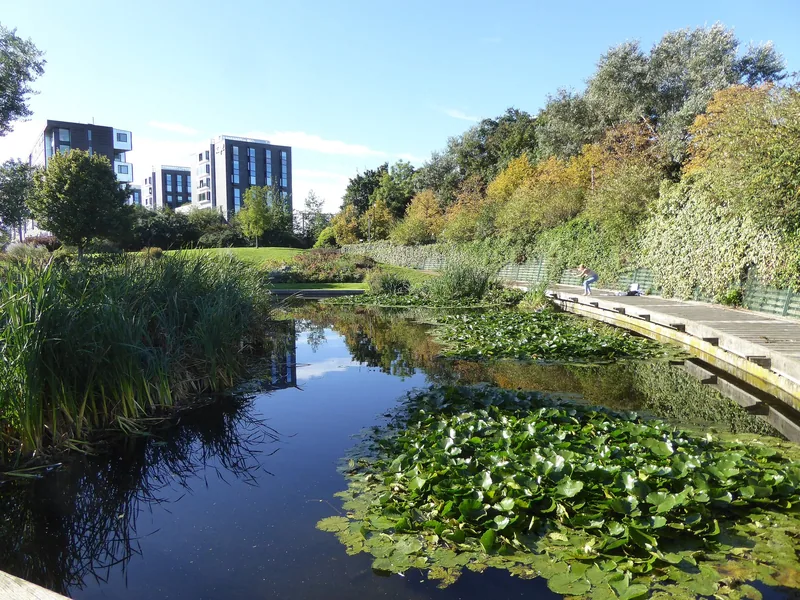
Photo: ClemRutter · CC BY-SA 4.0 · Wikimedia Commons · resized
Mile End Park and the bridge with grass on it
Mile End Park is a 32-hectare linear park, made on ground that industry and wartime bombing had wrecked, following the Regent's Canal from Victoria Park in the north down to Limehouse Basin in the south. Roads, railways and waterways cut it into sections, which is why it feels more like a route than a park.
The piece everybody photographs is the Green Bridge, a pedestrian bridge carrying the park over the Mile End Road so that the two halves join up. It opened in July 1999, was designed by Piers Gough, and has grass and trees planted on top of it, so you can walk over four lanes of traffic without knowing you have.
Along the park there are pavilions for art, ecology and children's play, a climbing wall, a go-kart track, a stadium and sports centre, and a good deal of meadow and woodland that supports more wildlife than a strip of inner-city park has any right to. It is genuinely useful for families, and our guide to city farms and playgrounds puts it in context.
The towpath is the way to see all of this, and it is flat. From Mile End station the canal is three minutes away, and from there you can walk north to Victoria Park in about fifteen minutes or south to Limehouse Basin and the Thames in about thirty. It is level the whole way, it has no road crossings, and it connects the cemetery park, Mile End Park and the Ragged School Museum without a single bus. Our guide to the Regent's Canal covers the wider network.
The Ragged School Museum, in one paragraph
Copperfield Road, on the canal bank, holds three warehouses that housed a free school for the poorest children in the district, the biggest of its kind in the country at the time. The museum inside opens Wednesday to Sunday from 10am to 5pm, an adult pays £5, a child £2.50 and a family £10, and there is a lift to every floor.
The reason to go is a reconstructed Victorian classroom, and on the first Sunday of each month an actor in costume teaches a lesson in it. Our page on the Ragged School Museum has the detail, including what the lesson is like and whether the journey is worth it with children, so we will not repeat it here. It is about ten minutes' walk from Mile End station through the park.
The match girls, and the women who made Bow matter
The Bryant and May match factory stood at Fairfield Road in Bow, and in July 1888 about 1,400 women and girls walked out of it. The immediate cause was the sacking of a worker; the underlying causes were the pay, the fines and phossy jaw, the disfiguring bone disease caused by working with white phosphorus. They organised, they won, and the union they formed became one of the earliest for unskilled women workers in Britain.
The factory buildings survive, converted into flats as the Bow Quarter, with the tall Italianate chimney still standing. There is no museum and nothing to go into: it is a private residential estate and you look at it from Fairfield Road.
Twenty-five years later the same streets held the Suffragette movement's East London Federation, which broke from the national leadership to organise working-class women in Bow and Poplar. The two stories are usually told separately and belong together, and the geography is what makes that clear: they happened in the same square mile.
Roman Road, and what a market day looks like
Roman Road, known locally as the Roman, runs east from the top of Mile End Park and follows the line of a Roman road. The market trades on Tuesday, Thursday and Saturday from 8am to 6pm, with clothing, household goods, toys, cosmetics and jewellery, a court of food stalls on St Stephen's Road selling bread, pastries and hot food, and a retro extension on the third Saturday of the month.
Saturday is the day to come, and outside those three days the street is an ordinary local high street with a good run of independent shops and cafes. A separate market, Roman Road Square at Globe Town, trades Monday to Saturday from 8am to 6pm and is the fruit, vegetable and fish market for the area.
Both are working markets rather than visitor markets, in the same way as the ones in our guide to London markets by day of the week, which sets out which market runs on which day across the whole city.
Bow Bells, and the confusion worth clearing up
A Cockney is traditionally someone born within earshot of the Bow Bells, and almost everybody assumes those bells are in Bow. They are not. The bells are at St Mary-le-Bow on Cheapside, in the City of London, four miles west, and the name comes from the bow-shaped arches of that church's Norman crypt rather than from this neighbourhood.
Bow does have a church in the middle of the road: St Mary's, Bow, sits on an island in the Bow Road with traffic on both sides, and it is the building that gives Bow Church DLR station its name. Our page on St Mary-le-Bow and the Bow Bells untangles the two properly.
Eating, drinking and the cinema
The Mile End Road is a long run of cheap and good food rather than a restaurant district: Bangladeshi and Pakistani grills, Vietnamese, Turkish, and a large student population from Queen Mary University of London, whose campus sits along the road and keeps the prices honest.
The Genesis Cinema at 93 to 95 Mile End Road is the local institution: an independent cinema on the site of a much older theatre, with a mainstream and repertory programme and live events. It is the best reason to stay here after dark.
For the food itself, we send you to the pages that keep the lists current rather than naming restaurants here: Chinese food beyond Chinatown covers the east London clusters, and cheap eats in London explains what a good £10 meal looks like in this part of the city.
Half a day on foot
- 10am, Mile End station. Walk south-east fifteen minutes to Tower Hamlets Cemetery Park. Allow an hour inside.
- 11.30am. Back north through Ackroyd Drive Greenlink into Mile End Park, over the Green Bridge.
- 12.30pm. Ragged School Museum on Copperfield Road, ten minutes along the canal. Wednesday to Sunday only.
- 2pm. North along the towpath to Victoria Park, about fifteen minutes, for the lakes and the pagoda.
- 4pm. Bus or walk to Roman Road if it is a Tuesday, Thursday or Saturday.
Runners will recognise this ground: the canal and the two parks make one of the better long routes in east London, and our guide to running routes in London has it. Going further east, Hackney Wick and Fish Island is twenty minutes up the towpath, and the Olympic Park beyond that.
Frequently asked questions
Is Tower Hamlets Cemetery Park free?
Yes, it is a free public park owned by Tower Hamlets Council and managed with the Friends of Tower Hamlets Cemetery Park. It is one of London's Magnificent Seven Victorian cemeteries, opened for burials in 1841 and closed to them in 1966, and it is now a Local Nature Reserve.
Are the Bow Bells in Bow?
No. The bells that define a Cockney are at St Mary-le-Bow on Cheapside in the City of London, about four miles west of Bow. The church in the middle of the Bow Road is St Mary's, Bow, which is a different building entirely.
What is the Green Bridge in Mile End?
A pedestrian bridge carrying Mile End Park across the Mile End Road, planted with grass and trees so that the park continues over the traffic. It opened in July 1999 and was designed by Piers Gough. Walking over it is free and takes a minute.
Is Mile End station step-free?
No. TfL's station dataset lists no lift and no ramped route at Mile End or at Bow Road. Bow Church, on the DLR, is step-free, as all DLR stations are, and it is about ten minutes' walk from the Bow Road end of the area.
Is Bow worth visiting as a tourist?
For half a day, if free green space and industrial and labour history interest you. The cemetery park and the canal walk are genuinely good and cost nothing. If you want museums, architecture or shopping, this is not the part of London to spend a morning in.
Sources
- London Borough of Tower Hamlets - Tower Hamlets Cemetery Park (checked September 2026)
- London Borough of Tower Hamlets - Mile End Park (checked September 2026)
- London Borough of Tower Hamlets - Markets in Tower Hamlets (checked September 2026)
- Transport for London - detailed station data (lifts and step-free routes) (checked September 2026)
- Transport for London - Journey Planner (sample journeys, Thursday 1 October 2026, 11:00) (checked September 2026)