
Henley-on-Thames is 49 minutes from Paddington with one change at Twyford, twice an hour, and an Off-Peak Day Return was £25.00 in September 2026. Marlow is 48 to 53 minutes with a change at Maidenhead, £24.00 return, but the branch train runs roughly hourly rather than half-hourly. The 8.7 miles of Thames Path between the two towns is the best riverside walk within reach of London, and it is the reason to make this trip rather than either town on its own.
Both are small Georgian towns on the Thames in the Chilterns, about thirty-five miles west of London, on separate railway branches from the main line to Reading. Henley is the rowing town: the Royal Regatta has been held there since 1839 and the straight mile of river below the bridge is the course. Marlow, five miles downstream, has a suspension bridge, a park on the water and fewer visitors.
Our guide to the Oxford and Cambridge Boat Race covers competitive rowing at the London end of the river, and our overview of the Thames Path and London's walking routes explains the trail inside the capital. This page is about the Chiltern stretch: the trains, the walk, and what July does to Henley.
Henley and Marlow: the numbers
- Henley-on-Thames
- 49 minutes from Paddington, change at Twyford, twice an hour
- Marlow
- 48 to 53 minutes from Paddington, change at Maidenhead, about hourly
- Off-Peak Day Return
- Henley £25.00, Marlow £24.00 (National Rail, September 2026)
- Oyster and contactless
- Not valid to either. Buy a ticket
- The walk between them
- 8.7 miles (13.9 km) on the Thames Path, flat and waymarked
- Regatta course
- 1 mile 550 yards, Temple Island to Poplar Point
- Henley Royal Regatta 2027
- Tuesday 29 June to Sunday 4 July
- Cost of the walk
- Free
- Verdict
- Worth a day as a one-way walk. Half a day for either town alone
The trains, and why you should walk one way
Henley sits at the end of a short branch from Twyford. The Paddington train takes about 35 minutes to Twyford and the branch train another 12 or so, and the whole thing comes to 49 minutes with one change, twice an hour. Marlow is the same idea from Maidenhead, but the Marlow branch is a single-track shuttle with a roughly hourly service, so your return time matters more there.
That asymmetry decides the shape of the day. Take the frequent service out to Henley in the morning, walk downstream to Marlow, and take the hourly branch train home from Marlow in the evening with a known departure time in your pocket. Doing it the other way round means finishing at Henley with trains you do not need and starting at Marlow with a wait you did not plan.
Neither town is in the contactless pay as you go area, so buy a ticket. Two separate Off-Peak Day Returns are not what you want for a one-way walk: ask at the ticket office for the correct single fares to Henley and back from Marlow, or use the journey planner to price the two legs separately. Our guide to buying British train tickets explains why this is one of the few trips where two singles are genuinely right.
Book the walk around the last Marlow branch train, not around lunch. The Marlow shuttle runs about once an hour and the connections at Maidenhead are tight rather than generous. Look up the evening departures before you leave Henley, write one down, and treat 8.7 miles as four hours rather than three: the path is flat but there are gates, locks and villages to slow you down, and none of that is time you will regret.
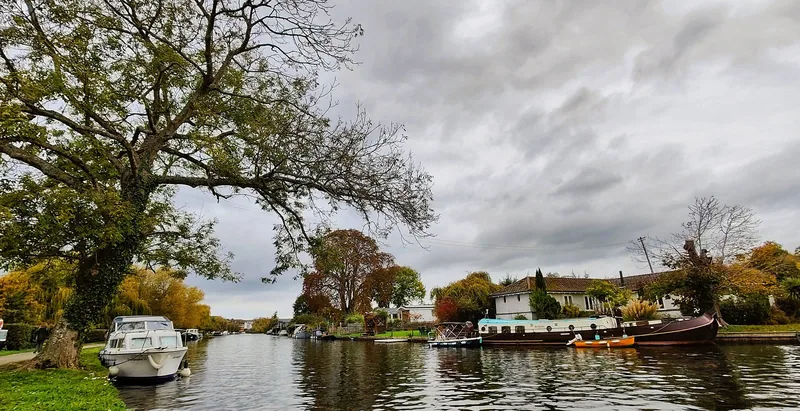
Photo: Rb.sg · CC BY-SA 4.0 · Wikimedia Commons · resized
The Thames Path from Henley to Marlow
National Trails gives this section as 8.7 miles, or 13.9 km. It is part of the 185-mile Thames Path National Trail, which runs from the river's source in the Cotswolds to the Woolwich Foot Tunnel, and it is flat, well waymarked and easy to follow without a map, though a map is still sensible.
Leaving Henley you walk the length of the regatta course along a dead-straight reach to Temple Island. The little temple on it is not a temple: it is a fishing lodge, built as a landscape feature to improve the view from Fawley Court, and it now marks the start line of the races.
The best stretch is at Hambleden Lock, where a line of weirs crosses the river on a walkway you can cross on foot, with the white weatherboarded Hambleden Mill beside it; the mill worked on a water turbine until 1955. Hurley, a couple of miles further on, is a small village with a great deal of surviving medieval fabric. The approach to Marlow opens with the pale tower of Bisham Church reflected on the far bank, and then you are in Higginson Park with the suspension bridge ahead of you.
There is one honest warning. This is a riverside path on a floodplain, and long sections are muddy from October to April and occasionally under water after heavy rain. Check the Environment Agency's river conditions before committing to it in winter, and treat it as a spring-to-autumn walk.
Henley: what is open and what is not
Henley is a handsome town of about twelve thousand people with a five-arched eighteenth-century bridge, a church tower beside it, and a riverside that exists to be looked at. It takes an hour to walk round properly.
The thing to know before you go is that the town's main indoor attraction has gone. The River & Rowing Museum's own website now leads with a notice that the museum is closed to the public, that its education workshops continue elsewhere, and that it is inviting expressions of interest from museums or organisations willing to take on the River and Rowing collections, either together or item by item. A leftover panel on the same site still says "We are open daily, 10am to 4pm". Treat the museum as closed, and do not build a wet-weather plan around it.
What remains is free and outdoors: the bridge, the churchyard, the towpath on both banks, and the mile of river that is the regatta course. The Leander Club and the other boathouses are working clubs rather than visitor attractions. If rain is forecast, Marlow has more shelter per street than Henley does, which is an argument for walking the other way round on a bad day.
The regatta course, and what July does to the town
Henley Royal Regatta will run from Tuesday 29 June to Sunday 4 July 2027, with tickets on sale in spring 2027. The Regatta Enclosure is open to everyone; the Stewards' Enclosure is for members and their guests, with a dress code and a waiting list measured in years.
The course itself is a piece of engineering worth understanding. It is 1 mile 550 yards long and 80 feet wide, running straight from below the Berkshire side of Temple Island to the finish at Poplar Point. The Straight Course has been in use since 1924, when part of Temple Island and part of the opposite bank were removed to make it straight; the traditional length was simply the longest run of open water obtainable on the Henley Reach in 1839. From the start it is 3,435 feet to Fawley and 6,930 feet to the winning post.
Regatta week is the worst week of the year to visit Henley casually. The town is full, the towpath along the course is closed off or crowded, the trains are packed, hotel prices double and much of the riverside is behind barriers you need a badge to pass. If you want the racing, plan for it and buy a Regatta Enclosure ticket. If you want the town and the walk, come in May, June before the regatta, or September.
Marlow, and the bridge
Marlow is the quieter of the two and, for our money, the better half day. The High Street runs down to the river and ends at the suspension bridge, a slender chain bridge of 1832 by William Tierney Clark, who went on to build the far larger Chain Bridge over the Danube in Budapest on the same principles. Standing on it, that resemblance is obvious.
Beside the bridge, All Saints Church has a tall spire that acts as a landmark for the whole reach, and on the other side Higginson Park runs along the water with lawns, a bandstand and a great many people doing nothing in particular. Marlow Lock and its weir are a short walk downstream and are the noisiest thing in the town.
For lunch, the Food Standards Agency rated four places on the High Street five at their most recent inspections in 2025 and 2026: a hotel pub at 51 to 53, a pub at 56, an all-day restaurant at 21 and an Italian at 92 to 94. On Henley's Hart Street, a coaching-inn pub at 7 to 15 and a restaurant in the Chantry House both held five, but four other businesses on that one short street held ratings of 3, which is a higher proportion than we would normally pass over in silence. Check the sticker in the window.
The river by boat, and the other way to see it
Passenger boats run on this stretch in the season, usually from Easter to October, and a return trip between Henley and Hambleden Lock is the easy alternative to the walk for anyone who cannot manage nine miles. Timetables are seasonal and weather-dependent, so check on the day rather than planning around them. We do not name or link the operators.
The other option is to walk part of the section and take the bus. Local buses connect Henley, Marlow and Maidenhead, which lets you walk as far as Hurley or Hambleden and pick up wheels for the rest. That is the version we would choose with children or in doubtful weather.
How this compares with the other Thames day trips
Three other towns on this river are day trips from London, and they do different jobs. Windsor has the castle and the crowds. Oxford is a city with colleges and a better wet-weather plan. The Cotswolds are the source end of the same river and need a car or a tour.
Henley and Marlow have none of those things and one that the others lack: a long, flat, beautiful stretch of towpath you can walk end to end between two railway stations, for the price of the train. If your idea of a day out of London is a river and a pub rather than a ticket queue, this is the trip.
Downstream, the same trail eventually reaches the Thames Barrier, where the National Trail used to end. Our guide to walking in London has the urban sections, our ranking of the cheapest day trips from London shows where a £24.00 return sits, and the full list is under day trips from London.
Frequently asked questions
How long is the train from London to Henley-on-Thames?
About 49 minutes from Paddington with one change at Twyford, twice an hour. Marlow takes 48 to 53 minutes with a change at Maidenhead, but its branch train runs roughly hourly. Neither town accepts Oyster or contactless, so buy a ticket.
How far is the walk from Henley to Marlow?
National Trails gives the Thames Path section as 8.7 miles, or 13.9 km. It is flat and waymarked, passing Temple Island, Hambleden Lock and Hurley, and we would allow four hours rather than three. Long stretches are muddy or flooded between October and April.
Is the River and Rowing Museum in Henley still open?
No. The museum's own website says it is closed to the public and that it is seeking organisations willing to take on the River and Rowing collections. One leftover panel on the site still advertises daily opening, which is out of date. Plan your day without it.
When is Henley Royal Regatta in 2027?
Tuesday 29 June to Sunday 4 July 2027, with tickets on sale in spring 2027. The Regatta Enclosure is open to anyone who buys a ticket; the Stewards' Enclosure is for members and their guests. Avoid the town that week unless the racing is why you are coming.
Which is better, Henley or Marlow?
Marlow, if you only have half a day: it is quieter, it has more shelter and the suspension bridge is the better single sight. Henley is the more famous town and the start of the walk. The right answer is neither on its own, but the towpath between them.
Sources
- National Rail Enquiries - London Paddington to Henley-on-Thames, times and fares (checked September 2026)
- National Rail Enquiries - London Paddington to Marlow, times and fares (checked September 2026)
- National Trails - Thames Path route sections, including Henley-on-Thames to Marlow (checked September 2026)
- Henley Royal Regatta - The Regatta Course (checked September 2026)
- Henley Royal Regatta - 2027 dates and enclosures (checked September 2026)
- River & Rowing Museum - closure notice (checked September 2026)
- Food Standards Agency - food hygiene ratings search (checked September 2026; used to confirm the businesses referred to here and to exclude any rated below 3)