
Most of what Londoners call Greek food is Cypriot. The tavernas of Green Lanes, Palmers Green and Camden were opened by Greek Cypriots who arrived from the 1950s onwards, and the meze they serve, fifteen or twenty small plates brought in waves for a fixed price per person, is a Cypriot institution rather than a Greek one.
The distinction matters because it changes what you order. A Greek taverna gives you moussaka, souvlaki and a menu you choose from. A Cypriot meze house asks how many of you there are and then simply starts cooking, and stopping it is your responsibility.
The food is in north London, along Green Lanes in Harringay and further north in Palmers Green, in Camden and Kentish Town, and in pockets of Bayswater. It is cheaper than its Mediterranean-restaurant equivalents in the centre and the portions are considerably larger.
Greek and Cypriot London
- Green Lanes, Harringay
- Tavernas, bakeries and grocers sharing a road with the Turkish grills. Harringay Green Lanes, Zone 3, Suffragette line; buses 29, 141, 341
- Palmers Green
- Further north, Zone 4. Direct trains from Moorgate, 27 minutes, about twice an hour
- Camden and Kentish Town
- Long-established tavernas, Zone 2, Northern line
- Bayswater
- A handful of older Greek restaurants, Zone 1
- Meze
- Priced per person, minimum two people, and it keeps arriving until you stop it
- Booking
- Needed at weekends; Sunday lunch runs long
Why the community is where it is
Greek Cypriots came to Britain in numbers from the 1950s, and again after the division of Cyprus in 1974. Many settled in Haringey and Enfield, in a corridor running north from Harringay through Wood Green and Palmers Green to Southgate. Turkish Cypriots settled in overlapping streets, which is why Green Lanes carries Greek bakeries and Turkish charcoal grills a few doors apart.
The Greek Orthodox cathedral in Bayswater, meanwhile, is the reason for the older Greek presence in west London, which is smaller and less about food. If you want to see the community rather than eat, the Easter services in north London churches are the moment: Orthodox Easter usually falls on a different Sunday from the Western one, and the food that follows it is the year's best.
Our guide to Highgate and Crouch End covers the area west of Green Lanes, and Camden Town the southern cluster.
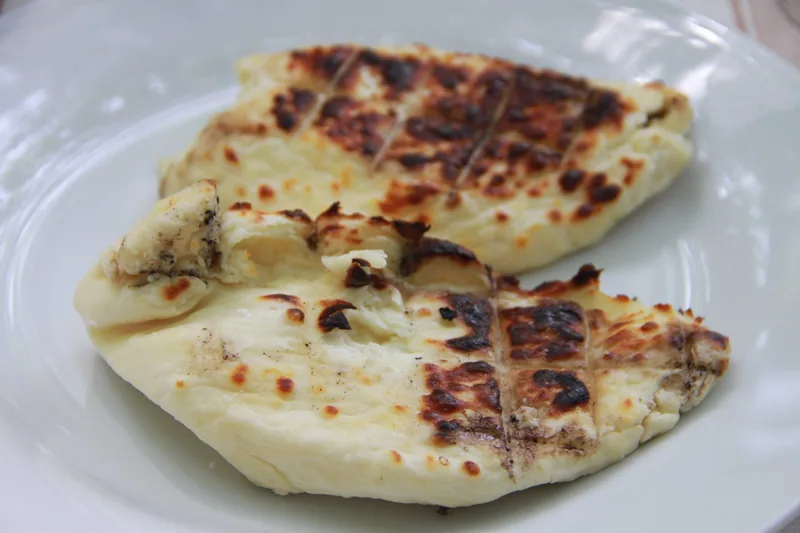
Photo: Anatoliy Smaga · CC BY-SA 4.0 · Wikimedia Commons · resized
How a Cypriot meze actually works
You sit down, someone asks how many are eating, and food begins to arrive. There is no ordering beyond that. The sequence is roughly fixed:
- Dips and bread. Tahini, taramosalata, tzatziki, hummus, olives, and warm pitta cut into strips.
- Cold plates. Salad, pickled vegetables, beetroot, potato salad, sometimes octopus in vinegar.
- Hot small plates. Halloumi, loukaniko sausage, keftedes meatballs, calamari, courgette fritters, dolmades.
- The grill. Souvlaki, sheftalia, lamb chops, chicken. This is where most people are already full.
- Fruit or a sweet. Melon, or loukoumades if you are lucky.
The price is per head and agreed before anything arrives. It is usually excellent value, and it is also more food than almost anyone can eat. The single most useful sentence in a Cypriot restaurant is "please stop bringing food", and it is said far too rarely.
Pace yourself at stage one. The dips and bread are the cheapest part of the meal and the easiest to fill up on, and they arrive when you are hungriest. Eat a little of each, then leave them. The grill at the end is the part you came for, and arriving at it full is the most common mistake in a meze house.
The dishes, and how the Greek and Cypriot versions differ
| Dish | What it is | Note |
|---|---|---|
| Halloumi | Firm sheep and goat cheese, grilled or fried until it squeaks | Cypriot. Best slightly charred, with lemon |
| Sheftalia | Minced pork and lamb with parsley and onion, wrapped in caul fat and grilled | Cypriot, and the thing to order if you order one thing |
| Souvlaki | Cubes of grilled meat on a skewer, or the wrap made from them | Greek and Cypriot both |
| Kleftiko | Lamb shoulder sealed and cooked for hours until it collapses | Order it if the restaurant has it; not every night |
| Moussaka | Layered aubergine, minced lamb and bechamel, baked | Greek. Often better at lunchtime when it is freshly made |
| Stifado | Beef stewed slowly with small whole onions, cinnamon and vinegar | Winter food |
| Afelia | Pork cooked with red wine and crushed coriander seed | Cypriot |
| Louvi and koupepia | Black-eyed beans with greens; vine leaves stuffed with rice and mince | Everyday Cypriot home cooking |
| Loukoumades | Small fried dough balls in honey syrup with cinnamon | The dessert worth leaving room for |
To drink: retsina is white wine flavoured with pine resin and divides opinion sharply; Cypriot brandy sour is the local aperitif; and Commandaria is a sweet dessert wine from Cyprus with a very long history. Greek coffee is served in a small cup with the grounds at the bottom, and you do not stir it or drink the last centimetre.
Green Lanes: bakeries, grocers and the shared street
The stretch of Green Lanes through Harringay is the densest concentration, and the Greek and Turkish businesses are mixed together along it. Greek bakeries sell koulouri bread rings, spinach and cheese pies, and trays of baklava. Grocers stock barrels of olives, sheep's milk cheeses, dried oregano on the stalk, and the small green Cypriot potatoes that people buy specially.
There is no Underground station on the road itself. Harringay Green Lanes, in Zone 3 on the Suffragette line of the London Overground, puts you in the middle. Manor House and Turnpike Lane on the Piccadilly line are at each end, and the 29 bus runs the whole way from central London for a flat fare of £1.75. Our guide to London buses explains the Hopper fare, which lets you break the journey.
Because the same road carries the charcoal grills described in our page on the Turkish hearths of north London, it is possible to do a Greek bakery, a Turkish supermarket and a Cypriot taverna within a few hundred metres. That is the single best food walk in north London and almost no visitors do it.
Palmers Green is where Londoners go when Green Lanes is full. It sits in Zone 4, with direct trains from Moorgate taking 27 minutes and running about twice an hour, and it has one of London's largest Cypriot populations with the restaurants and grocers to match. Prices are lower than in Camden and you will not need to book as far ahead. Check the train times on National Rail, because the service is much less frequent than a Tube line and thins out in the evening.
Camden, Kentish Town and the central options
Camden and Kentish Town have tavernas that have been in the same families for decades, and they are much easier to reach than Palmers Green. They are also more expensive and more used to visitors, which shows in the menu rather than in the cooking. Book for weekend evenings.
Central London's Greek restaurants, including a few in Bayswater and Fitzrovia, do a modern version of the same food at Zone 1 prices. They are a reasonable choice for one meal but they are not why this cuisine is worth writing about. Our guides to Paddington and Bayswater and Fitzrovia cover those areas.
Bakeries, grocers and Orthodox Easter
The bakeries are worth a separate trip from the restaurants. Look for tiropita and spanakopita, filo pastries filled with cheese or with spinach and feta, sold by the piece and eaten warm; koulouri, a sesame bread ring; and flaounes, the cheese-filled Easter pastry that Cypriot bakeries in north London make in enormous quantities each spring.
Greek grocers stock things that are genuinely hard to find elsewhere in London: oregano still on the stalk, several grades of olive oil sold in tins rather than bottles, barrel-aged feta cut to order, carob syrup, rose water, and the trahana used to thicken winter soups. Prices are considerably lower than in a delicatessen in the centre.
Orthodox Easter is the high point of the year. It usually falls on a different Sunday from the Western one, and the week before it fills the bakeries with flaounes and the butchers with whole lamb. If your trip coincides with it, Green Lanes and Palmers Green on the Saturday are the most interesting food shopping in London.
Vegetarians, allergies and children
A Cypriot meze suits vegetarians unusually well, because the first two stages are almost entirely meat-free and most restaurants will run a vegetarian meze at a lower price per head. Halloumi, dolmades, louvi, gigantes beans, spanakopita and the dips make a full meal on their own. Ask when you book rather than at the table. See vegan and vegetarian London.
Sesame, in tahini, is in several dips. Filo pastry and pitta contain wheat, and taramosalata contains fish roe, which surprises people who assume it is a vegetable dip. See gluten-free eating in London.
These are family restaurants in the fullest sense: children are welcome, the food is not spicy, and nobody minds a table that stays for three hours. See London with kids.
What it costs and when to go
A meze priced per head represents good value on a long evening, particularly for four or more people, and the fixed price makes budgeting straightforward. Ordering separately from the menu can work out cheaper for two people who do not want twenty plates. Our page about eating cheaply in the city covers how this compares with other options, and tipping in London explains the service charge.
Sunday lunch shows these restaurants at their busiest and their best: large family tables, several generations, and a kitchen that has been cooking since the morning. Book it. Our page on the British Sunday roast covers the native alternative on that day.
For other Mediterranean food with a long London history, see the delis and pizzerias of Italian London, and, at the eastern end of the same sea, the Lebanese grills of Edgware Road.
Frequently asked questions
Is Greek food in London actually Cypriot?
Much of it is. The restaurants that shaped the style were opened by Greek Cypriots who settled in north London from the 1950s onwards, and dishes such as sheftalia, afelia, halloumi and the per-person meze are Cypriot rather than mainland Greek. Mainland dishes such as moussaka and souvlaki appear on the same menus.
How does a meze work?
You pay a fixed price per person, usually with a minimum of two people, and the kitchen sends out a long sequence of small dishes: dips and bread first, then cold plates, then hot small plates, then grilled meat, then fruit. You do not order individual items, and you need to tell the staff when to stop.
Where is the Greek and Cypriot part of London?
A corridor in north London running from Harringay up through Wood Green to Palmers Green and Southgate, with Green Lanes as its main street. Camden and Kentish Town have long-established tavernas closer to the centre, and Bayswater has a smaller, older Greek presence in west London.
How do I get to Green Lanes without a Tube station?
Harringay Green Lanes station, Zone 3 on the Suffragette line of the London Overground, sits in the middle of the restaurant stretch. Manor House and Turnpike Lane on the Piccadilly line are about fifteen minutes' walk apart at either end, and the 29 bus runs the whole length of the road from central London for £1.75.
Is a Cypriot meze good for vegetarians?
Yes, and many restaurants offer a vegetarian meze at a lower price per person. The dips, halloumi, stuffed vine leaves, bean dishes, fritters and salads make a complete meal without the grill course. Mention it when you book so the kitchen can plan the sequence.
Sources
- Transport for London StopPoint data - Harringay Green Lanes and Palmers Green lines, bus routes and fare zones (checked September 2026)
- Transport for London - Bus and tram fares and the Hopper fare (checked September 2026)
- National Rail Enquiries - Moorgate to Palmers Green services (checked September 2026)
- Food Standards Agency - Food allergy and intolerance advice for consumers (checked September 2026)
- Food Standards Agency - Food hygiene ratings search (checked September 2026)