
Japanese food in London splits three ways: cheap and genuinely good noodle counters, mid-priced izakaya and katsu rooms, and a small number of expensive sushi restaurants where the money buys something real. The trick is knowing which of the three you are walking into, because from the pavement they can look the same.
For a long time the city's idea of Japanese food came from a handful of supermarkets and one noodle chain. That changed over the past fifteen years or so, and London now has specialist ramen shops, udon counters, izakaya, tonkatsu specialists, bakeries and convenience-style sandwich counters, most of them in Soho, Fitzrovia and the streets around St Giles.
This page is about what to order in each kind of place, what a conveyor belt is actually good for, and where spending more gets you more. For the other East Asian food in the same few streets, see our guides to Chinatown and regional Chinese cooking outside it.
The four things to know
- Ramen counters
- Small rooms, short menus, no bookings, queue for 10-20 minutes at peak. Soho, St Giles, Fitzrovia, Islington
- Conveyor belt sushi
- Priced by plate colour. Fast and fun; rarely the best sushi in the building
- Izakaya
- Japanese pub food: skewers, small plates, beer and sake. The best-value way to eat a long meal
- Counter sushi
- Omakase menus at a fixed price, booked weeks ahead. The expensive end
- Supermarkets
- Japan Centre and others sell ingredients, bento and fresh sushi to take away
- Useful stations
- Tottenham Court Road, Leicester Square, Oxford Circus, Goodge Street, all Zone 1
Ramen: what the styles mean
Ramen is wheat noodles in a seasoned broth, and the menu names describe the broth rather than the toppings. Ordering well means picking the broth you want.
| Style | The broth | Who it suits |
|---|---|---|
| Tonkotsu | Pork bones boiled hard for hours until the broth turns opaque and rich | The London default. Heavy, satisfying, not subtle |
| Shoyu | Clear chicken or pork stock seasoned with soy | Anyone who finds tonkotsu too much |
| Shio | Salt-seasoned, the lightest of the three | Summer, or a light lunch |
| Miso | Fermented soybean paste, often with sweetcorn and butter | Cold days |
| Tsukemen | Noodles served cold and separate, dipped into a concentrated broth | People who already know what they like |
Udon is different again: thick, soft wheat noodles, served hot in a light dashi broth or cold with a dipping sauce. Koya, which has served hand-made udon in London for years, is the best-known specialist and a useful counter-example to the idea that all Japanese noodles are ramen. Kanada-Ya, with counters including one on St Giles High Street near Tottenham Court Road station, is among the ramen shops that draw a regular queue.
Both are examples rather than recommendations to the exclusion of others: this is a crowded field in London and new counters open regularly.
Slurp, and eat it fast. Ramen is designed to be eaten in about ten minutes, before the noodles soften in the broth. Lifting the bowl and drinking from it is normal. So is making noise. Sitting and talking for an hour over a bowl of ramen produces a worse bowl of ramen, and in a small room with a queue outside it is also unkind.
Conveyor belts, and what they are for
Conveyor belt restaurants, kaiten-zushi, price plates by the colour of the dish and let you take whatever passes. They are fast, they work well with children, and they let a nervous first-timer try one piece of something rather than committing to a set.
What they are not is the best sushi in London at any price point. Fish that has been going round a belt is fish that has been out of the fridge. Most belt restaurants now also take orders from a screen for anything made fresh, and that is the better way to use them: order from the screen, treat the belt as a menu you can look at.
The other budget option is the takeaway box, from Japan Centre, from supermarket chilled counters or from one of the dedicated sushi shops in the City and the West End. Quality varies enormously. Look at the rice: if it has gone hard and dry at the edges, the box has been out too long.
Where the money is worth it
Three things justify a higher bill, and none of them is the address.
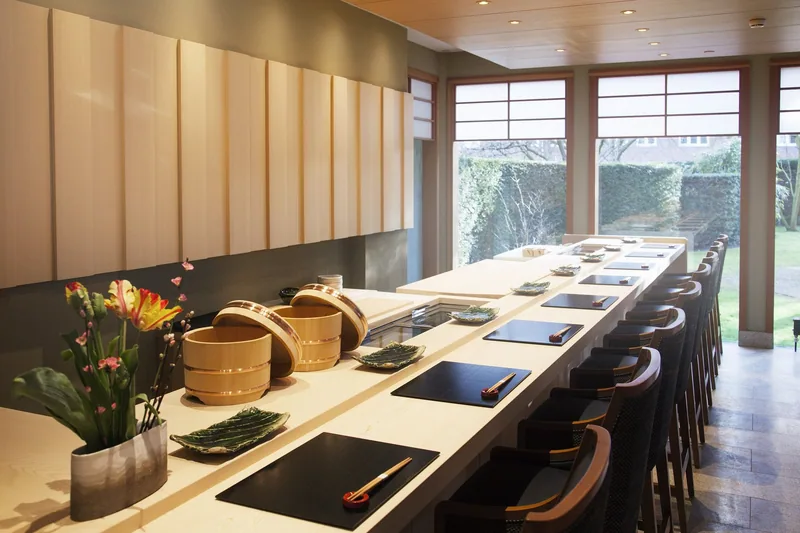
- A counter and a chef in front of you. Sushi served piece by piece, seasoned and sometimes already brushed with soy, eaten immediately. This is a different food from a tray of eight pieces.
- Omakase. A fixed menu chosen by the chef, usually 12 to 20 pieces. You are buying judgement and sourcing, and prices run from moderate to very high. Book well ahead.
- Specialists. A restaurant that does one thing, whether that is tonkatsu, yakitori, soba or tempura, will almost always beat a restaurant with a long menu covering all of them.
What does not justify a higher bill is a long menu of sushi, tempura, teriyaki, curry and dim sum in a room with black lacquer and low lighting. That combination is a warning sign, not a sign of range.
At the top end several Japanese restaurants in London hold Michelin stars, and lunch menus at those are often a fraction of the evening price. See our guide to Michelin-starred restaurants in London for how to use that.
The set lunch is the single best value in Japanese London. Restaurants that charge a great deal in the evening frequently serve a fixed lunch for a small fraction of it, with the same kitchen and the same fish. Book a table at midday rather than at eight, and you will eat better for less. Our page about eating cheaply in the city covers set lunches more broadly.
Izakaya: the most underused option
An izakaya is a Japanese drinking house that serves food, and the format suits London well: you order a few small plates, drink beer or sake, order more, and stay for two hours. Expect yakitori skewers cooked over charcoal, karaage fried chicken, edamame, grilled fish, pickles and agedashi tofu.
It is the best way to eat Japanese food in a group, because nobody has to choose a main course and the bill grows in small increments you can see. It is also where the sake list is, and a decent izakaya will let you taste before committing to a flask. Our guides to wine bars and craft beer cover the equivalent elsewhere in the city.
Katsu, curry and the everyday end
Tonkatsu is a breaded pork cutlet, deep fried and sliced, served with shredded cabbage, rice and a thick brown sauce. Chicken katsu curry, the version most Britons have eaten, is the same cutlet with a mild Japanese curry sauce. It is the gateway dish, it is genuinely Japanese in origin, and specialists do it far better than chains, with a crust that stays crisp under the sauce rather than collapsing into it.
Onigiri, rice triangles wrapped in seaweed with a filling, and katsu sando, the cutlet in soft white bread with the crusts cut off, are sold from counters across the West End and make one of the better cheap lunches to eat in a park. Japanese bakeries sell milk bread, melon pan and matcha pastries; our guide to bakeries and pastries in London covers them.
Where to look, neighbourhood by neighbourhood
| Area | What it has | Nearest station |
|---|---|---|
| Soho and St Giles | The densest concentration: ramen, udon, izakaya, sushi counters, Japan Centre | Tottenham Court Road, Leicester Square |
| Fitzrovia | Quieter rooms, several long-established restaurants | Goodge Street |
| The City | Weekday lunch trade, sushi counters, closed at weekends | Bank, Liverpool Street |
| Islington and Angel | Neighbourhood ramen and izakaya with shorter queues | Angel, Highbury & Islington |
| North-west and west London | Japanese grocery shops and neighbourhood restaurants serving local residents rather than visitors | Golders Green, Acton Town |
Our neighbourhood guides to Soho, Fitzrovia and Islington cover what else is on those streets.
Etiquette, allergies and paying
Chopstick rules matter less in London than visitors fear, but two are worth respecting: do not stand chopsticks upright in rice, and do not pass food chopstick to chopstick. Both are associated with funerals. Pouring for other people rather than for yourself is normal with sake and beer.
On allergies, dashi stock made with bonito flakes is in a great many dishes that look vegetarian, including miso soup and most noodle broths. Soy sauce contains wheat unless it is specifically tamari. Sesame is widespread. English law requires a restaurant to make the 14 regulated allergens known to you, so put the question directly. See vegan and vegetarian London and gluten-free eating in London.
Most ramen counters do not take bookings and many do not take a service charge either. Sushi counters and izakaya usually do both. Our page on tipping in London explains what is discretionary.
Eating Japanese food with children
It works better than most cuisines. Conveyor belts hold a child's attention, katsu curry is mild, edamame is finger food, and udon is easy to eat. Portions are small enough that a child can try several things without waste. See London with kids for eating out more generally, and London with teenagers, since a belt restaurant is one of the few meals that survives that age group.
For a comparable noodle-counter experience at a similar price, our guide to Vietnamese food on Kingsland Road covers the east London equivalent.
Frequently asked questions
Where is the best Japanese food in London?
Soho, St Giles and Fitzrovia have the greatest concentration, with ramen and udon counters, izakaya and sushi restaurants within a few streets of Tottenham Court Road station. For the best food rather than the widest choice, look for specialists that do one thing, whether that is ramen, tonkatsu, yakitori or sushi.
Is conveyor belt sushi any good?
It is good value and good fun, particularly with children, but the plates going round the belt have been out of refrigeration. Most belt restaurants also take orders from a screen for items made to order, and that is the better way to use them. Treat the belt as a menu rather than a serving method.
How much should I spend on sushi in London?
You can eat a decent takeaway box for the price of a sandwich, and a good counter omakase for the price of a theatre ticket or several. The step that makes the biggest difference is moving from a tray of pre-made pieces to a counter where each piece is made in front of you and eaten immediately.
Do ramen restaurants in London take bookings?
Most of the small counters do not. They run a queue instead, which at peak times means 10 to 20 minutes on the pavement. Going at 17:30 or after 21:00 avoids it. Izakaya and sushi restaurants generally do take bookings and need them at weekends.
Is Japanese food in London suitable for vegetarians?
Less automatically than it looks. Dashi stock made from dried bonito is in miso soup and most noodle broths, so those are not vegetarian unless stated. Many restaurants now offer a vegan broth and clearly marked dishes, but ask rather than assume, and check soy sauce if you avoid wheat.
Sources
- Japan Centre - Japanese supermarket and food hall, London (checked September 2026)
- Koya - hand-made udon, London (checked September 2026)
- Kanada-Ya - ramen restaurants and addresses (checked September 2026)
- Food Standards Agency - Food allergy and intolerance advice for consumers (checked September 2026)
- Food Standards Agency - Food hygiene ratings search (checked September 2026)