
London has two Korean food districts. One is a small cluster in and around Soho, useful if you are already in the West End. The other is New Malden, a suburb 22 minutes from Waterloo that is usually described as having the largest Korean community in Europe, and where the restaurants, bakeries and supermarkets are the reason to make the journey.
Korean food is built on rice, fermented vegetables and grilled meat, and it arrives in a way that confuses first-timers: a table covered in small side dishes nobody ordered, a grill set into the table, scissors instead of a knife. None of it is complicated once someone explains the rules, and this page explains them.
It also explains why New Malden is worth the train fare. A Korean community began to settle there in the 1970s, and as it grew it drew in more families and more businesses, so that today the High Street carries restaurants, karaoke rooms, bakeries and Korean supermarkets within a few minutes of the station.
Korean London at a glance
- New Malden
- Zone 4. Direct trains from London Waterloo, 22 to 23 minutes, several an hour. Oyster and contactless valid
- Fare
- Inside the Zones 1-4 daily cap of £12.80 for an adult (September 2026)
- Soho and the West End
- A cluster of restaurants around the streets north of Leicester Square, plus fried chicken and street-food counters
- Barbecue
- Book. Tables with grills are limited and most restaurants sell out on Friday and Saturday evenings
- Minimum order
- Many barbecue restaurants require two portions of meat for a table of two
- Drink
- Soju, Korean beer, barley tea. Some restaurants are unlicensed
New Malden, and how to get there
South Western Railway runs from Waterloo to New Malden without a change, and the journey takes 22 or 23 minutes on the fast trains. The station is in Zone 4, so Oyster and contactless work and the fare counts towards your daily cap. If you have already been travelling on the Tube that day, the trip may cost you nothing extra.
Come out of the station and turn towards the High Street. Within a few hundred metres you pass Korean restaurants, a bakery or two, karaoke bars and the supermarkets. It is an ordinary outer-London suburb with Korean signage over the shopfronts, not a themed district, and that is exactly the appeal.
Go for lunch rather than dinner if you are making a special trip. Restaurants are calmer, tables are easier, and you have the afternoon to look at the shops. Our guide to Oyster and contactless explains how the cap works on National Rail inside the London zones, and London travel zones covers where pay as you go stops.
A trip to New Malden can be free if you are already capped. New Malden is in Zone 4, where an adult using contactless is charged no more than £12.80 in a day. Anyone who has spent a morning crossing central London on the Tube will usually have reached, or nearly reached, that ceiling before lunch. Check the current cap on TfL's capping page.
The Soho cluster
The West End version is smaller and more expensive, and it does different things well. It is stronger on fried chicken, on fast bowls of bibimbap at lunchtime, and on late-night snacking, and weaker on the long, slow barbecue meal. A handful of restaurants sit in the streets around Soho and near Leicester Square, which makes them useful before or after a show.
If you want one Korean meal and have no spare half-day, eat in the centre. If Korean food is the reason you are in London, take the train.
What to order, and what all those little dishes are
Before anything you ordered arrives, the table fills with banchan: small dishes of pickled and seasoned vegetables. Kimchi, the fermented cabbage with chilli and garlic, is always among them. Others might be seasoned spinach, bean sprouts, braised potato, pickled radish or dried anchovies. They are included in the price, they are refillable in most restaurants, and they are meant to be eaten throughout the meal rather than first.
| Dish | What it is | Notes |
|---|---|---|
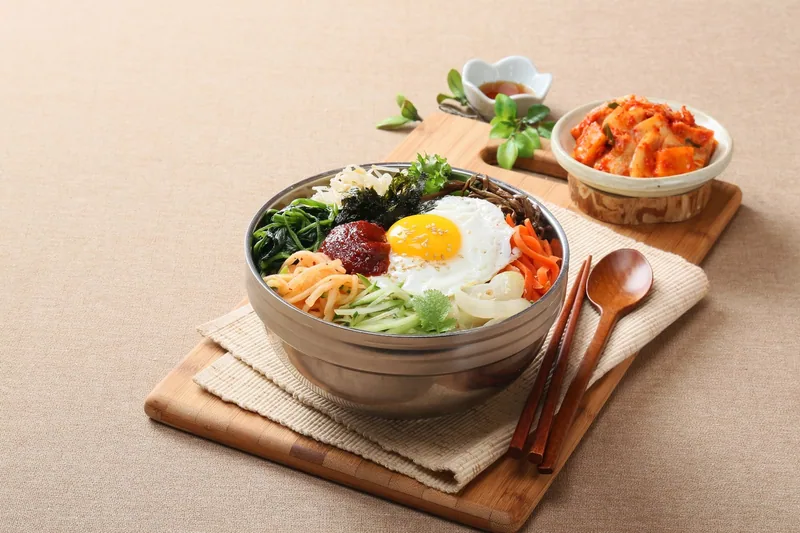
| Bibimbap | Rice topped with vegetables, meat and an egg, with chilli paste to stir through | The stone-bowl version keeps cooking at the table and gives you a crust of crisp rice |
| Bulgogi | Thin beef marinated in soy, pear and sesame, cooked quickly | The mildest thing on most menus |
| Samgyeopsal | Thick slices of unmarinated pork belly grilled at the table | The classic barbecue order; wrap in lettuce with garlic and paste |
| Galbi | Marinated short rib, grilled at the table | Richer and sweeter than pork belly |
| Kimchi jjigae | A bubbling stew of aged kimchi, pork and tofu | Sour, hot and salty. A winter dish |
| Sundubu jjigae | Soft tofu stew, usually with seafood, served furiously hot | Crack a raw egg into it at the table |
| Japchae | Sweet potato noodles stir-fried with vegetables and sesame oil | Served warm or cool; good for sharing |
| Tteokbokki | Chewy rice cylinders in a sweet chilli sauce | Street food. Much hotter than it looks |
| Korean fried chicken | Twice-fried and lacquered in soy and garlic or sweet chilli | Ordered by the portion to share, with beer |
How a table barbecue actually works
This is the meal most visitors come for and the one most likely to go wrong. The sequence is simple.
- You order raw meat by weight or by portion. Most restaurants set a minimum of two portions for a table.
- A grill in the centre of the table is lit, or a tray of hot coals is dropped into it.
- Staff either cook for you or leave you to it. If they leave you to it, they will still come and turn things when it matters.
- Meat is cut with scissors on the grill, not on your plate.
- You take a lettuce or perilla leaf, add a piece of meat, a smear of ssamjang paste, a sliver of raw garlic, and eat the parcel in one mouthful.
- Rice and a stew usually come at the end, not the beginning.
Book a barbecue table, and say that is what you want. Only some tables in a restaurant have grills, and they are the first to go. A booking made without specifying barbecue can land you at an ordinary table where the grill menu is unavailable. Friday and Saturday evenings in New Malden and Soho both need booking several days ahead.
You will smell of smoke afterwards. Extraction hoods help, but not enough for a jacket you care about. This is not a meal to have before a theatre performance, and our page on seeing a show in the West End would suggest the same in reverse.
Soju, beer and the drinking customs
Soju is a clear spirit, usually around 16 to 20 per cent, sold by the bottle and drunk in small glasses. Korean beer is light and designed to be drunk alongside it. The custom worth knowing is that you do not pour your own drink: you pour for the person next to you and they pour for you, holding the bottle with two hands when the other person is older.
Some Korean restaurants, particularly smaller ones in New Malden, are unlicensed. Ask when you book. Our guide to alcohol laws in London covers the licensing side, and British etiquette the local conventions you will meet everywhere else.
Non-drinkers are well served. Barley tea is poured free at most tables, and the fried chicken shops sell Korean soft drinks and makgeolli, a cloudy fermented rice drink, in a non-alcoholic form in some places. See drinking without alcohol.
Supermarkets, bakeries and taking things home
New Malden's Korean supermarkets are the reason many Londoners go there without eating out at all. Expect chilled kimchi in several strengths and ages, gochujang chilli paste in tubs, doenjang soybean paste, sesame oil, frozen dumplings, instant noodles by the shelf-metre and ready-marinated bulgogi from the butcher counter.
Korean bakeries sell a style of soft, sweet bread that owes something to Japan and nothing to France: cream buns, red bean buns, garlic and cream cheese bread, and sponge cakes covered in whipped cream and fruit. Our guide to bakeries and pastries in London puts them in context.
If you are self-catering, a bag from a Korean supermarket travels well and costs little. See apartments and short lets for where a kitchen is worth having.
Diets, allergies and heat
Most Korean dishes contain some combination of soy, sesame, wheat, fish and shellfish, and these are not always obvious. Kimchi is commonly made with salted shrimp or fish sauce, so it is not automatically vegetarian. Stocks are often built on dried anchovy. Ask.
Chilli heat varies more than the menu suggests. Tteokbokki and kimchi jjigae are genuinely hot, bulgogi and japchae are not, and restaurants will usually adjust for children if you ask. Our pages on vegan and vegetarian London and gluten-free eating cover what to check, and London with kids covers eating out with children.
Fitting it into a trip
A New Malden afternoon works well with anything else in south-west London. Trains from Waterloo continue to Wimbledon, and Hampton Court Palace is on a branch of the same network, so a palace in the morning and Korean food in the afternoon is an easy combination.
For other food worth a suburban journey, see our guides to Indian food in Southall, Tooting and Wembley and Japanese food and sushi. All three answer the same question: whether a train ride buys you better food than the centre can offer. In each case the answer is yes, if you go at lunchtime.
Frequently asked questions
Why is there a Korean community in New Malden?
Korean families began settling there in the 1970s, and the community grew because it was already established, which drew in more residents and more businesses. New Malden is now routinely described as the largest Korean community in Europe, with restaurants, supermarkets, bakeries and karaoke rooms on and around the High Street.
How do I get to New Malden from central London?
Take a South Western Railway train from London Waterloo. The journey is direct and takes 22 to 23 minutes, with several trains an hour. New Malden is in Zone 4, so Oyster and contactless are valid and the fare counts towards the Zones 1-4 daily cap of £12.80.
What are the small dishes on a Korean table?
They are called banchan: pickled and seasoned vegetables served with every meal, including kimchi and usually several others. They are part of the price rather than extras, most restaurants refill them free of charge, and they are eaten alongside the main dishes throughout the meal.
Do I need to book Korean barbecue in London?
Yes, and specify that you want a barbecue table. Only some tables in a restaurant have built-in grills, and those go first. Friday and Saturday evenings in both New Malden and the West End often need several days' notice, and many restaurants set a minimum of two meat portions per table.
Is Korean food very spicy?
Some of it. Kimchi stew and tteokbokki are genuinely hot, while bulgogi, galbi, japchae and most grilled meats are mild and slightly sweet. Chilli paste usually arrives on the side of bibimbap so you can control it yourself, and restaurants will make a dish milder for children if asked.
Sources
- National Rail Enquiries - journey planner, London Waterloo to New Malden (checked September 2026)
- Transport for London StopPoint data - New Malden station, fare Zone 4 (checked September 2026)
- Transport for London - Daily and weekly fare capping (checked September 2026)
- Food Standards Agency - Food allergy and intolerance advice for consumers (checked September 2026)
- Food Standards Agency - Food hygiene ratings search (checked September 2026)