
London's Italian food is best where it is oldest or simplest: the delis and church of Clerkenwell's Little Italy, the shop counters of Soho, and the pizzerias that do one thing with a wood oven. The expensive middle, a long menu of pasta at £20 a plate, is where most visitors lose money.
Italians have been in London for a long time. A community settled in Clerkenwell in the nineteenth century, working first as street traders, organ grinders and mosaic workers, later as ice cream makers and caterers. A second wave arrived after the Second World War and opened the coffee bars that changed how Londoners drank coffee. A third, much younger, arrived after 2008 and opened the bakeries and pasta counters that appeared across east London over the past decade.
Each wave left something you can still eat. This page covers where those things are, what to order, and how to avoid paying restaurant prices for a bowl of dried pasta with sauce.
Italian London at a glance
- Clerkenwell
- The historic Little Italy, around Clerkenwell Road and St Peter's Italian Church. Farringdon, Zone 1
- Soho
- Delis, coffee bars and fresh pasta shops on and around Brewer Street and Old Compton Street
- Pizza
- Wood-fired Neapolitan across east and south London; Roman-style pizza al taglio sold by weight in the centre
- Ice cream
- Gelaterie in Soho, Covent Garden and the neighbourhoods; look for covered tubs rather than piled-up mountains
- Best value
- A deli sandwich, a slice of pizza by weight, or fresh pasta bought raw and cooked at home
- The trap
- Tourist-street trattorie with laminated menus in five languages
Clerkenwell: what is left of Little Italy
The Italian quarter was centred on the streets between Clerkenwell Road, Farringdon Road and Rosebery Avenue. Most of the housing is gone, but the anchor remains: St Peter's Italian Church on Clerkenwell Road, built in the 1860s for the community, which still holds Italian-language services and is the starting point of the procession in honour of Our Lady of Mount Carmel each July. That procession has run for well over a century and is the one day a year when the old quarter looks like itself. Check the parish for the date, because it moves with the calendar.
Terroni of Clerkenwell, at 138 Clerkenwell Road, describes itself as London's oldest delicatessen and sits almost opposite the church. A deli of this kind is the best-value Italian food in central London: a sandwich made to order with proper mortadella or porchetta costs a fraction of a restaurant lunch, and the shelves behind carry the pasta, oil, anchovies and coffee worth taking home.
Our Clerkenwell neighbourhood guide covers the rest of the area, which is a short walk from the Postal Museum and from Exmouth Market.
A deli counter is a menu. Ask what came in that week, ask for a sandwich made with it, and ask them to add something you have not heard of. Italian shop assistants in London are, as a rule, delighted to be asked and slightly disappointed when they are not. This is also how to find out which cheeses and cured meats are actually good at that moment.
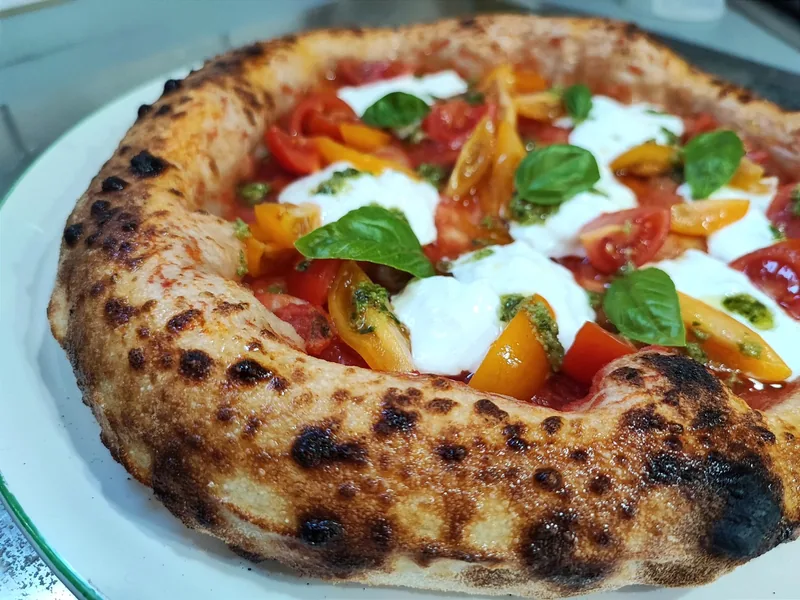
Photo: CDibisceglia · CC BY-SA 4.0 · Wikimedia Commons · resized
Soho: fresh pasta, coffee bars and shop counters
Soho's Italian shops are older than its restaurants and more reliable. Lina Stores has sold Italian groceries and fresh pasta from Brewer Street since 1944, and now runs restaurants on Greek Street, in King's Cross and on Marylebone Lane as well. Buying a bag of fresh tagliatelle and a tub of pesto from the deli counter costs very little and takes four minutes to cook.
The post-war coffee bars of Frith Street and Old Compton Street are the reason Londoners drink espresso at all, and one or two survive with the original fittings. Order standing at the bar, as Italians do, and you will pay less than for a seat. Our guide to coffee in London covers the modern scene, which owes more to Australia than to Italy.
Soho's Italian restaurants are a mixed field. The ones worth booking keep short menus and change them; the ones to avoid list forty pasta dishes and a carbonara with cream. See our Soho guide for the wider street, and Covent Garden next door, where the pressure of passing trade is stronger and the quality more uneven.
Pizza: the two traditions, and how to tell them apart
| Style | What it looks like | How it is sold |
|---|---|---|
| Neapolitan | Soft, wet in the middle, puffed and blistered at the rim, cooked in under two minutes in a very hot wood oven | Whole, one per person, eaten with a knife and fork or folded |
| Roman al taglio | Rectangular, thin and crisp, baked in trays | Cut with scissors and sold by weight. You point at the length you want |
| Roman tonda | Round and cracker-thin all the way to the edge | Whole |
| British high-street pizza | Thicker, drier, baked in a conveyor oven | Whole, usually with a long list of toppings |
Neapolitan pizzerias cluster in east and south London: Hackney, Peckham, Bermondsey, Brixton. A queue outside one on a Friday evening is a real signal, because most take no bookings and the ovens limit how many pizzas can be made an hour. Al taglio counters are a central London lunch: pick two or three slices, ask for them reheated, and pay by weight.
Our guide to London's food markets covers several of the arches and market units where these ovens ended up, and Borough and Bermondsey covers the railway arches south of the river.
How not to pay £20 for a bowl of pasta
Dried pasta with a simple sauce costs a restaurant very little. The price on the menu reflects rent, staff and location, not ingredients, and there is nothing wrong with paying it in a good restaurant. There is something wrong with paying it in a bad one. Four tests, in order of usefulness:
- Length of menu. Fifteen dishes suggests a kitchen cooking. Sixty suggests a freezer.
- Regionality. A menu that says where a dish comes from usually means somebody chose it. A menu covering every region at once usually means nobody did.
- Who is eating. At 20:00 on a Tuesday, are there people who look like regulars?
- The bread and the water. Charged for, or free? Neither is wrong, but a cover charge you did not expect changes the maths on a cheap main course.
The cheaper alternatives are genuinely good. A deli sandwich, a slice of al taglio, a plate of fresh pasta cooked at home, or a lunchtime set menu will all feed you better for less. See our page about eating cheaply in the city, and for the opposite end, Michelin-starred restaurants, several of which are Italian and most of which serve a much cheaper lunch.
Buy the pasta, do not order it. A bag of fresh filled pasta from a Soho or Clerkenwell deli, a piece of parmesan and a bottle of oil will cost less than one restaurant main course and feed two people twice. If your accommodation has any kind of kitchen, this is the single best-value meal in central London. See our guide to aparthotels and serviced apartments for where that is possible.
Coffee, gelato and the sweet end
Italian coffee in London means a short, strong espresso at a bar, a cappuccino before eleven in the morning and not after, and a macchiato at any time. Nobody will refuse to sell you a cappuccino at four in the afternoon, but you will notice the pause.
For gelato, the rule is simple: avoid shops where the ice cream is piled into coloured peaks above the rim of the tub. Air and stabiliser hold that shape. Good gelato is kept covered, in flat metal containers, in muted colours, and pistachio should look dull green rather than bright.
Pasticceria is the third pleasure: cannoli filled to order rather than in advance, sfogliatelle, and at Christmas the panettone that London bakeries now make in serious quantity. See bakeries and pastries in London and, for the seasonal version, Christmas in London.
Wine, aperitivo and where to drink it
Aperitivo is a drink before dinner with something to eat alongside, and a growing number of London bars now do it properly, with a negroni or an Aperol spritz and a plate of olives and crisps rather than a full meal. It is an inexpensive way to spend an early evening and it suits British opening hours better than a late Italian dinner does.
Italian wine bars, enoteche, sell by the glass from a long list and are one of the better places in London to drink something unfamiliar without committing to a bottle. Our guide to wine bars in London covers the options.
Vegetarians, allergies and children
Italian food suits vegetarians well, but parmesan is made with animal rennet and appears in a great many dishes, so ask if that matters. Egg is in fresh pasta; dried pasta is usually just flour and water. Pizza dough contains wheat, and gluten-free bases are common but rarely made in a separate oven. See vegan and vegetarian London and gluten-free eating.
For families, Italian restaurants are the easiest cuisine in London: children are welcome, portions can be halved, and nobody minds noise. Our guide to London with kids covers eating out with children in more detail.
For other European food with a long London history, see Greek and Cypriot food and Polish and Eastern European food.
Frequently asked questions
Where was London's Little Italy?
In Clerkenwell, in the streets between Clerkenwell Road, Farringdon Road and Rosebery Avenue. Most of the housing has gone, but St Peter's Italian Church on Clerkenwell Road remains the centre of the community and holds a procession each July in honour of Our Lady of Mount Carmel.
Where can I buy fresh pasta in central London?
The Italian delicatessens in Soho and Clerkenwell sell it by weight, along with sauces, cheese and cured meats. Lina Stores has sold fresh pasta from Brewer Street in Soho since 1944, and Terroni on Clerkenwell Road is a long-established deli in the old Italian quarter. Both are shops as well as restaurants.
What is the difference between Neapolitan and Roman pizza?
Neapolitan pizza is round, soft and slightly wet in the middle, with a puffed, blistered rim, baked for under two minutes in a very hot wood oven. Roman pizza al taglio is rectangular, thin and crisp, baked in trays and sold by weight, cut with scissors. Roman tonda is round and cracker-thin throughout.
How do I avoid a bad Italian restaurant in London?
Look at the length of the menu and whether it names regions. A short, seasonal menu is a good sign; sixty dishes covering the whole country is not. Check whether local people are eating there on a weekday evening, and read the small print on cover charges and service before you sit down.
How can I tell good gelato from bad?
Good gelato is stored covered in flat metal tubs, in colours that look muted rather than bright. Ice cream piled into tall coloured peaks above the rim is holding that shape because of air and stabilisers. Pistachio is the easiest test: it should be a dull khaki green, not vivid.
Sources
- Terroni of Clerkenwell, 138 Clerkenwell Road - delicatessen website (checked September 2026)
- Lina Stores - Soho delicatessen and restaurant locations (checked September 2026)
- Food Standards Agency - Food allergy and intolerance advice for consumers (checked September 2026)
- Food Standards Agency - Food hygiene ratings search (checked September 2026)
- GOV.UK - Tips at work: service charges and gratuities (checked September 2026)