
London is 60 miles from the open sea, yet it has eaten seafood seriously for centuries, because everything came up the Thames. Today the fish arrives by lorry overnight, the wholesale market opens at four in the morning, and you can eat a dozen oysters for £12 or for £60 depending entirely on where you sit down.
The city's seafood has three separate traditions. There are the Victorian and Edwardian fish restaurants, with white tablecloths, Dover sole and a crustacean counter. There are the oyster bars, which used to be working-class food and became expensive some time in the twentieth century. And there is the market trade, still centred on Billingsgate, which is where every fishmonger and half the restaurants in London buy.
Fried fish is a separate subject with its own rules, and our guide to fish and chips in London covers it. This page is about everything else: raw, grilled, steamed and shelled.
Seafood in London at a glance
- Cheapest oysters
- £1 each at Wright Brothers during set hours (see below), September 2026
- Retail benchmark
- 12 Jersey oysters £21, 12 Carlingford £23 delivered (Wright Brothers, September 2026)
- Wholesale market
- Billingsgate, Tuesday to Saturday 04:00–08:30, open to the public
- Oldest fish restaurants
- Bentley's, Mayfair, trading since 1916; J Sheekey, St Martin's Court, since 1896
- Typical main course
- Grilled fish £24–£40 in a central-London fish restaurant
- Best day for a market visit
- Saturday, when there is no wholesale rush and traders will sell small amounts
Billingsgate: the market that is about to move
Billingsgate is the United Kingdom's largest inland fish market. It stood beside the Thames in the City for centuries, moved to a shed on the north edge of the Isle of Dogs in 1982, and is now on borrowed time: the City of London Corporation has confirmed that traders will stay at the present site until at least 2028, with Albert Island in the Royal Docks named in December 2025 as the preferred new location for what would become New Billingsgate Market.
Until then you can still go. The market trades Tuesday to Saturday from 04:00 to 08:30 and is open to the general public, not only to trade buyers. The nearest stations are Poplar and Blackwall on the DLR, both about five minutes' walk, or Canary Wharf on the Jubilee line, about ten.
The Corporation's own visitor rules matter more than they sound. Children under 12 are not allowed on the market floor. Items with wheels, including suitcases, trolleys and folding carts, are not permitted. Non-slip footwear is advised, because the floor is wet and being hosed for most of the morning.
Go to Billingsgate at the end of trading, not the start. Between 04:00 and about 06:00 the merchants are selling boxes to restaurants and will not be interested in one sea bass. From roughly 06:30 the pace drops and traders are far more willing to break a box and sell you a couple of fillets. Take cash as well as a card, and take a cool bag.
The market sits at the northern edge of the area covered in our guide to the Isle of Dogs, and the towers in the background belong to Canary Wharf. The DLR runs from about 05:30, which is early enough for a 06:30 arrival from central London.
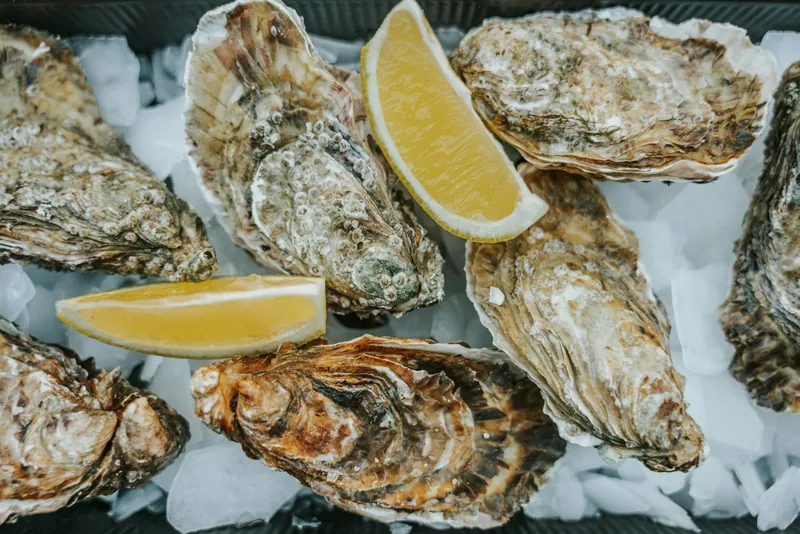
Oysters: what you are choosing between
Two kinds of oyster are sold in Britain and they taste and cost quite differently.
Native oysters (the flat, round ones, often sold as Colchester, Mersea, Lindisfarne or Whitstable) are the original British oyster. They are slower-growing, more metallic and more expensive, and they are a winter product. This is where the old rule about only eating oysters in months with an "r" in the name comes from: natives spawn in the warm months and are not at their best then.
Rock oysters (the long, ridged, teardrop-shaped ones, usually from Jersey, Ireland, Scotland or Cornwall) are farmed, available all year, milder and cheaper. Almost every £1 oyster deal in London is a rock oyster.
For a sense of scale, Wright Brothers' own retail prices in September 2026 were £21 for twelve Jersey oysters and £23 for twelve Carlingford, delivered. In a restaurant the same dozen typically costs two to three times that, which is what you are paying for shucking, ice, mignonette and a chair.
Where to eat oysters cheaply
The single most useful thing to know about London oysters is that several restaurants run a fixed-price oyster hour. Wright Brothers, which began as a Borough Market oyster company, publishes the times for its £1 oyster offer on its own website:
| Branch | £1 oyster times (September 2026) | Address |
|---|---|---|
| Borough Market | Monday to Wednesday, 15:00–18:00 | 11 Stoney Street, SE1 9AD |
| Battersea Power Station | Monday to Friday 15:00–18:00; Sunday 18:00–21:00 | 26 Circus West Village, SW11 8EZ |
| South Kensington | Monday to Friday 12:00–18:00; Sunday 16:00–18:00 | 56 Old Brompton Road, SW7 3DY |
| The Mermaid (basement bar, South Kensington) | Thursday to Saturday, 18:00–19:00 | as above |
Bank holidays, Good Friday and Easter Monday are excluded, and the company recommends booking a table because the offer is popular. Two people can eat a dozen oysters between them for £12 plus drinks, which is the cheapest oyster in central London by some distance. The Battersea branch is a few minutes from the power station, covered in our guide to Battersea and Nine Elms; the Old Brompton Road one is in South Kensington.
Other restaurants run similar offers at quiet hours. The pattern is always the same: mid-afternoon on weekdays, early on Sunday evening, never at 20:00 on Saturday.
The old fish restaurants, and what they cost
Bentley's Oyster Bar & Grill on Swallow Street has been shucking oysters in Mayfair since 1916. It has two halves: a ground-floor oyster bar with counter seats, where you can eat a plate of shellfish and a glass of wine without committing to a meal, and a more formal grill upstairs. Sitting at the counter is both cheaper and more entertaining.
J Sheekey, at 28–32 St Martin's Court, has been feeding theatre audiences since 1896 and keeps a crustacean bar down the middle of the room. It is open Monday to Saturday 12:00 to 23:00, with the last seating at 22:45, and Sunday 12:00 to 21:00. Its location, in an alley between Charing Cross Road and St Martin's Lane, makes it the obvious place to eat after a show; our guide to Leicester Square and Theatreland explains the geography.
Sweetings, at 39 Queen Victoria Street in the City, is the oddest survivor: a narrow Victorian fish restaurant that serves lunch only on weekdays, does not take bookings and seats most customers at a counter. Turn up early or expect to wait. Check its current hours before you go, because they are short and they change.
In all of these, a main course of grilled fish typically runs between £24 and £40, and the crustacean platters are considerably more. A discretionary service charge, often around 12.5 per cent, is usually added in London restaurants; it is optional, and our page on tipping in London explains the rules.
Beyond the white tablecloth
London's best seafood is not always in a fish restaurant. Three other routes are worth knowing.
Market counters. Several stalls at Borough Market sell cooked shellfish to eat standing up, which is the cheapest way to try scallops, crab or prawns without a restaurant bill.
Japanese restaurants. Some of the best raw fish in London is served as sushi and sashimi rather than on a seafood platter. Our guide to Japanese food and sushi in London covers the range, from conveyor belts to counters where the chef decides.
Pubs and wine bars. A growing number of small wine bars serve oysters, tinned fish and crab toast as bar snacks. See our guide to wine bars in London, and for the British classics such as potted shrimp and jellied eels, traditional British food.
Seaside seafood within a day return
If you want to eat oysters where they are grown, Whitstable in Kent is about 90 minutes from St Pancras or Victoria and has been an oyster town since Roman times, with an oyster festival in July. Our guide to a day trip to Whitstable has the trains and the practicalities.
The Essex side of the estuary grows the other famous native, from Mersea Island and the Colne, and most of those oysters end up in London restaurants within a day of being lifted.
Eating shellfish safely
Raw shellfish carries a small but real risk of food poisoning, which is why the NHS advises pregnant women to avoid raw oysters and other raw shellfish. People with liver disease or a weakened immune system are also usually advised against them. Cooked shellfish does not carry the same risk.
Shellfish is one of the 14 allergens that UK food businesses must be able to tell you about, and crustaceans and molluscs are listed separately: someone who reacts to prawns may be fine with mussels, and the other way round. Ask rather than assume, and be specific about which you mean.
A practical test at the counter: oysters should be closed and heavy, and should smell of the sea and nothing else. If a shucked oyster smells of anything sharp or sour, send it back. In a good oyster bar nobody will argue.
Frequently asked questions
Can anyone visit Billingsgate Fish Market?
Yes. The City of London Corporation states that the market is open to the general public. It trades Tuesday to Saturday from 04:00 to 08:30. Children under 12 are not allowed on the market floor, wheeled trolleys and suitcases are banned, and non-slip footwear is advised because the floor is wet.
Where can I eat cheap oysters in London?
Wright Brothers sells oysters at £1 each during fixed hours at its Borough Market, Battersea Power Station and South Kensington branches, and in The Mermaid bar. The times differ by branch and exclude bank holidays, Good Friday and Easter Monday, so check the current times and book a table.
Is it safe to eat oysters in London in summer?
Farmed rock oysters are sold and eaten all year round in London and are handled under the same food-safety rules in July as in January. The old advice about months with an "r" applies to native oysters, which spawn in summer and are not at their best then. The NHS advises pregnant women to avoid raw shellfish at any time of year.
What is the difference between native and rock oysters?
Natives are flat and round, slower-growing, stronger in flavour and a winter product; they cost more. Rock oysters are long and ridged, farmed, available all year and milder. Restaurants usually list both, with the native ones at the top of the price range.
Is Billingsgate market closing?
Not immediately. The City of London Corporation has said traders will remain at the present site until at least 2028, and in December 2025 named Albert Island in the Royal Docks as the preferred location for a combined New Smithfield and New Billingsgate. The move still needs legislation and planning permission.
Sources
- City of London Corporation - Find Billingsgate Market (trading hours and stations) (checked September 2026)
- City of London Corporation - Billingsgate Market visits and rules (checked September 2026)
- City of London Corporation - The future of Smithfield and Billingsgate Markets (checked September 2026)
- Wright Brothers - £1 oyster times by branch (checked September 2026)
- Wright Brothers - retail oyster prices (checked September 2026)
- J Sheekey - opening hours and address (checked September 2026)
- Bentley's Oyster Bar & Grill - about the restaurant (checked September 2026)
- NHS - foods to avoid in pregnancy (checked September 2026)