
Clapham is a residential district of south-west London built around one large common, about four miles south of Westminster. Its visitor interest is not a single attraction but three stories in a small area: a wartime shelter deep under the Common that briefly housed men from the Empire Windrush in 1948, the church where the anti-slavery campaigners of the Clapham Sect worshipped, and a famous railway junction that is not actually in Clapham at all.
Most people who come here are visiting friends, staying in a cheaper hotel south of the river, or changing trains. That is fine: Clapham rewards an afternoon on foot, and almost everything below lies within a twenty-minute walk of Clapham Common Tube station. The grass itself, the ponds and the paddling pool are covered on our page about Clapham Common and Brockwell Park. This page is about the streets, the buildings and the history around and beneath it.
Clapham at a glance
- Where
- South-west London, SW4; the Common is shared between the boroughs of Lambeth and Wandsworth
- Tube
- Clapham North, Clapham Common and Clapham South, all on the Northern line
- Overground
- Clapham High Street (Windrush line)
- Clapham Junction
- A separate main-line station on St John's Hill, SW11, in Battersea, about 1.5 miles west of Clapham Common station
- The deep shelter
- Only by pre-booked guided tour (London Transport Museum's Hidden London programme); dates and prices on the museum's site
- Time needed
- Two to three hours on foot for the Common, the Old Town and the church
Clapham Junction is in Battersea, and it matters for your hotel
The single most useful fact about Clapham is that its best-known name belongs to somewhere else. Clapham Junction station stands on St John's Hill in Battersea, in the London Borough of Wandsworth, with an SW11 postcode. The railway company that opened it in the 1860s named it after the better-known village to the east, and the name stuck. From the station to Clapham Common Tube station is about a thirty-minute walk, or a short bus ride.
This catches people out when they book accommodation. A hotel described as "Clapham" may be near the Common, on the Northern line, or near the Junction, on the main-line railway. Both are good bases, but they are different journeys: the Junction gives you fast trains to Victoria and Waterloo and direct trains to Gatwick, while Clapham Common gives you the Northern line straight to the West End and the City. Check the postcode before you pay.
For the Junction itself and the streets around it, see our guide to Battersea and Nine Elms. If you are using it as a stepping stone to the airport, our page on getting between Gatwick and central London explains which trains stop there.
SW4 is Clapham; SW11 is the Junction. When a booking site says "Clapham", look at the postcode. SW4 puts you near the Common and the Northern line. SW11 puts you in Battersea beside Clapham Junction station, which is a different, if equally convenient, part of town.
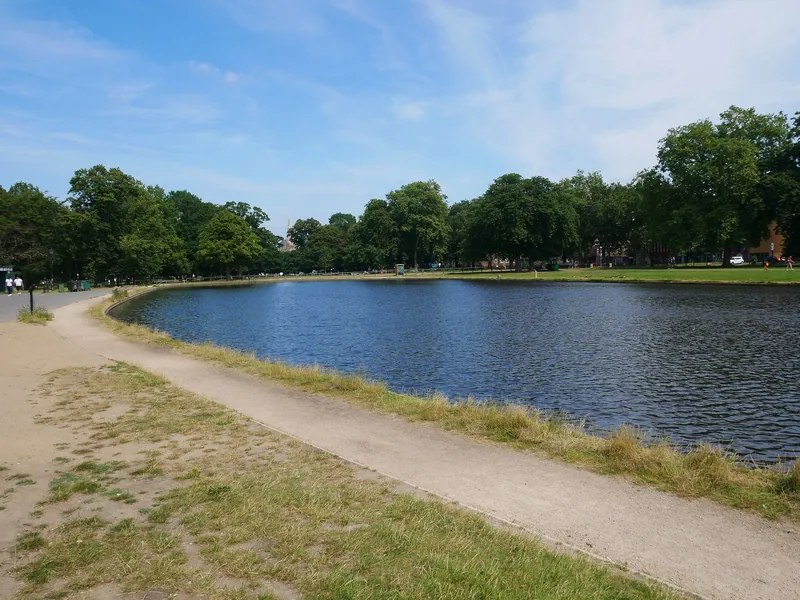
Photo: Doyle of London · CC BY-SA 4.0 · Wikimedia Commons · resized
Eight thousand bunks under Clapham Common
Beneath the southern end of the Common, below Clapham South station, run two parallel tunnels each about 1,400 feet long. They are one of eight deep-level shelters the government built in 1940 to 1942, designed so that they could later become part of an express Tube line. That line was never built. The Historic England list entry, which protects the shelter at Grade II, describes the tunnels as divided into sections named after naval commanders, each with its own canteen and lavatories, and calls Clapham South "the most complete surviving and atmospheric" of the deep shelters, because some of its 1940s iron bunks, painted signs and graffiti are still there.
Subterranea Britannica, the society that records underground sites, counts 7,952 bunks in the shelter, arranged in tiers along the curved walls. The shelter was opened to the public during the flying-bomb and rocket raids of 1944 and closed in 1945. On the surface you can still see its two entrance buildings: round concrete drums with brick additions, one at the corner of Clapham Common South Side and The Avenue, and one near Balham Hill. They look like oversized pillboxes and are easy to walk past without noticing. Our page on London's lost tunnels explains how they fit with the other deep shelters along the Northern line.
June 1948: where the Windrush passengers slept
The shelter's most important chapter came after the war. When the Empire Windrush docked at Tilbury on 22 June 1948, most of its passengers from the Caribbean had somewhere to go. More than two hundred did not, and the Colonial Office housed them in the Clapham South shelter, which was empty and had beds. Sources give the number housed at between about 230 and 240 men; we have not found an official figure and give none here.
The nearest labour exchange was on Coldharbour Lane in Brixton, a walk of under two miles. The men went there to look for work, found lodgings nearby, and so Brixton became the centre of Caribbean London. When Lambeth Council ran a Windrush 75 walking tour in 2023, it started from Windrush Square in Brixton for exactly this reason. The shelter period itself was short: the men found jobs and rooms within weeks.
The deep shelter stayed in use for odd purposes for years afterwards. In 1951 it reopened as a cheap hostel for visitors to the Festival of Britain, and it later became a document store. To follow the story on the ground, take one of the buses that run east along Acre Lane to Brixton, or ride the Windrush line, the Overground route named in 2024 in honour of the same generation, which stops at Clapham High Street.
Going down: the Hidden London tours
The only way into the shelter is a guided tour run by London Transport Museum under its Hidden London name. Tours are pre-booked, open only to people aged 10 and over, run on selected dates rather than every week, and sell out. The museum's website blocks our checking tools, so we cannot print this season's dates or price; look them up on the London Transport Museum site before you plan a day around one.
Be ready for stairs. Subterranea Britannica records 192 steps between the surface and the tunnels, and the original lifts no longer run. Our page on Hidden London tours compares this site with the museum's other disused stations and shelters.
The shelter has no lift for visitors. Access is by a long spiral staircase in one of the entrance drums, which you also climb to get out. If stairs are a problem, the surface entrances and the Common above are the part of this story you can see.
Holy Trinity and the Clapham Sect
On the north side of the Common, set back among the trees, stands Holy Trinity Clapham, a plain brick church with a small domed bell turret. It opened for worship in 1776, and the parish marked its 250th anniversary in 2026. Historic England lists it at Grade II*: the architect was Kenton Couse, the Doric porch across the west end was added in 1812, and the chancel at the east end dates from 1902 to 1903.
The church is famous for a group of its parishioners. William Wilberforce and a circle of wealthy evangelical friends lived around the Common in the late 18th and early 19th centuries and worshipped here. Later writers named them the Clapham Sect. They campaigned for the abolition of the British slave trade, which Parliament passed in 1807, and then of slavery itself in most of the British Empire, passed in 1833. Part of the church is now the William Wilberforce Centre.
Holy Trinity is a working parish church with a large congregation, not a museum. Sunday services are open to anyone; at other times, check the church's own website before travelling specially. For the other side of the same history, the trade itself and the money it made in London, the London Museum Docklands has a permanent gallery on it.
The Old Town and the north side of the Common
The oldest part of Clapham is the Old Town, a small triangle of streets just north-east of the Common beside the church. Several of the houses on Clapham Common North Side and in the Old Town are Georgian and listed, including a terrace of large brick houses at numbers 12 to 21 that Historic England grades II*. They survive from the village where City merchants built country houses in the 18th century, which is why the Clapham Sect lived here.
The Old Town is also the end of bus route 88, which runs from Parliament Hill in north London through the West End and over the river. It stands outside the Omnibus building, the former library, whose forecourt holds a Roman altar stone; our route 88 guide describes the ride.
A bandstand from South Kensington
The large cast-iron bandstand in the middle of the Common is older than it looks. Historic England's list entry dates it to 1861, designed by Captain Francis Fowke for the Royal Horticultural Society's garden in South Kensington, and re-erected here in 1890 when that garden was cleared. So the "1890 bandstand" you will read about elsewhere is the date it arrived, not the date it was made. Concerts are held on it in summer.
Of the Common's three ponds, Lambeth keeps one for model boating, and on a Sunday morning you may see radio-controlled yachts on it. Lambeth Council runs the whole Common, although more than half of it is in Wandsworth; our page on the Common itself explains how it came into public hands.
Clapham High Street, Northcote Road and eating out
Clapham's eating and drinking is spread along three strips. Clapham High Street, between Clapham North and Clapham Common stations, is the busiest, with chains and bars that fill up at weekends. The Old Town is calmer. Northcote Road, south of Clapham Junction, is technically in Battersea but is what many Londoners mean by "Clapham" when they talk about weekend brunch.
We do not recommend individual restaurants on this page. If you choose one, look it up on the Food Standards Agency's hygiene register first, by name and postcode. For the bigger south London food scene a stop to the east, see where to eat in Brixton.
Getting there and getting around
Three Northern line stations serve the area. Clapham North is best for the High Street, Clapham Common for the Old Town and Holy Trinity, and Clapham South for the deep shelter entrances and the southern half of the Common. All three are south of Kennington, where the line's two central branches rejoin, so trains through both the West End and the City reach them without a change; our Northern line guide explains the two branches. TfL's station data records no lifts at Clapham North or Clapham Common, and their platforms are narrow islands with trains on both sides, which feel cramped in the rush hour.
Clapham High Street station, on the Overground, is a few minutes' walk from Clapham North and links Clapham with Peckham and Shoreditch without going through the centre. Clapham Common and Clapham North are in Zone 2.
Is Clapham worth a visit?
As a destination in its own right, only if one of its stories interests you. A Hidden London tour of the shelter is the best reason to come, and the walk from Clapham South across the Common to Holy Trinity and the Old Town fills the rest of an afternoon. For a green space alone, the Common is pleasant but not unique; Balham to the south is similar. As a base, Clapham is well connected and residential, but not a place for sightseeing on foot.
Frequently asked questions
Is Clapham Junction in Clapham?
No. Clapham Junction station is in Battersea, on St John's Hill, in the London Borough of Wandsworth, with an SW11 postcode. It took the name of the better-known village to the east. Clapham itself, around Clapham Common, is about a thirty-minute walk away.
Can you visit the Clapham South deep shelter?
Yes, but only on a pre-booked guided tour run by London Transport Museum's Hidden London programme. Tours run on selected dates and often sell out. There are about 192 steps down and back up, and no lift for visitors.
Why were Windrush passengers housed under Clapham Common?
In June 1948 several hundred men from the Empire Windrush had nowhere to stay, and the Colonial Office used the empty wartime shelter at Clapham South. The nearest labour exchange was on Coldharbour Lane in Brixton, which is why many settled there.
What was the Clapham Sect?
It was the name later given to a group of evangelical Anglicans, including William Wilberforce, who lived around Clapham Common and worshipped at Holy Trinity church. They campaigned for the abolition of the British slave trade, achieved in 1807, and of slavery in most of the Empire, passed in 1833.
Which Tube station is best for Clapham Common?
Clapham Common station, on the Northern line, comes up at the north-east corner of the Common, near the Old Town and Holy Trinity. Clapham South is better for the southern half of the Common and the deep shelter entrances.
Sources
- Historic England - Clapham South Deep Tube Shelter and Surface Building at Lambeth Entrance, list entry 1385901 (checked November 2026)
- Historic England - Church of Holy Trinity, Clapham Common North Side, list entry 1080491 (checked November 2026)
- Historic England - Bandstand, Clapham Common, list entry 1357657 (checked November 2026)
- Subterranea Britannica - Clapham South deep shelter (checked November 2026)
- Lambeth Council - Clapham Common (checked November 2026)
- Lambeth Council - Windrush 75: A Lambeth Story tour (checked November 2026)
- Holy Trinity Clapham - History (checked November 2026)
- National Rail - Clapham Junction station (checked November 2026)