
Route 88 runs from Parliament Hill Fields, at the top of Hampstead Heath, to Clapham Old Town, and it is the only London bus that links three national art collections in one ride: the National Gallery and the National Portrait Gallery at Trafalgar Square, and Tate Britain on Millbank. It is 49 stops each way, about 80 minutes scheduled, and it runs in every hour of the day and night, seven days a week.
The northern terminus is Parliament Hill Fields, not Camden. Camden Town is about a third of the way down. That matters because the 88 is the route to use if galleries are the point of your day: you can start on the Heath, cross Kentish Town and Camden, run down Albany Street past Regent's Park, come through Oxford Circus and Piccadilly Circus, stop at Trafalgar Square, carry on down Whitehall past Horse Guards to Westminster Abbey, and get off outside Tate Britain, all on one tap. Our round-up of bus routes worth riding for the view covers the six best-known sightseeing routes and does not include this one, which is an omission we are correcting here. If you have not used a London bus before, how paying and boarding work comes first: one tap on the way in, nothing on the way out, and no cash.
Route 88 in numbers (September 2026)
- Termini
- Parliament Hill Fields (NW5) and Clapham Old Town / Omnibus (SW4). Northbound journeys begin one stop earlier, at Wingate Square
- Stops
- 49 in each direction
- Hours
- 24 hours, every day. First southbound departure 00:00 or 00:01, last 23:48 or 23:49
- Frequency
- Six or seven an hour from 06:00 to 20:00, five in the late evening, two an hour between 01:00 and 05:00
- Scheduled running time
- 79 minutes, Parliament Hill Fields to Clapham Old Town
- Measured running time
- 50 minutes at 03:45, 92 minutes at 08:37, 96 minutes at 16:06
- Night service
- There is no N88. The 88 itself is the night bus
- Fare
- £1.85 flat; daily bus cap £5.55
Both ends are somewhere slightly different from the name
At the north end the stand is on Highgate Road at Parliament Hill Fields, a couple of minutes from the Heath's southern gates and five from the ponds. It is not Hampstead village and not Highgate; it is the flat, unglamorous edge of Hampstead Heath where the running track and the lido are. Gospel Oak station is a short walk away, and Kentish Town is the next proper high street south.
At the south end the picture is untidier. Southbound buses terminate at Clapham Old Town, outside the Omnibus. Northbound journeys, though, start at Wingate Square, a residential street a few hundred metres west, and then run back through Clapham Old Town. If you are catching the 88 north from Clapham you want a stop on the main road, not the terminating stand, and the app will tell you which. The bus then crosses Clapham Common along the north side.
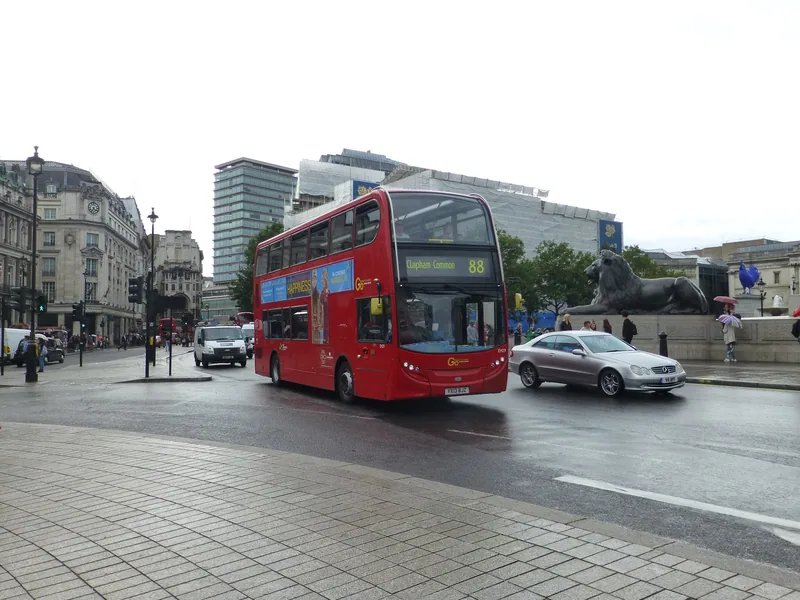
Photo: Leif Jørgensen · CC BY-SA 4.0 · Wikimedia Commons · resized
The galleries, in the order the bus passes them
Travelling south, the run that earns this route its nickname begins at Oxford Circus. From there it is Regent Street, Piccadilly Circus, Haymarket and Trafalgar Square, where the stop puts you at the foot of the steps below the National Gallery; the National Portrait Gallery entrance is thirty seconds further, round the corner on Charing Cross Road. Both are free.
Then Whitehall, with Horse Guards Parade on the right and the whole ceremonial set piece described in our guide to Horse Guards and Whitehall. The bus stops at Westminster station on Parliament Square, then at Westminster Abbey, then turns down Horseferry Road and Page Street into Millbank, where the Tate Britain stop is directly outside the portico.
Tate Britain is listed Grade II*: the original 1897 building is by Sidney R J Smith, the Duveen Galleries by John Russell Pope opened in 1937, and the Clore Gallery that holds the Turner collection was added by James Stirling in 1984 and 1985. One detail almost nobody registers, because it is on the lawn rather than inside: the bronze in front of the gallery is Henry Moore's Two Piece Reclining Figure No 1 of 1959, listed in its own right at Grade II in January 2019. It is about a metre high on a metre-high concrete pedestal, and you can see it from the top deck.
Three national collections, one £1.85 fare, and no admission charges. The National Gallery, the National Portrait Gallery and Tate Britain are all free to enter and all within two stops of each other on the 88. A couple can do the lot for £3.70 in bus fares.
It runs all night, every night, and there is no N88
The 88 is a full 24-hour route rather than a day route with a night replacement, and this is the fact that makes it useful beyond sightseeing. Transport for London's timetable for the Parliament Hill Fields stand lists departures in all 24 hours on Monday to Thursday, on Friday, on Saturday and on Sunday. The first southbound bus goes at midnight or one minute past; the last at about 23:48. The northbound timetable from Wingate Square matches it hour for hour.
Counted out of that timetable, the overnight service is two buses an hour from 01:00 to 05:00 and four in the hour after midnight. A half-hour wait is the worst case at any point in the night, which for a route also running six or seven buses an hour by day is generous. Because there is no N-prefixed version, nothing on the front of the bus tells you it is a night service; it is simply the 88, at the same flat fare. Our guide to London's night buses covers the N-prefixed network around it.
How long it takes, by the hour
We put thirteen southbound departures from Parliament Hill Fields to Clapham Old Town through Transport for London's Journey Planner for a Wednesday in late September 2026.
| Departure | Parliament Hill Fields to Clapham Old Town |
|---|---|
| 03:45 | 50 minutes |
| 06:10 | 55 minutes |
| 07:36 | 84 minutes |
| 08:37 | 92 minutes |
| 10:07 | 92 minutes |
| 11:37 | 94 minutes |
| 13:07 | 94 minutes |
| 14:37 | 95 minutes |
| 16:06 | 96 minutes |
| 17:37 | 93 minutes |
| 19:08 | 81 minutes |
| 21:01 | 73 minutes |
| 23:01 | 64 minutes |
The pattern is not the one most people expect. The slowest hour is the middle of the afternoon, not the evening rush, and the morning peak is eight to twelve minutes quicker than the middle of the day. TfL's published speed figures agree: across the five four-week periods from 1 April to 21 August 2026 the 88 averaged 6.62 to 6.73 miles an hour over all hours, and 6.36 to 6.57 in the weekday morning peak, so the gap between the two is small and the mid-afternoon is what drags the all-day figure down. Allow an hour and a half for the full length in daylight and an hour after nine in the evening.
You will not save time going south in the evening rush. The 17:37 from Parliament Hill Fields was three minutes quicker than the 16:06. If you want the fast version of this ride, take it after nine at night or before six in the morning.
Cumberland Terrace, which is the one thing to look up for
Between Camden Town and Great Portland Street the 88 runs the length of Albany Street and Chester Gate along the eastern edge of Regent's Park, and this is the most architecturally serious stretch of the whole route. On the west side stands Cumberland Terrace, numbers 1 to 59, listed Grade I. Historic England dates it to about 1827 and gives the architects as John Nash and James Thomson, working for the Commissioners of Woods, Forests and Land Revenues; it was built by J G Bubb, the triumphal arches through it by W M Nurse. It is a stucco palace front roughly 240 metres long, in three blocks joined by those arches, with a giant Ionic portico in the middle. There is a bus stop called Cumberland Terrace, and the 88 is the only bus route that uses it.
Two stops earlier, northbound only, the route passes Prince Albert Road at London Zoo; southbound it does not. And at the top of the route, opposite the Kentish Town station stop on Highgate Road, the building with the Egyptian-style faience front is the Forum, a cinema of 1934 by J Stanley Beard and W R Bennett, listed Grade II in May 1990 and now a concert hall. Our guide to the music venues of Camden and Kentish Town covers what happens inside it, and Kentish Town and Archway the street it stands on.
A Roman altar at the southern terminus
The last stop is called Clapham Old Town / Omnibus, after the building the bus stands outside: the former Clapham Library at 1 Clapham Common North Side, now a theatre. The library building is not listed. The object in its forecourt is.
It is an inscribed Roman altar stone, dug up during building work on Clapham Common South Side in 1912 and listed at Grade II on 27 March 1981. The list entry says it was erected by Vitus Ticinius Ascanius and is probably first century. It stands in the open, three miles from the Roman city, unexplained by any sign. Behind it, on the Common, Holy Trinity Clapham has been listed Grade II* since July 1955: it is the church of the Clapham Sect, the group of Anglican reformers who campaigned against the slave trade from these few streets.
Stop letters, and where to sit
London bus stops carry a letter on the flag, and on a route that crosses itself at Oxford Circus and Camden the letter is what keeps you going the right way. Southbound the ones worth knowing are Parliament Hill Fields stop GK, Kentish Town Station stop KB, Camden Town Station / Camden Street stop R, Oxford Circus Stn / Margaret Street stop RF, Piccadilly Circus stop F, Trafalgar Sq / Charing Cross Stn stop A, Westminster Abbey stop X, Tate Britain stop M, Vauxhall Bus Station stop D and Clapham Common Station stop K. Northbound the same places become Clapham Common Station stop D, Vauxhall Bus Station stop B, Tate Britain stop L, Westminster Abbey stop W, Trafalgar Square stop T, Oxford Circus Station stop RC and Kentish Town Station stop KF.
For the front seats upstairs, board at Parliament Hill Fields going south or in Clapham going north, while the bus is empty. Going south, sit on the right for Cumberland Terrace, Horse Guards and Downing Street, and on the left for Tate Britain and the river at Vauxhall. Going north, the sides swap and Parliament fills the windscreen as the bus turns out of Millbank.
One accessibility point is worth stating plainly. Of the Underground stations this route passes, Transport for London's station data records no lifts at all at Kentish Town, Camden Town, Oxford Circus, Piccadilly Circus, Stockwell, Clapham North and Clapham Common. Westminster has four and Vauxhall six. Every bus on the 88 has a ramp and one wheelchair space, so along most of this corridor the bus is the level route rather than the fallback; see step-free transport in London for the wider picture.
What it costs, and what goes wrong
The fare does not depend on distance, so the full 49 stops cost £1.85, the same as one stop. The Hopper fare covers any further bus or tram journey inside the hour. Children under 11 travel free with an adult and need no card, so two adults and two young children ride from the Heath to Clapham for £3.70, and if the adults use buses all day the pair of them pay no more than £11.10 once the £5.55 cap bites. Our explainer on how the caps work has the conditions.
Whitehall and Parliament Square close for state occasions, remembrance services and demonstrations, and when they do the 88 loses the best part of its own route. Vauxhall is the other recurring problem: the gyratory there has been rebuilt in stages for years and the bus station stops move. Buses on this route are also frequently curtailed at Oxford Circus or Vauxhall rather than running the full length, so read the destination blind before you board. Route 11 covers the Westminster stretch from the west if the 88 is diverted away from it.
Frequently asked questions
Where does the 88 bus start and finish?
At Parliament Hill Fields on Highgate Road in the north, beside the southern edge of Hampstead Heath, and at Clapham Old Town in the south. It does not start in Camden, although it runs through Camden Town about a third of the way along. Northbound journeys begin a few hundred metres west of the southern terminus, at Wingate Square.
Does the 88 bus run 24 hours?
Yes. Transport for London's timetable lists departures in every hour of the day and night on all four timetabled day types, so the route runs right through the night seven nights a week. There is no separate N88, and the overnight service is two buses an hour between 01:00 and 05:00 at the standard flat fare.
Which museums are on the number 88 bus route?
The National Gallery and the National Portrait Gallery at Trafalgar Square, and Tate Britain on Millbank, all free to enter and all with stops on the route. Going north the bus also passes London Zoo on Prince Albert Road, though not in the southbound direction.
How long does the 88 take from Camden to Westminster?
The full route takes between 50 minutes at four in the morning and 96 minutes in the middle of the afternoon, and Camden to Westminster is roughly the middle third of it, so allow 30 to 40 minutes by day. The Northern line does the same journey in about a quarter of an hour, so take the bus for the view rather than the speed.
Where should I get on the 88 for a seat at the front upstairs?
At Parliament Hill Fields stop GK if you are heading south, or in Clapham if you are heading north, because the bus is empty at both. By Camden Town southbound and by Vauxhall northbound the front row has usually gone.
Sources
- Transport for London - Unified API, route 88 stop sequence and stop letters (checked September 2026)
- Transport for London - Unified API, route 88 timetable from Parliament Hill Fields (checked September 2026)
- Transport for London - Buses performance data, mean observed speed by route to period 5 of 2026-27 (checked September 2026)
- Transport for London - Bus and tram fares, Hopper fare and caps (checked September 2026)
- Mayor of London - MD3517, bus and tram fares from 1 November 2026 (checked November 2026)
- Transport for London - Detailed station data, lifts and step-free information (checked September 2026)
- Historic England - Numbers 1-59 and attached railings, Cumberland Terrace, list entry 1067386 (checked September 2026)
- Historic England - Roman altar in forecourt of Number 1, Clapham Common North Side, list entry 1080492 (checked September 2026)
- Historic England - Two Piece Reclining Figure No 1 sculpture, Millbank, list entry 1451036 (checked September 2026)
- Historic England - The Forum, Highgate Road, list entry 1379018 (checked September 2026)