
A riverside pub in London is not the same thing as a pub near the river. The ones worth travelling for have a terrace, a jetty or a window directly over the water, and a handful of them are built so low on the bank that the Thames comes in through the door at the top of a spring tide. The Thames here is tidal all the way to Teddington, which is why.
Our guide to London's historic pubs covers the old riverside inns as buildings and as history. This page is about the water: which pubs actually look at it, when the tide will be high, which stretch catches the evening sun, and how to walk or sail between them without ending up a mile inland.
The river rises and falls by around seven metres in central London twice a day. That single fact shapes everything below, from the view from a terrace to whether the towpath you planned to walk along is underwater.
Riverside drinking in brief
- Tidal range
- Roughly seven metres in central London, twice a day. Check times on the Port of London Authority's tide prediction tool
- Best stretch for terraces
- Hammersmith to Chiswick on the north bank, and Greenwich
- Best stretch for history
- Wapping to Limehouse, with Rotherhithe opposite
- The pub that floods
- The White Cross, Riverside off Water Lane, Richmond TW9 1TH. Young's put the tide times on their own page
- Getting there
- River bus piers, the Windrush line, the DLR, and the Thames Path on foot
- Booking
- Walk in for a drink. Essential for a meal, and often impossible for a terrace seat on a warm Saturday
- Warning
- The foreshore floods fast and the river is cold and fast-moving. Do not walk on it as the tide turns
Which pubs actually face the water
Plenty of London pubs advertise a river view and deliver a car park, a road and a glimpse. The ones that genuinely sit on the water fall into four types, and knowing which you are getting saves disappointment.
- On a jetty or balcony over the river. The Mayflower in Rotherhithe has a wooden deck built out over the water; the Prospect of Whitby in Wapping has a terrace and a balcony above it. You are looking straight down at the Thames.
- At water level behind a window. The Grapes in Limehouse is a narrow building whose back room is almost entirely window. It seats very few people, and they get the best view in east London.
- A terrace across a path. The Founders Arms on Bankside and the Cutty Sark in Greenwich put tables between the building and the river wall, with the Thames Path running past.
- A garden on the bank. The Crabtree, between Hammersmith and Fulham, has a large lawn running down towards the water, which is a different pleasure altogether.
The Dove in Hammersmith belongs in a fifth category of its own: a very small waterside terrace and a famously cramped front bar, both looking straight out at the river where it bends. Fuller's runs it, and lists it as open from midday to 23:00 on weekdays and to 22:30 on Sunday, with a real fire, dogs allowed and food served in two sittings rather than all afternoon.
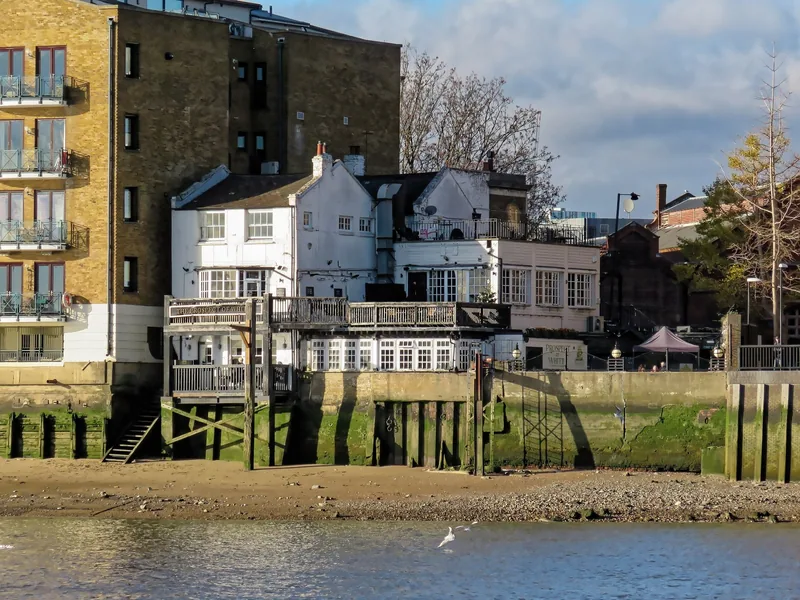
Photo: Acabashi · CC BY-SA 4.0 · Wikimedia Commons · resized
The tide, and why you should look it up
The Thames in London is an estuary, not a river in the ordinary sense. It rises and falls twice a day, the water runs upstream on a flood tide and downstream on an ebb, and at low water wide beaches of gravel and brick appear beneath the walls.
For a pub visit, the tide decides two things. At high water the river is full, wide and close, which is what you want from a terrace. At low water you get mud, a longer view and, in some places, a drop of several metres between your table and the water. Neither is wrong; they are simply different afternoons.
The Port of London Authority publishes tide predictions for stations all along the river, and the difference between London Bridge and Richmond is over an hour, so check the right one. If you want the river at its fullest, aim to be sitting down half an hour before high water at the nearest station.
Never walk out onto the foreshore as the tide turns. The Thames comes in faster than people expect, the steps down are often slippery and a long way apart, and the water is cold and moving quickly even in summer. Stay above the wall unless you know the tide times and where the next set of stairs is. Our page on the Thames foreshore explains the rules on going down there at all, which have tightened.
Richmond: the pub that floods, on purpose
The White Cross sits on Richmond's riverside at the end of Water Lane, and it is built low enough that a high spring tide puts water across the terrace and up to the door. The pub has made a feature of it: Young's publish the high tide times on the pub's own page, keep a rack of wellington boots for customers, and will carry drinks out to people who are marooned at a table.
The pub says the water comes over at around 4.5 metres, which happens on a handful of days around each new and full moon. It is open from 11:00 to 23:00 daily, with food from midday. Richmond is in Zone 4 on the District line, the Mildmay line of the Overground and South Western Railway, so the journey is inside the ordinary daily fare cap.
Two things to know. Water on the terrace does not mean water in the bar, so there is no need to flee. And the two ways in are at different heights, so you can usually reach the upper door with dry feet. Our guides to Richmond and to Twickenham and the Richmond riverside cover what else to do with the afternoon, because the flooding is a twenty-minute spectacle rather than a day out.
The same stretch floods elsewhere. The towpath at Twickenham, the road at Strand-on-the-Green in Chiswick and sections of the path below Hammersmith Bridge all go under on big tides, which is worth knowing if you had planned to walk between pubs.
Wapping and Limehouse: the north bank east of the Tower
This is the stretch with the oldest river pubs, strung along a narrow road that runs behind converted warehouses with occasional gaps down to the water. The Prospect of Whitby and the Town of Ramsgate are a few minutes apart in Wapping; the Grapes is further east in Limehouse, on a quiet terrace of old houses.
The walk between them is the point. It takes about half an hour end to end, passes old dock entrances and the stairs where watermen once worked, and is described in our guide to the Thames Path. Wapping station is on the Windrush line of the Overground; Limehouse is on the DLR and on c2c trains, and our page on the DLR and Overground explains both.
Across the water, the Mayflower in Rotherhithe is the other half of this stretch. It is almost directly opposite, and getting between the two means either the Overground under the river or a long detour, which our guide to Wapping and Rotherhithe covers.
The Gun, further east on the Isle of Dogs, is the one most people miss. It faces the O2 across the water from a terrace on a bend, and it is a Fuller's pub with a serious kitchen rather than a bar with crisps.
Bankside and the centre
Central London has fewer genuine riverside pubs than its length of waterfront suggests, because most of the bank is occupied by offices, galleries and walkways. The Founders Arms at Bankside is the practical choice: a plain modern building with a long terrace looking north across the river towards St Paul's, a few minutes from Tate Modern and the Millennium Bridge.
It is not an old pub and it does not pretend to be. What it has is the view, at the point where the river is at its most photographed, and enough tables to absorb a crowd. Our guide to the bridges of London covers the walking route past it.
Greenwich, where the river turns
Greenwich has two riverside pubs worth the journey, a few minutes apart along the path east of the Old Royal Naval College. The Trafalgar Tavern is the grand one, a Regency building with tall windows over the water; whitebait dinners here were a political institution in the nineteenth century and the pub still serves them. The Cutty Sark, further along and smaller, is a Young's house with tables out on the cobbles and a bow window upstairs.
Between them lies the best short riverside walk in London, with the river bending north around the Isle of Dogs and the towers of Canary Wharf directly opposite. Arrive by boat if you can; our guide to the river bus explains the piers and the fares, and our Greenwich guide covers the rest of the day.
Hammersmith to Chiswick: the stretch that gets the sun
Upstream of Hammersmith Bridge the river runs roughly east to west, which has a consequence nobody mentions: pubs on the north bank here face south across the water and hold the sun until it goes down behind the trees. That is why this short stretch has more people sitting outside on a spring evening than the whole of the central river.
The Dove is the famous one, with its tiny terrace and its low ceilings. The Crabtree, a walk downstream towards Fulham, has the garden. Strand-on-the-Green, further west past Chiswick, has a row of pubs on a path that floods, a fact its regulars treat as weather rather than as a problem.
Our guide to Hammersmith and Barnes covers the area, which fills on the day of the university boat race and is quiet the rest of the year.
Terraces face the water, which is not the same as facing the sun. A pub on the south bank looking north has the better view and the worse afternoon light; a pub on the north bank looking south across an east-west stretch gets sun on its tables until evening. If you want both, Greenwich and Hammersmith are the two places where the river bends enough to give them.
Getting between them, and when to arrive
Three methods, in order of pleasure. The river bus stops at piers near several of these pubs and turns the journey into part of the outing. The Thames Path lets you walk a stretch and take a train back. The Underground and Overground are fastest but put you a few streets inland, which on this part of the river is further than it sounds.
Timing matters more here than at an ordinary pub. Terrace tables at the good ones go by midday on a warm Saturday and are not held for anyone; a weekday afternoon or an early evening in spring or autumn gets you the same view with a seat. Sunday lunch in a riverside pub is one of the better things to do in London in winter, and our guide to the Sunday roast explains what to look for, but you must book.
If you have not been in a British pub before, our guide to ordering at the bar covers the practical side. If the food is the reason for the trip, several of these are kitchens with a bar attached rather than the other way round; see gastropubs in London. And for pubs with proper gardens rather than river terraces, our page on beer gardens in London has the ones with real space, while our pub walks string several of these together into a route.
Frequently asked questions
Which London pub floods at high tide?
The White Cross in Richmond, on the riverside at the end of Water Lane. Water comes across its terrace on the highest spring tides, at around 4.5 metres, on a handful of days around each new and full moon. The pub publishes the tide times and keeps wellington boots for customers.
How do I check the Thames tide times?
Use the Port of London Authority's tide prediction tool, which covers stations from the estuary up to Richmond. High water is over an hour later at Richmond than at London Bridge, so pick the station nearest the pub. Arrive about half an hour before high water for the fullest river.
Which riverside pubs have the best views in London?
For the water directly below you, the Mayflower in Rotherhithe, the Prospect of Whitby in Wapping and the Grapes in Limehouse. For the skyline, the Founders Arms at Bankside. For the bend of the river and Canary Wharf opposite, the Trafalgar Tavern and the Cutty Sark in Greenwich.
Can I get between riverside pubs by boat?
Partly. The river bus calls at piers near Bankside, Greenwich, Canary Wharf and several points in between, and it is the most enjoyable way to cover the central and eastern stretch. It does not serve every pub, and the upstream stretch above Westminster is better done by train and on foot.
Should I reserve a table at a riverside pub?
For a drink at the bar, no. For an outdoor seat on a warm weekend you would want to, except that most riverside pubs refuse to hold terrace tables, which leaves arriving before midday as the only method. Meals, and a Sunday roast in particular, must be booked.
Sources
- Port of London Authority - Tidal information and tide prediction tool (checked September 2026)
- The White Cross, Richmond (Young's) - The pub that floods: tide times and opening hours (checked September 2026)
- Greene King - The Prospect of Whitby, Wapping (checked September 2026)
- The Dove, Hammersmith (Fuller's) - opening hours and location (checked September 2026)
- The Cutty Sark, Greenwich (Young's) (checked September 2026)
- The Trafalgar Tavern, Greenwich (checked September 2026)
- Transport for London - River services and piers (checked September 2026)