
London works better with a baby than its reputation suggests, but it was built long before pushchairs and it shows. The three things that actually shape your days are stairs, changing tables and nap timing. Everything else is easier than you expect: babies travel free, most museums are free, and no one will look twice if you feed a baby in a café.
This page is for travellers with a child under about 18 months, still in a pushchair or a carrier and not yet walking far. For toddlers and older children, our guide to London with kids covers fares, attractions and family rooms, and our page on getting around with a pushchair deals with the transport mechanics in detail.
The short answer: stay somewhere with a lift, use buses far more than the Tube, plan one fixed thing a day, and accept that you will see about half of what you would have seen without the baby. That is fine.
The numbers that matter
- UK ETA
- £20, and every traveller needs one, including a newborn
- Baby's fare
- Free on the Tube, buses, DLR, Overground, Elizabeth line and river services
- Children free per adult
- Up to four under-11s with one fare-paying adult
- Step-free Tube stations
- 95 of them, about a third of the network
- Step-free elsewhere
- All DLR stations, all 41 Elizabeth line stations, all buses
- eGates
- Age 8 and over only, so you will queue at a desk
- Emergency number
- 999, or 111 for urgent non-emergency medical advice
The ETA: your baby needs one too
This is the single most common expensive mistake. The UK Electronic Travel Authorisation is required for each person travelling, and GOV.UK states plainly that this includes babies and children. There is no family application and no exemption for infants. It costs £20 per person and lasts two years, or until that passport expires, whichever comes first.
You apply through the official UK ETA app or on GOV.UK, and you need the baby's own passport, a photograph of their face and a payment card. Most decisions come back by email inside 24 hours, though the Home Office allows itself up to three working days, and the approval has to be in hand before departure. Only apply on GOV.UK or in the official app: other websites charge more for the same thing and cannot make it faster.
At the border, remember that eGates are only open to people aged 8 and over who are at least 120 cm tall, so a family with a baby goes to a staffed desk. Queues at desks are longer than at the gates, particularly at Heathrow in the morning. Our full guide to UK entry requirements and the ETA covers which nationalities need one.
A baby without an ETA can be refused boarding at your departure airport. Airlines check before you fly, not on arrival, and an approved ETA for the parents does not cover the child. Apply for each passport in the family at the same time, and do it at least three working days before you travel.
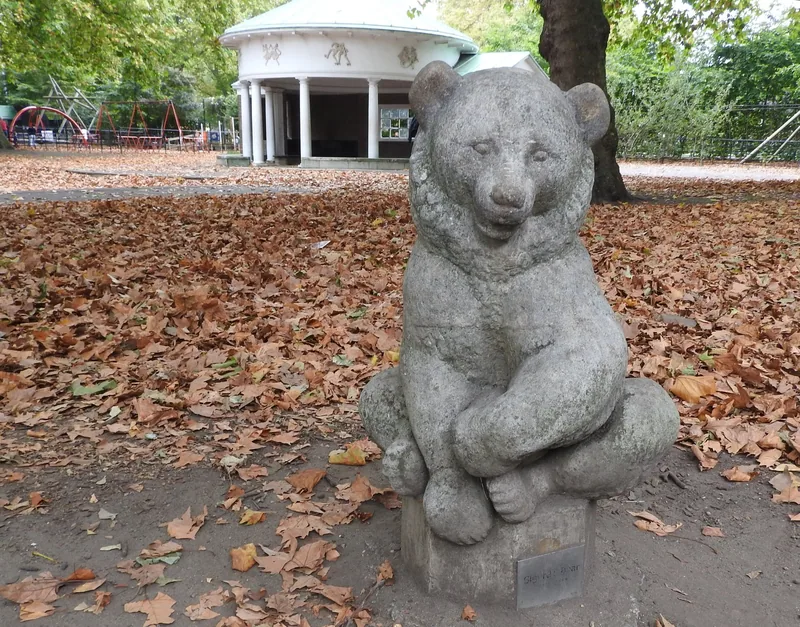
Photo: ClemRutter · CC BY-SA 4.0 · Wikimedia Commons · resized
Buses beat the Tube, almost always
Every London bus is wheelchair-accessible, with a ramp at the middle door and a dedicated space. You can take an unfolded pushchair straight on. There is one rule to know: the space belongs to wheelchair users first, and if someone in a wheelchair needs it, the driver will ask you to fold the pushchair or wait for the next bus. Buses come every few minutes on most central routes, so this is an inconvenience rather than a problem.
The Tube is the opposite. Only 95 of the network's stations are step-free, about a third, and many of the busiest central ones are not. Where there is no lift you are carrying the pushchair, the baby and the bag down two or three flights, often on a moving escalator you should not use with a pram.
Three parts of the network are reliably easy: the DLR, where every station is step-free and the trains have no driver's cab so you can sit at the front; the Elizabeth line, where all 41 stations are step-free from street to platform; and the river services, where all boats are wheelchair-accessible and all but three piers are step-free.
Your baby travels free on all of it. Children under 11 travel free with a fare-paying adult, up to four per adult, and under-5s travel free on river services as well. Our pages on children's fares, using the buses and step-free transport have the detail, and the TfL Go app will plan a step-free route if you set it to.
A black cab is the other answer. Every licensed taxi in London is wheelchair-accessible with a ramp, so a pushchair usually goes in unfolded, there is no surcharge for luggage, and all taxis must accept contactless payment. The minimum fare is £4.40 and a one-mile daytime journey costs between £8.40 and £13.00. Our guide to black cabs, minicabs and Uber explains the tariffs.
Feeding, and what the law actually says
Feeding a baby in public in London is unremarkable. In cafés, on park benches, in museum galleries and on buses, nobody comments.
The legal position is in section 17 of the Equality Act 2010: a service provider discriminates against a woman if, in the 26 weeks after she gives birth, it treats her unfavourably because she is breastfeeding. In practice that means a café or shop cannot ask you to stop or to leave. Complaints are rare enough to be newsworthy when they happen.
For bottle feeding, most cafés will fill a bottle with hot water if you ask, and some chains will warm one. London tap water is safe to drink everywhere; our page on tap water and refill points lists where to fill a bottle for free. If you need to sterilise or warm milk in your room, note that the UK runs on 230 volts at 50 hertz with the three-pin BS 1363 plug, so a travel steriliser bought elsewhere needs an adapter and may need a voltage check; see UK plugs and voltage.
The large museums generally have a quiet room or a family room where you can feed and change without queuing for the toilets. Ask at the information desk when you go in rather than hunting for one later.
Finding somewhere to change a nappy
This is the genuine weak point. Central London has far fewer public toilets than its visitor numbers justify, and changing tables are concentrated in a few places.
The reliable ones, in rough order of usefulness:
- The big free museums. The Natural History Museum, Science Museum, V&A, British Museum, Tate Modern and the National Gallery all have baby-changing facilities and family rooms, and you can walk in without a ticket.
- Department stores. The larger stores on Oxford Street and Knightsbridge have proper parent rooms, usually on the children's floor, with seating, a sink and warm water.
- Mainline stations. Most have changing facilities, some inside paid toilets.
- Large chain cafés and fast-food restaurants. Less pleasant, but they are everywhere.
- Changing Places toilets. Larger rooms with a bench and hoist, mainly for disabled users but invaluable with a bigger baby; find them on the Changing Places Consortium's map.
Transport for London's toilets at stations are free to use, though some non-TfL facilities charge. Our page on finding a toilet in London has the maps and the paid options.
Plan your day around three fixed changing points, not one. Pick a museum, a department store and a station roughly where you will be at mid-morning, lunchtime and mid-afternoon, and you will never be more than fifteen minutes from a table. Trying to find one on the spot in Soho or the City at 4pm is how a good day goes wrong.
Naps, and building the day around them
Most families end up with one of two patterns. Either the baby sleeps in the pushchair while you walk, in which case you want long flat routes and outdoor time, or the baby only sleeps in a cot, in which case you go back to the room in the middle of the day and accept a shorter afternoon.
If the pushchair works, these routes are flat, continuous and pleasant: the Thames Path between Westminster Bridge and Tower Bridge on the south side; the Regent's Canal towpath from Little Venice to Camden; Hyde Park and Kensington Gardens from the Italian Gardens to the Albert Memorial; Greenwich Park's lower paths; and the Queen Elizabeth Olympic Park at Stratford, which is newer and has the widest paths of any of them.
If you need the room, stay somewhere central enough that the return trip is 20 minutes rather than 50. That single decision matters more than the hotel itself.
The parks are free and open from early morning until dusk or midnight depending on the park. Our guide to Hyde Park and Kensington Gardens covers the routes and cafés on that side of town. One warning for that route: the Diana Memorial Fountain has not been running since 1 July 2026, when a fault took its water system out of service.
What to bring, and what to buy when you arrive
Nappies, wipes, formula and baby food are sold in every supermarket and pharmacy in London, and the large chains are open late. There is no reason to fill a suitcase with them. Bring two days' worth and buy the rest here.
Bring instead: a rain cover that actually fits your pushchair, because it will rain; a carrier or sling, which solves every staircase the pushchair cannot; a warm layer even in July, because evenings are cooler than visitors expect; and a lightweight pushchair rather than the big one, because the big one will not fit through a café door or into a black cab's floor space comfortably.
If you are bringing infant formula or medical food from abroad, customs rules allow up to 2 kg per person of powdered infant milk, infant food or medical food from the EU and neighbouring countries, provided it is unrefrigerated, branded and unopened. Our page on UK customs allowances covers the rest, including the ban on bringing meat and dairy products in from the EU.
Our page on doing laundry in London explains the launderettes and collection services, which you will need sooner than you think.
If the baby is ill
Accident and emergency care is free to everyone in England, including visitors, and so are GP and nurse consultations in primary care. If the baby is admitted as an inpatient, an overseas visitor who is not exempt is charged at 150% of the national NHS rate, so travel insurance matters.
For anything that is not an emergency, call 111 or use 111.nhs.uk. It is free, it runs 24 hours, and it will tell you whether to go to a pharmacy, an urgent treatment centre or A&E. Urgent treatment centres handle sprains, fevers, rashes and minor injuries without an appointment, and neither GP registration nor a British address is required to be seen at one.
Pharmacies can supply some prescription medicines without a doctor under the Pharmacy First scheme, but most of it applies to children aged one and over. For a baby under one, use 111 or a GP.
Dial 999 for an emergency. Our pages on healthcare for visitors and emergency numbers set out what is free, what is charged and how to find the nearest pharmacy.
Rooms, cots and lifts
Ask three questions before you book, in this order. Is there a lift to every floor? Is a cot included or charged? Is the room on a street that is quiet after 11pm?
Many London hotels occupy converted Victorian houses with no lift and steep stairs, and the listing will not always say so. Cots are usually free for under-2s but not always, and some hotels have only a handful. Ask at the time of booking and again the week before you arrive.
Apartments and aparthotels often work better than hotel rooms with a baby, because you get a separate space to sit in once the baby is asleep and a kitchen for sterilising and cooking. Our page on where to stay in London with children compares the areas and the room types.
Which attractions actually work
| Works well | Why | Avoid |
|---|---|---|
| Free national museums | No ticket, step-free, family rooms, you can leave after 40 minutes | Timed-entry paid attractions you cannot walk out of |
| Parks and the river path | Flat, outdoors, pushchair naps | Long queues outdoors in the cold |
| Bus routes 11, 15 and 24 as sightseeing | £1.75, ramp access, a seat and a view | Hop-on hop-off open-top tours in wind or rain |
| The DLR from Bank to Greenwich | Step-free throughout, front seats | The Tube in rush hour, anywhere |
| Markets in the morning | Wide aisles before the crowds arrive | Markets at weekend lunchtime |
Our list of free museums in London is the single most useful page for a trip like this: nothing to book, nothing to lose if the baby melts down twenty minutes in.
Flying home: milk and food through security
UK airport rules are generous with babies. You may take enough baby food, baby milk and sterilised water for the journey, and there is no legal limit on the quantity, although you should check with your airport. Formula milk, cow's milk, soya milk for babies, baby food and sterilised water are all allowed in hand luggage provided the baby is with you.
Expressed breast milk may be carried even if you are travelling without the baby, in containers of up to 2,000 ml each. Frozen breast milk is not allowed in hand luggage, although it can go in the hold. Cooling gel packs and ice packs are allowed in both. Every container will be screened separately, and staff may ask to open them.
Pushchairs are usually allowed to the aircraft door and are screened at security. Our guide to flying with children from London covers check-in, seat allocation and which terminals have the better family facilities.
Frequently asked questions
Does a baby need a UK ETA?
Yes. GOV.UK states that everyone travelling needs their own Electronic Travel Authorisation, including babies and children, at £20 each. It is linked to the child's passport and lasts two years or until that passport expires, whichever comes first.
Do babies travel free on London transport?
Yes. Children under 11 travel free on the Tube, buses, DLR, Overground and Elizabeth line when with a fare-paying adult, up to four children per adult, and under-5s travel free on river services. No card or ticket is needed for a baby.
Can I take a pushchair on a London bus without folding it?
Usually yes. Every bus has a ramp and a dedicated space, and unfolded pushchairs are allowed. If a wheelchair user needs that space, they have priority and you will be asked to fold the pushchair or take the next bus.
Where can I change a nappy in central London?
The free national museums, the large department stores and the mainline stations are the most reliable. Museums are the best of these because entry is free and the family rooms are quiet. The Changing Places map lists larger accessible rooms across the city.
How much baby milk can I take through airport security?
Enough for the journey, with no legal limit, although you should check with your airport first. Formula, baby food and sterilised water are allowed when the baby is present; expressed breast milk is allowed in containers up to 2,000 ml, but frozen breast milk must go in the hold.
Is it acceptable to breastfeed in public in London?
Yes, and it is protected in law. Section 17 of the Equality Act 2010 makes it unlawful for a service provider to treat a woman unfavourably because she is breastfeeding in the 26 weeks after giving birth. In practice, feeding a baby in a café or park attracts no attention at all.
Sources
- GOV.UK - Apply for an electronic travel authorisation (ETA) (checked September 2026)
- GOV.UK - Hand luggage restrictions: baby food and baby milk (checked September 2026)
- Equality Act 2010, section 17 - Pregnancy and maternity discrimination (checked September 2026)
- Transport for London - Step-free access and avoiding stairs (checked September 2026)
- NHS - When to use 111 (checked September 2026)
- Changing Places Consortium - Find a toilet (checked September 2026)
- Transport for London - Taxi fares (checked September 2026)