
Riding your own e-scooter on any London road, pavement or cycle lane is against the law. Renting one from an approved scheme is legal, but only in eleven boroughs, only if you are 18 with a driving licence, and only if you end the trip in a marked bay. Hire e-bikes follow different rules again.
This is one of the few subjects in London where visitors get fined for doing something that is perfectly normal at home. Scooters that are sold openly in British shops cannot legally be ridden anywhere except private land with the owner's permission.
Our guide to cycling in London covers the road network, the Cycleways and what it feels like to ride here. This page is narrower: the legal position, the schemes that exist, and the parking and carriage rules that catch people out.
Where each one stands
- Your own e-scooter
- Illegal on public roads, pavements and cycle lanes. Police can fine and seize.
- Rental e-scooter (Lime or Voi)
- Legal in eleven participating boroughs. Age 18+, provisional licence or better, capped at 12.5mph.
- Hire e-bike (Lime, Forest, Voi, Bolt)
- Legal across London. No licence needed. Must be parked in a designated bay in central boroughs.
- Santander Cycles e-bike
- Legal, docked, £3 per 30 minutes. App or membership key only.
- All of them on the Tube
- E-scooters banned outright. Non-folding e-bikes banned since 31 March 2025.
The law on privately owned e-scooters
Transport for London states the position plainly: it is illegal to use privately owned e-scooters or other powered transporters on public roads. They are treated as motor vehicles that cannot meet the requirements placed on motor vehicles, which means they cannot be insured, registered or taxed, and so cannot be used legally.
Riding one on a pavement is a separate offence, because driving a vehicle on a pavement is generally against the law regardless of what the vehicle is. Parks, canal towpaths and shopping centres are also out, because they are not private land that belongs to you.
The penalties TfL lists are a fine of up to £300 and six points on your driving licence. For a visitor with a foreign licence, the points matter less than the fine and the seizure of the scooter, but the fine is real and enforcement has increased.
Buying an e-scooter in London does not make riding one legal. Shops may sell them lawfully for use on private land. That is the loophole, and it is not a loophole that helps you on the way back to your hotel.
The rental trial: who runs it and where
London's rental e-scooters are part of a formal trial, not a permanent scheme. Two operators hold contracts, Lime and Voi, and the trial has approval to run until 31 May 2028.
Eleven boroughs take part: Camden, the City of London, Ealing, Hammersmith and Fulham, Kensington and Chelsea, Lambeth, Richmond upon Thames, Southwark, Tower Hamlets, Wandsworth and Westminster.
That list covers most of what a visitor thinks of as central London, but there are gaps that matter. Islington, Hackney and Shoreditch are not in the trial, so an e-scooter cannot legally be ridden into them. The app will not let you end a trip there either.
To ride, you must be 18 or over and hold at least a provisional driving licence. A foreign driving licence is accepted by the operators' verification systems, but you will need to photograph it when you set up the account, so do that before you are standing in the rain next to a scooter. The trial scooters are limited to 12.5mph.
Hire e-bikes are a separate thing entirely
The bright green and red e-bikes parked on pavements across London are not part of the TfL trial. They are dockless hire bikes, licensed borough by borough, and because they are bicycles rather than powered transporters they are legal everywhere a bicycle is legal. No licence, no minimum age of 18, no borough boundary.
Four operators are commonly seen: Lime, Forest, Voi and Bolt. Coverage, pricing and the fee to start a ride all differ, and each of them charges by the minute, which adds up faster than visitors expect on a slow ride through traffic.
The practical warning is about weight. These bikes are heavy, the brakes are strong, and the motor cuts in sharply when you push off. If you have not ridden an e-bike before, find a quiet street for the first two minutes rather than a junction.
Parking: the rule that costs people money
The single most common mistake is ending a hire on the pavement where you happen to be. In the central boroughs you cannot. Westminster, for example, has built more than 380 parking places for hire e-bikes, with over 200 marked bays and more than 170 virtual ones, and aims to have a bay every 300 metres. The council's position is that trips must end in one of them.
The apps enforce this with geofencing. If you are outside a bay, the app refuses to end the trip and the meter keeps running. People stand there paying by the minute while they work out what is happening.
Two habits fix it. Open the map and find your destination bay before you set off, not when you arrive. And allow a couple of extra minutes at the end, because the nearest bay can be a street away from the door you actually want.
A badly parked bike can still be your problem after you walk away. Operators remove bikes left outside bays and can charge the last rider or suspend the account. Never leave one across a pavement, in front of a dropped kerb, by a taxi rank or at a crossing.
Santander Cycles: the docked alternative
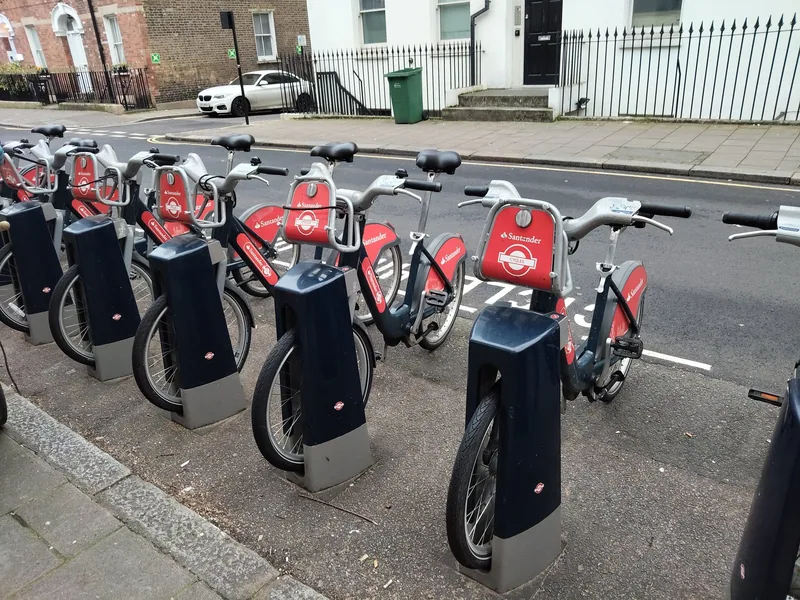
TfL's own scheme solves the parking problem by having docks. About one bike in six in the fleet is electric, and there are more than 12,000 bikes at roughly 800 docking stations across inner and central London.
An electric Santander Cycle costs £3 for up to 30 minutes, and £3 for each further 30 minutes. If you hold a Day Pass, which starts at £3.50 and covers unlimited 60-minute rides on standard bikes over 24 hours, an e-bike journey adds £1. Standard pedal bikes are £1.65 for 30 minutes (prices September 2026; check the current rates on the TfL site).
One rule catches people out: electric Santander Cycles cannot be hired at the docking station terminal. You need the app or a membership key. If you walk up to a dock with a bank card expecting to take the e-bike, you will be given a standard one. Our step-by-step guide to hiring a Santander Cycle covers the process.
For short hops between museums or from a station to a hotel, the docked scheme is usually the cheaper and calmer option. For a one-way trip to somewhere with no dock, the dockless bikes win.
Where you can actually ride
Rental e-scooters may be used on roads and on TfL cycle tracks within the participating boroughs. They may not be used on pavements, in the Royal Parks or on footpaths, and that includes the paths through Hyde Park and Kensington Gardens, which are governed by their own regulations.
Hire e-bikes follow ordinary cycling rules, which means the same roads and cycle tracks as any bicycle, and the same prohibition on pavements. Towpaths along the Regent's Canal allow cycling in places and not in others, and the signs are the authority.
Both types must obey traffic lights, ride on the left, and use lights after dark. If you have not driven in Britain before, the section on junctions and roundabouts in our guide to driving in the UK as a foreign visitor applies to two wheels as much as four.
None of these can travel with you on public transport
This is the rule visitors are least likely to guess, and it is strictly enforced.
E-scooters, folded or not, are not allowed on any TfL service or in any TfL station. There is no exception for carrying one in a bag.
Non-folding e-bikes have been banned from the Tube, the London Overground, the Elizabeth line and the DLR since 31 March 2025, after fires involving battery conversions. The ban includes ordinary bicycles converted with a kit. Folding e-bikes are still allowed, because TfL says it has had no reports of foldable e-bike fires in London. Breaking the rule can mean being refused entry, removed from the network, or fined up to £1,000 under the bylaws.
There are a few services where a non-folding e-bike may still travel: the Woolwich Ferry, river services, some coach operators with their agreement, and the Silvertown Tunnel cycle shuttle. The London Cable Car bans all e-bikes and all e-scooters. Our page on taking a bike on London transport sets out the full picture for ordinary cycles, including the peak-hour restrictions.
Helmets, insurance and what happens if you fall
Helmets are not a legal requirement for adults on bicycles or on trial e-scooters in Britain. Operators recommend them and some provide them on the scooter, but most riders you see will not be wearing one.
The operators carry third-party insurance for the trial scooters, which covers injury or damage you cause to someone else. It does not usually cover your own injuries. Check what your own policy says about cycling and powered scooters before you ride; our guide to travel insurance and healthcare cover for a UK trip explains what a standard policy tends to include.
Riding under the influence of alcohol is an offence on an e-scooter as it is in a car, and breath tests apply. This surprises people leaving the pub who think of the scooter as a toy.
What this means for a short visit
For most visitors, the honest advice is that e-scooters are not worth the administration. Setting up an account, uploading a licence, learning the borough boundaries and hunting for a parking bay takes longer than the journeys save on a three-day trip.
Hire e-bikes are more useful, especially for river-side stretches and for crossing parks on roads rather than paths. Santander Cycles are the easiest to understand and the least likely to end in a parking dispute.
And for a great many central journeys, the fastest option is still your feet. Our guide to when walking beats the Tube lists the routes where that is true, and a look at how to avoid the rush hour may solve the same problem more cheaply. Having the right apps on your phone before you arrive makes all of this easier, and our list of the apps worth having in London covers which ones actually help.
Frequently asked questions
Can I bring my own e-scooter to London and ride it?
No. Privately owned e-scooters cannot be used on public roads, pavements, cycle lanes or in parks anywhere in Great Britain. You may only use one on private land with the landowner's permission. Police can issue a fine of up to £300 and seize the scooter, so bringing one from home is not worth it.
Do I need a driving licence to hire an e-scooter in London?
Yes. You must be 18 or over and hold at least a provisional driving licence, and the operator will ask you to verify it inside the app before your first ride. A foreign licence is accepted by the verification process. Hire e-bikes do not require a licence.
Where can I leave a hire e-bike when I have finished?
In a designated parking bay, which the app shows on its map. In central boroughs such as Westminster the app will not let you end the trip anywhere else, and the charge keeps running until you reach a bay. Look up the bay nearest your destination before you set off.
Can I take a hire e-bike or e-scooter on the Tube?
No. E-scooters are banned from all TfL services and stations, folded or not. Non-folding e-bikes have been banned from the Tube, Overground, Elizabeth line and DLR since March 2025 for fire safety reasons. Folding e-bikes are allowed. In any case, hire bikes must be returned to the street, not taken underground.
Which boroughs allow rental e-scooters?
Camden, the City of London, Ealing, Hammersmith and Fulham, Kensington and Chelsea, Lambeth, Richmond upon Thames, Southwark, Tower Hamlets, Wandsworth and Westminster. Islington, Hackney and most of east and north London are outside the trial, and the apps will not let you end a trip there.
Sources
- Transport for London - E-scooters and the rental trial (checked September 2026)
- Transport for London - Cycles on public transport (checked September 2026)
- Transport for London - Safety ban on non-folded e-bikes (checked September 2026)
- Transport for London - Santander Cycles: what you pay (checked September 2026)
- Transport for London - Using Santander Cycles e-bikes (checked September 2026)
- Westminster City Council - Dockless e-bike parking bays (checked September 2026)