
Lincoln's Inn Fields is a public square in Holborn, which Camden Council calls the largest square in London. It is free and open from 7.30am, but the gates are locked in the late afternoon in winter, at 4pm from late November. Two free museums face each other across it, Sir John Soane's on the north side and the Hunterian on the south, and the gardens of Lincoln's Inn lie behind its eastern wall.
It is a large rectangle of lawn, plane trees and paths, with tennis courts in the middle and tall terraced houses of three centuries on three sides. Most visitors come to it as an address for one of the museums and walk straight across. This page is about the square itself: what stands on each side, what the memorials are, when the gates shut, and how to use it as a short cut between Holborn, the Strand and the Inns of Court. For the neighbourhood around it, start with our guide to Holborn.
Lincoln's Inn Fields at a glance
- Cost
- Free
- Opens
- 7.30am every day, under Camden's park byelaws
- Closes
- Camden's square page says "until dusk". Its published 2026 timetable for its parks gives 4.30pm from 2 November and 4pm from 23 November 2026 to the end of winter (checked November 2026)
- Size
- About 3.2 hectares on Historic England's register, Grade II, registered 1 October 1987
- Tennis
- Three hard courts, also used for netball, no floodlights; standard booking £14.30, under-16s and seniors £5.70 (checked November 2026)
- Nearest stations
- Chancery Lane (Central), about 5 minutes; Holborn (Central, Piccadilly), about 7 minutes
- Address
- Lincoln's Inn Fields, London WC2A 3TL
The gates close in the afternoon in winter
The square is surrounded by railings, and Camden locks the gates at night. The council gives two versions of the rule. Its page for Lincoln's Inn Fields says the square is open from 7.30am "until dusk". Its separate timetable for its parks lists a fixed closing time that changes on named Mondays through the year: in 2026 it was 9.30pm in June, 6pm from mid-October, 4.30pm from 2 November and 4pm from 23 November.
Whichever version you go by, the result in winter is the same: by mid-afternoon the gardens are about to shut. The tennis courts follow the park, opening from 8am and taking their last booking an hour before the park closes. If you plan to cut through the square after work between November and January, you will be walking round the outside on the pavement.
The pavements around all four sides stay open at all hours, and so do the museums' front doors on the north and south sides, on their own opening days. Only the central gardens are locked. For the closing pattern across Camden's other squares, including Russell Square, which stays open later, see our page on Bedford Square and the Bloomsbury squares.
From late November the gardens of Lincoln's Inn Fields lock at 4pm. That is before most offices close and close to sunset. Plan an afternoon visit to the Soane or the Hunterian with this in mind if you want to sit in the square afterwards.
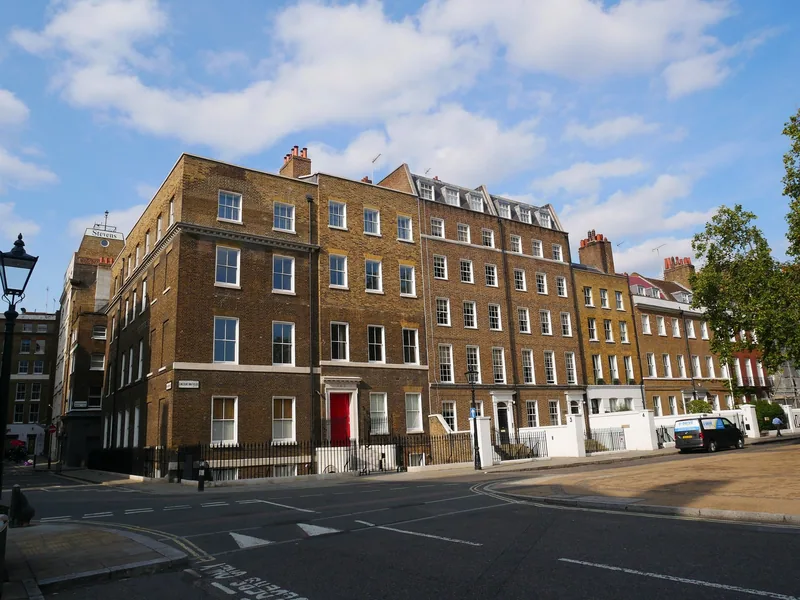
Photo: Ethan Doyle White · CC BY-SA 4.0 · Wikimedia Commons · resized
A square laid out in the 1630s
The fields were open ground west of Lincoln's Inn until the 1630s, when the speculator William Newton was allowed to build houses along their edges. The oldest survivor is Lindsey House, at numbers 59 and 60 on the west side, built between 1638 and 1641. Historic England lists it Grade I and quotes the architectural historian Sir John Summerson, who called it "perhaps, historically, the most important single house in London", because its design became the model for London terraces for the next two centuries.
Nobody knows for certain who designed it. The list entry says it has been attributed to Inigo Jones, John Webb, Peter Mills and Nicholas Stone. It was divided into two houses in 1751 and 1752. You can see it from the pavement: a stuccoed front with tall Ionic pilasters running up through two floors, which makes it look quite different from its brick neighbours.
The square was also a place of execution. Lord William Russell, a leading Whig politician, was beheaded here on 21 July 1683 after being convicted of treason for his alleged part in the Rye House Plot against Charles II. Today the gardens are a public park run by Camden Council, and the Friends of Lincoln's Inn Fields work with the council to look after them.
The north side: the Soane and its neighbours
The north side is the one most visitors come for. At number 13 is Sir John Soane's Museum, the architect's house and collection, free and without booking, open Wednesday to Sunday. Its front, with a projecting stone loggia, is the most unusual face on the square, and the building is listed Grade I.
The houses either side are as interesting from outside. Numbers 15 and 16, and 18 and 19, are listed with their railings; numbers 24 to 28 have iron lamp-holders on their gate piers. Stand back by the garden railings to see the whole run at once, which is easier in winter when the plane trees are bare.
Inside the railings on this side is a curved granite seat with a bronze group of a seated woman surrounded by nine children. It is the memorial to Margaret MacDonald, the wife of the first Labour prime minister, Ramsay MacDonald, made in about 1911 by the sculptor R. R. Goulden. The inscription says she "spent her life in helping others". It is listed Grade II.
The south side: the Royal College of Surgeons and the Hunterian
The south side is dominated by the Royal College of Surgeons, behind a giant portico of six Ionic columns. The building is a rebuild of 1835 to 1839 by Charles Barry, the architect of the Houses of Parliament, reusing the portico of George Dance the younger's college of 1806 to 1813. Historic England lists it Grade II*. Inside is the Hunterian Museum, the surgeon John Hunter's collection of anatomical specimens, which is free and open Tuesday to Saturday.
The Soane and the Hunterian face each other across the gardens, a two-minute walk apart. Because they keep different days, Wednesday to Saturday is the only time both are open; on a Sunday only the Soane is, and on a Tuesday only the Hunterian.
Off the south-west corner, in Portsmouth Street, is the seventeenth-century timber-framed house known as the Old Curiosity Shop. Our page on London's oldest shops explains what Historic England says about it and why the link with Dickens is only a tradition.
The east side, the gate into Lincoln's Inn, and the west terrace
The east side of the square is not houses but the long wall and gardens of Lincoln's Inn, one of the four Inns of Court, the professional societies to which every barrister in England and Wales belongs. Its gates are open to people on foot during the working week, generally from 8am to 7pm, and closed at weekends. Our page on Temple Church and the Inns of Court explains what the Inns are and what you may visit.
On the west side, beyond Lindsey House, are more grand houses, including Powis House and number 65, both listed Grade II*. At the north-west corner, inside the railings, is a stone Gothic drinking fountain of 1861, inscribed "The Fear of the Lord is a Fountain of Life". Historic England's list entry says it was paid for by an anonymous local woman, at a time when the parish wells were polluted with sewage. A granite fountain of about 1880 in the south-east corner commemorates Philip Twells, a Member of Parliament.
On the north-east side is a stone seat designed by Sir Edwin Lutyens as a memorial to W. F. D. Smith, 2nd Viscount Hambleden, of the W. H. Smith family. The bronze bust that sat on it was stolen in the 1970s, so only the pedestal and its inscription remain.
Tennis, netball and a bench at lunchtime
The centre of the gardens holds three public hard tennis courts, which can also be used for netball. They are run by Camden and booked online through the council's Camden Active service. The standard charge is £14.30 and under-16s and seniors pay £5.70 (checked November 2026); bookings are not refundable, although Camden says it may credit your account if rain stops play. The courts have no floodlights, so in winter the playing day ends early.
The entrance for the courts is the gate opposite the Royal College of Surgeons. Camden lists public toilets nearby rather than inside the gardens.
On weekday lunchtimes the benches and lawns fill with people from the offices and chambers around the square, which is its busiest and liveliest time. On Sundays and in the evenings it is very quiet. If you want the square to yourself, come on a weekend morning.
The quickest quiet route from Holborn to the Strand runs through the square. Walk from Holborn station down Kingsway, turn left into the square at its north-west corner, cross the gardens diagonally to the south-east corner, then follow Serle Street to Carey Street, behind the Royal Courts of Justice, and on to the Strand. Allow about ten to fifteen minutes, most of it away from traffic, while the gates are open.
Walking on: the Strand, the Courts and Covent Garden
Lincoln's Inn Fields sits at a crossroads of walks. South, past the Royal College of Surgeons, you reach the back of the Royal Courts of Justice and the Strand, which our guide to Aldwych and the Strand covers. East, through Lincoln's Inn, is Chancery Lane and the way to Fleet Street. West, along Great Queen Street, is Covent Garden, about ten minutes on foot.
For a small, odd, paid attraction a few streets north, Novelty Automation on Princeton Street has hand-built coin-operated machines. If you are comparing London's squares, our page on Berkeley Square and the Mayfair squares covers the other famous set, and the London Open Gardens weekend each June opens many private squares that are usually locked.
If you are staying nearby, our page on staying in Holborn explains what the area is like after the offices empty.
Frequently asked questions
Is Lincoln's Inn Fields the largest square in London?
Camden Council, which manages it, describes it as the largest square in London and the oldest in the borough. Historic England registers the gardens as a Grade II historic park and garden covering about 3.2 hectares.
What time does Lincoln's Inn Fields close?
It opens at 7.30am. Camden's page for the square says it closes at dusk, and the council's published timetable for its parks gives fixed times that change on set Mondays through the year, falling to 4pm from late November through midwinter. In summer the gardens stay open until the evening.
Which museums are on Lincoln's Inn Fields?
Sir John Soane's Museum at number 13 on the north side and the Hunterian Museum inside the Royal College of Surgeons on the south side. Both are free. The Soane opens Wednesday to Sunday and the Hunterian Tuesday to Saturday, so both are open only from Wednesday to Saturday.
Can you play tennis in Lincoln's Inn Fields?
Yes. There are three public hard courts in the middle of the gardens, run by Camden and booked online. The standard charge was £14.30 in November 2026, with a reduced rate for under-16s and seniors. There are no floodlights.
Who was executed in Lincoln's Inn Fields?
The best-known execution is that of Lord William Russell, the Whig politician, who was beheaded in the fields on 21 July 1683 after being convicted of treason over the Rye House Plot. The fields were an open space on the edge of London at the time.
Sources
- London Borough of Camden - Our historical parks: Lincoln's Inn Fields (checked November 2026)
- London Borough of Camden - Park opening and closing times 2026 (checked November 2026)
- Camden Active - Lincoln's Inn Fields tennis courts (checked November 2026)
- Historic England - Lincoln's Inn Fields, registered park and garden 1000819 (checked November 2026)
- Historic England - Lindsey House, 59 and 60 Lincoln's Inn Fields, list entry 1379333 (checked November 2026)
- Historic England - The Royal College of Surgeons, list entry 1222011 (checked November 2026)
- Historic England - Mrs Ramsay MacDonald memorial seat, list entry 1379340 (checked November 2026)
- Historic England - Gothic drinking fountain, Lincoln's Inn Fields, list entry 1379337 (checked November 2026)