
Below about a mile the bus wins, above about two miles the Tube wins, and in between it depends on whether the Tube journey needs a change. We timed five common central London journeys both ways on Transport for London's own journey planner, across three consecutive departures each, and the pattern held every time. The bus also costs a family of four less than half what the Tube does for the same day.
The reason the short answer is so clean is that a Tube journey is not just the train. It is the walk to the station, the escalator down, the wait, the ride, the escalator up and the walk out, and in central London that overhead is five to ten minutes before the train has moved. A bus stop is on the pavement and the bus is at eye level. How the two networks work in their own right is covered in our guides to London buses and the Underground.
The rule of thumb
- Under about 1 mile in the centre
- Bus, or walk
- 1 to 2 miles
- Whichever needs no change; the Tube if it is one line, the bus if the Tube needs two
- Over about 2 miles
- Tube, by a wide margin
- Weekday 08:00-09:30 and 17:00-18:30
- Tube, even for shorter distances, because traffic is worse than crowding
- With a pushchair or a wheelchair
- Bus: every London bus is wheelchair-accessible and most Tube stations are not step-free
- Adult single fare, bus
- £1.75 (£1.85 from 1 November 2026), any distance
- Adult single fare, Tube in Zone 1
- £3.10 peak, £3.00 off peak
- Daily cap, buses and trams only
- £5.25
- Daily cap, Zones 1-2 including any Tube journey
- £8.90
Five journeys, timed both ways
All the times below come from TfL's journey planner, sampled at 11:00, 11:30 and 14:00 on a weekday and taken across three consecutive departures rather than one, so they are typical rather than the best or worst train of the day. Each figure is door to door and includes the walking at both ends.
| Journey | Roughly | By bus | By Tube | On foot | Winner |
|---|---|---|---|---|---|
| Oxford Circus to Piccadilly Circus | 0.5 mile | 13-14 min | Not offered | 19 min | Bus |
| Victoria to Parliament Square | 1 mile | 11-13 min | 18 min | 29 min | Bus |
| King's Cross to the British Museum | 1 mile | 25-26 min | 25 min | 32 min | Dead heat |
| Marble Arch to Notting Hill Gate | 1.8 miles | 20-21 min | 18 min | - | Tube, just |
| Trafalgar Square to the Tower of London | 2.4 miles | 37-44 min | 25-26 min | - | Tube |
Four of those five results are worth a sentence each.
Oxford Circus to Piccadilly Circus. TfL's own planner will not offer you the Tube at all. Ask it for that journey and it gives you three buses and a nineteen-minute walk; the single stop on the Bakerloo line is not in its answers. That is the planner telling you something the map does not. Other pairs of stations in the same position are listed in Tube stations it is quicker to walk between.
Victoria to Parliament Square. The bus wins by five to seven minutes even though the fastest route involves changing buses at St James's Park, because the Tube alternative means going down into Victoria, riding three minutes on the District or Circle line, and walking up out of Westminster. It also drops you beside the river rather than in a subway.
King's Cross to the British Museum. Identical: 25 minutes either way. The Piccadilly line covers the distance in two minutes and then asks you to walk seventeen from Russell Square, which is most of the journey. Walking the whole way takes 32 minutes and is the better choice on a dry day.
Trafalgar Square to the Tower of London. Here the bus loses badly, and not by a fixed amount: our three samples came out at 37, 38 and 44 minutes depending on whether the planner found a single route 15 all the way or made us change at Bank. The Tube was 25 or 26 minutes on every sample. Over two miles through the City, the bus is at the mercy of the traffic and the train is not.
The variance matters as much as the average. Every Tube sample in that table came within one minute of every other. The bus samples varied by up to seven minutes on the same journey at the same time of day. If you have a booked timeslot at a museum or a train to catch, that predictability is worth more than the four minutes the bus might save you.
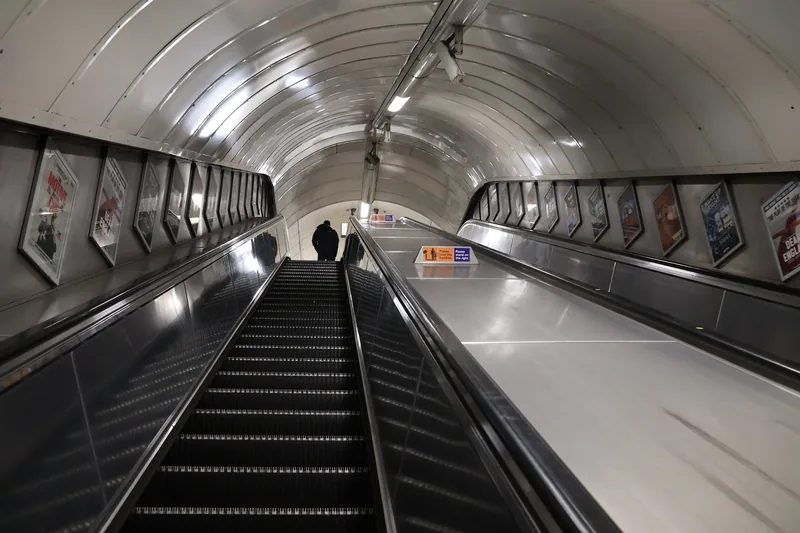
Photo: DiscoA340 · CC BY-SA 4.0 · Wikimedia Commons · resized
What decides it: the six minutes before the train arrives
The reason the crossover sits at about a mile is that the fixed cost of a Tube journey in central London is large. TfL's planner allowed six to thirteen minutes of walking to reach the platform in our five samples, and three to seven minutes at the other end. At Covent Garden, Hampstead or Holborn it is longer still, because the platforms are deep and the escalators are long.
A bus has almost no fixed cost. You walk two or three minutes to a stop, and central London bus routes run frequently enough that the wait is short. What a bus has instead is a variable cost, which is traffic, and that grows with distance and with the time of day.
So the arithmetic is simple. Below a mile, the Tube's fixed cost eats the whole journey. Above two miles, the bus's variable cost does. The middle is decided by whether your Tube trip is one line or two, because a change underground costs four to ten minutes and sometimes a 400-metre walk.
What it costs for two adults and two children
The fares are not close, and this is where the bus makes its strongest case. Our arithmetic, from TfL's published adult and discounted fares, for two adults and two children aged 8 and 12, with the 12-year-old carrying an Oyster card with the Young Visitor discount added:
| One journey | Most for a whole day | |
|---|---|---|
| By bus | £1.75 + £1.75 + free + £0.85 = £4.35 | £5.25 + £5.25 + free + £2.55 = £13.05 |
| By Tube, Zone 1 off peak | £3.00 + £3.00 + free + £1.50 = £7.50 | £8.90 + £8.90 + free + £4.45 = £22.25 |
The eight-year-old travels free on both, with no card needed on the bus and with a fare-paying adult on the Tube, up to four children per adult. The twelve-year-old is the one who needs planning: the Young Visitor discount halves both the fares and the caps, but it only exists on an Oyster card, so a bank card for a teenager costs full adult price. Our page on children's fares on London transport has the rules by age, and travelling as a group or family covers larger parties.
The Hopper fare makes a bus change free, so two buses cost the same as one. Any further bus or tram journey started within an hour of touching in costs nothing extra on the same card. That is why the Victoria to Parliament Square route above, which needs two buses, still costs £1.75 for an adult and beats the Tube on price as well as time.
One caution. Mixing the two modes in a day moves you on to the Tube and rail cap of £8.90 rather than the bus cap of £5.25, because TfL's caps count all modes together. A bus-only day is only cheap if it is genuinely bus-only; the mechanics are in how the contactless fare caps work.
When the answer changes completely
- With a pushchair or a wheelchair. Take the bus. Every London bus has a ramp and a wheelchair space, and most Underground stations do not have a step-free route from the street. This overturns the distance rule at any distance; see getting around with a pushchair and step-free transport in London.
- With large suitcases. Neither is comfortable, but a bus has a shallow floor and no escalator. Our notes on luggage on the Tube explain where it goes wrong.
- In the weekday peak. Take the Tube, even for the shorter journeys. Between 08:00 and 09:30 and again from 17:00 to 18:30, central London traffic slows to a crawl while the trains get more frequent, not less. Our page on avoiding the rush hour has the times.
- After midnight. The bus network runs all night, every night; the Night Tube runs on five lines and only on Friday and Saturday. See London night buses.
- When you want to see the city. The Tube shows you a tunnel. Sitting upstairs at the front of a bus along Whitehall or over Waterloo Bridge is the cheapest sightseeing in London, and our list of bus routes worth riding for the view picks the best ones.
The journey where both lose to walking
Our five samples threw up two cases where the planner's own fastest answer was to walk: Oxford Circus to Piccadilly Circus, where walking beats the Tube because there is no Tube answer, and King's Cross to the British Museum, where 32 minutes on foot compares with 25 by either mode and takes you through Bloomsbury rather than under it.
That is not a coincidence. Central London is smaller than the Tube map makes it look, and a surprising number of journeys between famous places are twenty minutes on a pavement. Before you pay for anything, check the walk: our guide to walking in London and when it is faster than the Tube has the pairs that catch people out, and the sights around the Churchill War Rooms are a good example of a cluster where no transport is needed at all.
Frequently asked questions
Is the bus quicker than the Tube in London?
For journeys under about a mile in central London, usually yes. We timed Victoria to Parliament Square at 11 to 13 minutes by bus against 18 by Tube, and Oxford Circus to Piccadilly Circus at 13 to 14 minutes by bus with no Tube option offered at all. Over about two miles the Tube wins clearly.
Why won't the journey planner show me a one-stop Tube journey?
Because it is slower than the alternatives. Ask TfL's planner for Oxford Circus to Piccadilly Circus and it offers three bus routes and a 19-minute walk, and leaves out the single stop on the Bakerloo line. The time spent getting down to and up from a deep platform is longer than the ride.
Is the bus cheaper than the Tube?
Considerably. An adult bus single is £1.75 whatever the distance against £3.00 to £3.10 for a Zone 1 Tube journey, and the bus and tram daily cap is £5.25 against £8.90 for Zones 1-2. For two adults and two children aged 8 and 12 a bus day costs at most £13.05 and a Tube day at most £22.25.
Which is better with a pushchair?
The bus, at any distance. Every London bus is wheelchair-accessible with a ramp and a dedicated space, and fewer than half of Underground stations have a step-free route from street to platform. The distance rule does not apply if the station at either end has stairs.
Does the Hopper fare mean two buses cost the same as one?
Yes. Any bus or tram journey started within one hour of touching in is included in the same £1.75, as long as you use the same card or device each time. That is why a two-bus route can still be cheaper and faster than a single Tube journey over the same ground.
Sources
- Transport for London - Journey Planner, used for all five timed comparisons (checked September 2026)
- Transport for London - Bus and tram fares, caps and the Hopper fare (checked September 2026)
- Transport for London - Tube and rail fares and peak times (checked September 2026)
- Transport for London - Fare capping across all modes (checked September 2026)
- Transport for London - discounted travel for 11 to 15-year-olds (checked September 2026)
- Transport for London - transport accessibility, including buses and step-free stations (checked September 2026)