
Gants Hill is a Central line station under a roundabout in suburban Essex, 28 minutes from Holborn, and between its two platforms is a barrel-vaulted concourse about 45 metres long that looks nothing like anywhere else on the Underground. It is inside the ticket barriers, so any valid fare gets you to it: £3.60 off-peak from Oxford Circus. Hardly anybody goes to look, and it is the best five minutes of architecture on the whole Central line.
The station has no building. There is nothing at street level except a roundabout on the A12 and a set of pedestrian subways: you go down a subway from the pavement, through a booking hall one level below the road, and down again to the platforms. TfL's own station record lists a single ticket hall, five gates, three escalators, no lifts and, under facilities, the phrase "subway to street". That is the whole plan.
Our guide to the Central line explains the Hainault loop and how to read the front of the train, which you will need to do to get here. This page is about the station.
Gants Hill at a glance (September 2026)
- Line and zone
- Central line, Hainault loop, Zone 4
- From central London
- 28 minutes from Holborn, 32 from Oxford Circus, direct
- Fare
- £3.60 off-peak, £4.80 peak from Oxford Circus; £7.00 for a paper single
- What you are coming to see
- The barrel-vaulted lower concourse between the two platforms, inside the gateline
- Architect
- Charles Holden, in his last group of designs for London Underground
- Opened
- 1947, after the war stopped the work for eight years
- Listed?
- No. There is no listed building within 300 metres of the station
- Step-free
- No. Three escalators, no lifts
- How long it takes
- Five to ten minutes, or twenty if you photograph it
What you are actually looking at
Come down the escalators and you arrive in the middle of a long tunnel with a smooth curved ceiling running away from you in both directions, lit from coves along the sides rather than from fittings hanging in the middle. The two platforms are set off it to either side, so the vault is not a passage between them, it is a room with the trains at the edges. The proportions and the indirect lighting are what make it: the light washes the curve and the eye follows it to the far end.
The comparison everyone makes is with the Moscow Metro, and the London Transport Museum makes it too: the museum calls the concourse the "Moscow Hall", ties it to Charles Holden's visit to the Moscow Metro, and dates the commission to 1947. We could not read that page directly, because the museum's website refuses automated requests and there is no archived copy, so treat the Moscow story as the museum's account rather than a documented commission brief. What is not in doubt is that the vault is deliberate, that it is unique on the network, and that Holden designed it.
One thing to notice while you are there. Because the concourse is a continuous vault rather than a corridor with cross-passages, there is no ordinary Underground clutter of tiled recesses, ducts and doorways. It is the only place on the Underground where the space is the design rather than the decoration on the walls.
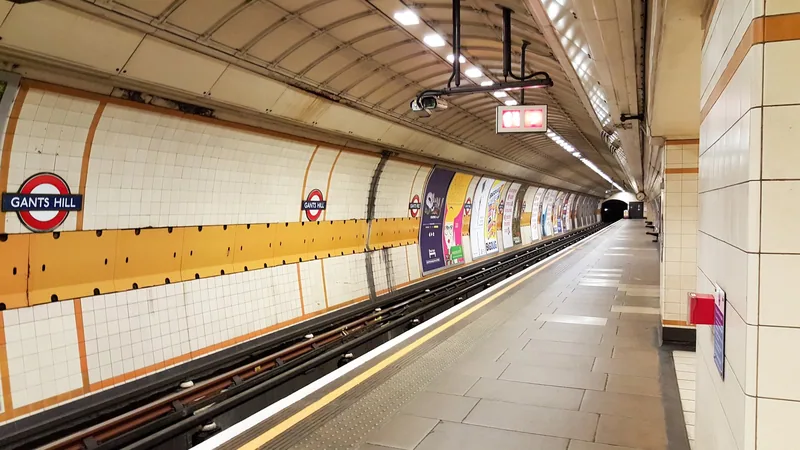
Photo: The wub · CC BY-SA 4.0 · Wikimedia Commons · resized
Holden's last group, and the eight-year gap
Historic England's list entry for Redbridge, the next station towards London, sets out the history and names Gants Hill in it: Gants Hill, Wanstead, Redbridge and Ruislip Manor were among Charles Holden's last designs for London Underground. They were drawn up under the 1935 to 1940 New Works Programme, which was to extend the Central line east and west, and then the Second World War stopped everything.
The unfinished works were used first as air-raid shelters. Then, from 1942, the tunnels between Leytonstone and Gants Hill were converted into an aircraft component factory run by Plessey. The tunnel you ride through to get here spent three years as a production line.
Nothing on the eastern extension opened until after the war. Historic England dates the opening of Redbridge to 14 December 1947, and the museum dates the Gants Hill commission to the same year. The delay is why Gants Hill feels later than Holden's famous Piccadilly line stations of 1932 and 1933, which our page on Charles Holden's Underground stations covers in detail, and why the surface here has nothing in Holden's manner at all: the money had gone.
It is not a listed building, and that is a finding
Many published descriptions imply otherwise, so it is worth stating plainly. Gants Hill station is not on the National Heritage List for England. A name search of Historic England's own open data returns nothing, and a search of every listed building within a box of about 330 metres around the station returns nothing at all: not the station, not the roundabout, not a single building on any of the approaches.
Its neighbours are protected. Redbridge Underground Station, one stop towards London, is listed Grade II (list entry 1401101, listed 20 July 2011). Three stops the other way round the loop, the bus shelter at Newbury Park is listed Grade II as well. Gants Hill, which is architecturally the most interesting of the three, has no protection whatever.
Make the vault part of a journey rather than a there-and-back. The concourse is inside the ticket barriers, so you need a valid fare to reach it. Ride out from central London, look at it, then carry on round the Hainault loop instead of touching out and in again at the same gateline: Gants Hill to Newbury Park is £2.20 off-peak and takes a few minutes, and it puts you next to the other listed thing out here.
Newbury Park, three stops on, and the Festival of Britain plaque
If you have come this far, the second stop is the one that makes the trip a proper afternoon. The bus station shelter outside Newbury Park station is a great concrete vault with a copper-panelled roof arch, listed Grade II as list entry 1081019, and it is by a different architect: Oliver Hill (1887-1968), working for London Transport.
The story parallels Gants Hill exactly. Frank Pick commissioned Hill in 1937 to design a whole railway interchange here, with decorative glass carried over from Hill's British Pavilion at the 1937 Paris Exhibition. The war stopped it, the commission was revived in 1947 in a scaled-back form consisting of the bus shelter and a small staff cafeteria, and the shelter was finished in 1949. Historic England records that it was one of only nineteen buildings given an award of merit in the 1951 Festival of Britain Special Architectural Awards, and the plaque carrying the Festival's 1951 emblem is still mounted on the vault facing Eastern Avenue. Go and look for it; almost nobody does.
Getting there, and which train
Gants Hill is on the Hainault loop, which means two things. A train showing Hainault via Newbury Park reaches Gants Hill within a few minutes of Leytonstone, which is what you want. A train showing Hainault via Woodford goes the long way round the same loop and takes roughly half an hour longer to arrive at the same platform. Read the front of the train, not just the destination.
From central London the direct times are 28 minutes from Holborn and 32 from Oxford Circus. The fare from Oxford Circus is £3.60 off-peak and £4.80 at peak times with contactless or Oyster, and a paper single is £7.00 whatever the distance; our explainers on London's travel zones and using the Underground cover the rest.
Two things about the ride. The Central line has no air conditioning, which on a hot afternoon makes a 30-minute run east genuinely unpleasant; see which Tube lines have air conditioning. And the eastbound evening peak out of the City is heavy as far as Leytonstone, so go in the middle of the day if you can.
Step-free access: there is none
Gants Hill has three escalators and no lifts, and TfL's station data holds no step-free record for it at all. Every route in and out is by subway and escalator, and the subways have steps at the pavement end. There is no alternative surface entrance, because there is no surface building.
That rules the station out entirely for wheelchair users, and makes it hard work with a pushchair or a heavy case. Redbridge, one stop towards London, is no better. Our page on accessible transport explains what staff can and cannot do in a station of this shape. If the vault is what you came for and the escalators are the problem, the London Transport Museum holds photographs of it.
What else is out here, honestly
Not much, and it is better to say so. Gants Hill above ground is a busy junction with shops and restaurants along Cranbrook Road and Eastern Avenue, and it is a real neighbourhood rather than a destination. There is no museum, no park at the roundabout and nothing to see at street level.
Two things are within reach if you want to build a day. Wanstead, two stops back towards London, is the station for the open grassland at the southern edge of Epping Forest; see Wanstead Flats and, for the woods proper, Epping Forest. And Gants Hill is the northern end of the Superloop route SL12, which runs to Rainham through Newbury Park, Romford and Elm Park; our pages on the Superloop and Romford and Havering cover that corridor.
Frequently asked questions
Why does Gants Hill station look like the Moscow Metro?
Because of its long barrel-vaulted lower concourse with indirect lighting, set between the two platforms. The London Transport Museum calls it the Moscow Hall and connects it to Charles Holden's visit to the Moscow Metro. It is the only space of its kind on the London Underground.
Can I go and see the Gants Hill concourse without travelling?
No. The vault is on the platform level, inside the ticket barriers, so you need a valid fare. From Oxford Circus that is £3.60 off-peak. The practical approach is to make it part of a journey and carry on round the Hainault loop afterwards rather than touching out and back in at the same station.
Is Gants Hill station a listed building?
No. Historic England's list contains no entry for Gants Hill station, and a search of every listed building within about 330 metres of it returns nothing. Redbridge station, one stop away, is listed Grade II, and the bus shelter at Newbury Park is listed Grade II as well.
How do I get to Gants Hill from central London?
Central line eastbound, on a train shown as Hainault via Newbury Park. Twenty-eight minutes from Holborn and thirty-two from Oxford Circus. A train shown as Hainault via Woodford reaches the same station about half an hour later, having gone round the loop the other way.
Is Gants Hill station step-free?
No. It has three escalators and no lifts, and the only entrances are pedestrian subways with steps up to the pavement. There is no surface station building and no alternative route in, so the station is not usable by wheelchair users.
Sources
- Transport for London Unified API - Gants Hill Underground Station: escalators, lifts, gates and facilities (checked September 2026)
- Transport for London - detailed station data: Gants Hill area levels, booking hall and platforms (checked September 2026)
- Historic England - Redbridge Underground Station, list entry 1401101, Grade II, with the history of the Central line eastern extension (checked September 2026)
- Historic England - Newbury Park Station Bus Shelter, list entry 1081019, Grade II (checked September 2026)
- London Transport Museum - ten designs Charles Holden brought to London, including the Gants Hill "Moscow Hall" (checked September 2026)
- Transport for London Unified API - single fare, Oxford Circus to Gants Hill (checked September 2026)