
The Central line is the red one, and it is the line that runs straight along Oxford Street: 49 stations from Epping in the Essex countryside, under the whole of central London, out to West Ruislip and Ealing Broadway in the west. It splits at both ends, it has the second-hottest platforms on the network, and it is the only line that links London's two Westfield shopping centres.
Two things decide whether it works for you. The first is the branches: an eastbound train from Oxford Circus might be going to Epping, to Hainault the long way round, or to Hainault the short way round, and they are not the same journey. The second is step-free access, which on this line is close to non-existent where visitors need it. The network, the fares, the map and how to touch in belong to our visitor's guide to the Underground; this page is about the line itself.
The Central line in brief
- Colour on the map
- Red
- Stations
- 49
- Eastern ends
- Epping (Zone 6) and Hainault (Zone 4), plus the Hainault loop via Woodford
- Western ends
- West Ruislip (Zone 6) and Ealing Broadway (Zone 3)
- Trains through the West End at the morning peak
- 30 an hour westbound at Oxford Circus, one every two minutes
- Air conditioning
- None, and no funded replacement date (September 2026)
- Step-free from street to platform
- 15 of 49 stations in TfL's station data of 3 August 2026, plus Northolt from September 2026
- Night Tube
- Friday and Saturday nights, but not to Epping and not to West Ruislip
Reading the destination: four ends and one loop
West of the centre the line divides at North Acton. One branch runs through West Acton and Ealing Broadway and stops there. The other carries on through Hanger Lane, Perivale, Greenford, Northolt, South Ruislip and Ruislip Gardens to West Ruislip. Ealing Broadway is the branch most visitors want, because it also has the District line and the Elizabeth line to fall back on.
East of Leytonstone it is stranger. One branch runs out through Snaresbrook, South Woodford, Woodford, Buckhurst Hill, Loughton, Debden and Theydon Bois to Epping. The other is a loop: Wanstead, Redbridge, Gants Hill, Newbury Park, Barkingside, Fairlop, Hainault, Grange Hill, Chigwell and back to Woodford. Trains run round it in both directions, so a Hainault train from the centre may go via Newbury Park, which is the short way, or via Woodford, which is the long way.
The practical rule is simple. For Epping, Loughton and the forest, read the front of the train and ignore anything signed Hainault. For Gants Hill or Newbury Park, a train signed Hainault via Newbury Park gets you there in a few minutes; one signed Hainault via Woodford takes about half an hour longer round the loop.
Leytonstone is where the eastern branches part, not Stratford. If you board at Stratford or Mile End going east you are still on a train that will commit itself at Leytonstone, so check the destination before you sit down. Getting it wrong costs you a wait on a windy platform at Leytonstone for the next train on the branch you actually wanted.
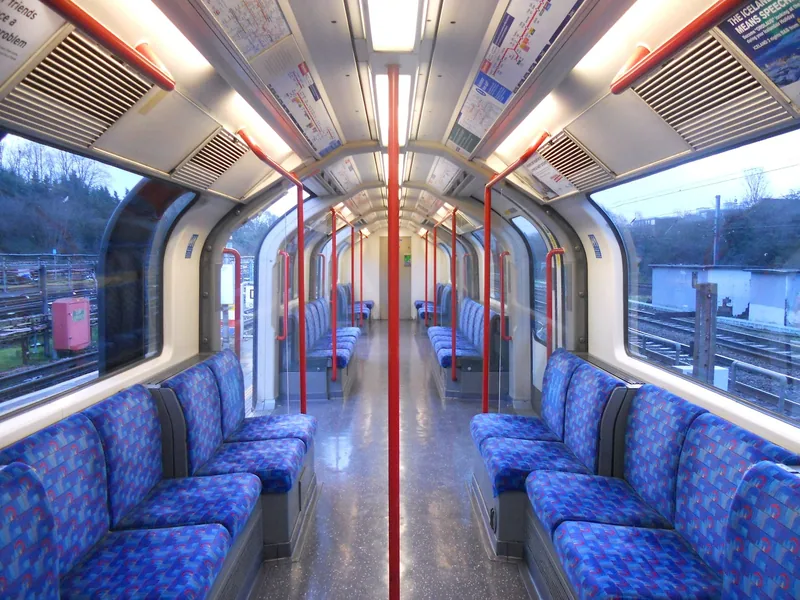
Photo: PeterSkuce · CC BY-SA 4.0 · Wikimedia Commons · resized
The 1992 trains, and why they feel old
The Central line runs a fleet built in the early 1990s. It was the first Tube fleet designed to be driven automatically, and on most of the line the train drives itself while the operator opens and closes the doors. That is why the ride is smooth and the stops are abrupt.
Inside, the carriages have longitudinal seats along the walls, no walk-through gangways and no screens telling you the next station. You get announcements and a strip map, which is enough if you know the stops and awkward if you do not. There is no proper luggage space; if you are moving between hotels with cases, read our notes on taking suitcases on the Tube first, because the doorways fill up fast.
These trains are also the reason the line is hot. They are being refurbished rather than replaced, and TfL has no funded date for a new fleet, so nothing about the temperature is going to change soon.
Second hottest, not hottest
The Central line's reputation as the worst line in a heatwave is not quite deserved. On TfL's own platform temperature data for the evening peak in August 2024, the Central line averaged 30.6 °C. The Victoria line averaged 31.1 °C and is hotter in every month of the year. The Central is second, which is small comfort at Bank in July but worth knowing if you are choosing between two routes.
The Elizabeth line runs under the same corridor, from Liverpool Street through Farringdon, Tottenham Court Road and Bond Street to Paddington, and every one of its trains is air-conditioned. On a hot afternoon that swap costs you nothing on your daily cap. The full temperature table and the roll-out dates are in our page on which Tube lines have air conditioning, and the parallel route is explained in how the Elizabeth line works for visitors.
Mile End: the best interchange on the network
Most changes between a deep Tube line and a sub-surface line mean stairs, a passage and a wait. Mile End does not. TfL's station data shows the eastbound Central platform and the eastbound District platform at the same level with a level path between them, and the same westbound. You step off one train, walk across the platform, and wait for the other.
That makes Mile End the sensible place to swap between the Central line and the District or Hammersmith & City lines if you are heading for Whitechapel, Tower Hill or Victoria, and it is far easier than fighting through Liverpool Street. The area around it is covered in our guide to Bow and Mile End.
Three other Central line changes are worth a warning. At Bank the Central platforms sit at the deepest point of a station that also holds the Northern, Waterloo & City and DLR platforms plus a passage to Monument, and the walk between the far ends is long enough that many people prefer to surface and walk. At Notting Hill Gate the Central platforms are below the Circle and District platforms, with escalators between them. And at Holborn the Central line and the Piccadilly line share a cramped ticket hall that TfL closes to incoming passengers at busy times.
Step-free access: almost nothing in the middle
This is the line's real weakness. Working through TfL's detailed station data, 15 of the 49 stations have a step-free route from the street to a platform, and in the whole central section there are only three: Bond Street, Tottenham Court Road and Stratford.
That leaves Oxford Circus, Holborn, Chancery Lane, St Paul's, Bank, Liverpool Street, Marble Arch, Lancaster Gate, Queensway and Notting Hill Gate with stairs somewhere in the route. Bank and Liverpool Street both have step-free access to other lines and not to the Central line, which is the kind of distinction that ruins a day if you read the lift symbol on the map and assume it applies to your train.
Further out the picture improves: Ealing Broadway, Greenford, Stratford, Woodford, South Woodford, Newbury Park, Hainault, Roding Valley, Buckhurst Hill, Debden, Theydon Bois and Epping are step-free. Two of them are step-free in one direction only, because the accessible entrance serves a single platform: at Barkingside and Theydon Bois the eastbound platform is reachable and the westbound is not.
Two changes are in progress. Northolt became step-free in September 2026, after the data above was published. Leyton is being rebuilt with two lifts, two staircases and a larger ticket hall, work that started in February 2025 and which TfL expects to finish by summer 2027; the station stays open apart from a few weekend closures. Both are part of the Mayor's target of making half of all Tube stations step-free by 2030. How the turn-up-and-go assistance service works, with no booking, is in our guide to step-free and accessible transport in London.
Stratford is the step-free way into the East End. If you are using a wheelchair or pushing a pram and you want the Central line east of the City, start or finish at Stratford rather than Liverpool Street. It is step-free, it is on the Elizabeth line and the DLR as well, and the Jubilee line is across the concourse.
What the weekend does to it
The Central line is less prone to total shutdowns than the lines being rebuilt, but the branches are where weekend work lands. The Hainault loop, the West Ruislip branch and the section beyond Loughton are all worked on in weekend blocks, and replacement buses on those outer sections are slow.
Saturday service on the line is also thinner than on a weekday. TfL's timetable data for Oxford Circus shows about 15 westbound trains an hour on a Saturday against 24 to 30 on a weekday, so trains are busier rather than more frequent, particularly between Tottenham Court Road and Notting Hill Gate when the shops are open.
Check the status on the Friday. TfL publishes planned work weeks ahead on its live status page, and our advice for the days when a line is down is in getting around when the Tube is not running.
Night Tube: not to Epping, not to Ruislip
On Friday and Saturday nights the Central line runs all night from Ealing Broadway to Hainault and from Ealing Broadway to Loughton. Two parts get nothing at all: the West Ruislip branch, and the stretch beyond Loughton to Debden, Theydon Bois and Epping.
For most visitors that is fine, because the night section covers Oxford Circus, Tottenham Court Road, Holborn, Bank, Liverpool Street, Bethnal Green, Mile End and Stratford. If your hotel is at Epping or on the Ruislip branch, work out the night bus before you go out. Fares are off-peak and count towards the daily cap, and the sections on other lines are set out in our guide to the Night Tube.
The journey only this line makes: Westfield to Westfield
Both of London's Westfield centres sit on the Central line, and nothing else links them directly. White City, for Westfield London, is eight stops west of Oxford Circus. Stratford, for Westfield Stratford City, is at the other end of the same line. One train, no changes, and you can compare the two in an afternoon; which is worth your time is argued out in our guide to the Westfield centres at Stratford and White City.
The same line does something better still at its eastern end. Four Central line stations sit on the edge of Epping Forest: Buckhurst Hill, Loughton, Theydon Bois and Epping. Epping to Oxford Circus takes about 47 minutes on TfL's journey planner, which means a genuinely wild six thousand acres of ancient woodland is inside an hour of the West End on an ordinary Tube fare with a daily cap on it.
| From Oxford Circus | Direction | What is at the other end |
|---|---|---|
| Tottenham Court Road | Eastbound, 1 stop | The Elizabeth line, Soho and Denmark Street |
| St Paul's | Eastbound, 4 stops | The cathedral and the western City |
| Stratford | Eastbound, about 25 minutes | The Olympic Park, Westfield Stratford City |
| White City | Westbound, 8 stops | Westfield London, the BBC buildings |
| Epping | Eastbound, about 47 minutes | Epping Forest and open country |
The two ends of the line also explain two neighbourhoods worth a half day: our guides to Stratford and to Shepherd's Bush and White City cover what is there beyond the shopping, and the park itself is in London 2012 and the Olympic Park today.
When to avoid it
The worst of the Central line is the evening peak between Bank and Notting Hill Gate, when City workers and Oxford Street shoppers arrive on the same trains. TfL's timetable puts 27 trains an hour through Oxford Circus between 16:00 and 19:00, and they still fill up.
Half an hour either side changes the experience completely, and after 19:00 you will usually sit down. The wider pattern, including which interchanges are worst, is in our guide to avoiding the London rush hour. For the short central hops, walking often wins, and the pairs where it does are listed in Tube stations it is quicker to walk between.
Frequently asked questions
Is the Central line the hottest line on the Underground?
No, it is second. On TfL's platform temperature data for the evening peak in August 2024 the Central line averaged 30.6 °C and the Victoria line averaged 31.1 °C. The Victoria line is hotter in every month of the year, including January. Neither line has air-conditioned trains and there is no funded replacement date for the Central line fleet.
Which Central line branch do I need for Epping Forest?
The Epping branch, not the Hainault branch. The branches separate after Leytonstone. Buckhurst Hill, Loughton, Theydon Bois and Epping are all on the edge of the forest, and Epping is about 47 minutes from Oxford Circus. Trains signed Hainault, whether via Newbury Park or via Woodford, will not take you there.
Which Central line stations are step-free?
Fifteen of the forty-nine in TfL's station data published in August 2026, with Northolt added in September 2026. In the central section only Bond Street, Tottenham Court Road and Stratford have a step-free route from street to platform. Bank and Liverpool Street are step-free to other lines but not to the Central line, and Barkingside and Theydon Bois are step-free to the eastbound platform only.
Does the Central line run all night at weekends?
On Friday and Saturday nights it runs from Ealing Broadway to Hainault and from Ealing Broadway to Loughton. There is no night service on the West Ruislip branch and none beyond Loughton to Debden, Theydon Bois or Epping. Night fares are off-peak and count towards the daily cap.
What is the difference between Hainault via Newbury Park and Hainault via Woodford?
They are the two directions of the same loop. Via Newbury Park is the direct way from central London and reaches Gants Hill and Newbury Park within a few minutes of Leytonstone. Via Woodford goes the long way round through Woodford, Chigwell and Grange Hill and takes roughly half an hour more to reach the same stations.
Sources
- Transport for London - Stations, platforms, lifts and step-free data (feed of 3 August 2026) (checked September 2026)
- Transport for London - Central line route and branch data (checked September 2026)
- Transport for London - Central line timetable at Oxford Circus (checked September 2026)
- Transport for London - Leyton station step-free access (checked September 2026)
- Transport for London - Step-free access (checked September 2026)
- Transport for London - The Night Tube (checked September 2026)
- London Datastore - London Underground average monthly temperatures (checked September 2026)