
Between 1930 and 1933 the architect Charles Holden built a run of Underground stations in outer London that are now among the most highly protected modern buildings in Britain: four of them are listed at Grade II*, and the office block he designed above St James's Park station is Grade I. You can walk into every one of them on an ordinary fare. This page says what each is, what to look at when you get off, and how long the journey between them takes, using Historic England's own list entries.
Charles Henry Holden (1875-1960) worked through the practice Adams, Holden & Pearson, and he worked for one client in particular: Frank Pick (1878-1941), who ran the Underground Group and became Chief Executive of the London Passenger Transport Board in 1933. In 1930 the two of them made a study tour of continental railway stations and modern architecture together, and what came back from that trip is what you see at Arnos Grove and Southgate. Our guide to art deco London places these stations in the wider picture of the period, and makes the important practical point about the ticket halls; this page goes station by station.
The listed Holden stations, from Historic England's list
- St James's Park (55 Broadway)
- Grade I, list entry 1219790, listed 9 January 1970. Built 1927-9
- Sudbury Town
- Grade II*, 1294594, listed 19 February 1971. Built 1930-1
- Arnos Grove
- Grade II*, 1358981, listed 19 February 1971. Built 1932
- Southgate
- Grade II*, 1188692, listed 19 February 1971. Opened March 1933
- Oakwood
- Grade II*, 1078930, listed 19 February 1971. Built 1933
- Cockfosters
- Grade II, 1358718, listed 26 May 1987. Built 1933
- Turnpike Lane
- Grade II, 1263624, listed 17 May 1994. Built 1932
- Boston Manor
- Grade II, 1063901, listed 21 March 2002
- Bounds Green
- Grade II, 1393641, listed 19 January 2010
- Wood Green
- Grade II, 1401120, listed 20 July 2011
The dates that explain the map
The northern extension of the Piccadilly line beyond Finsbury Park was authorised by an Act of Parliament on 4 June 1930, seven miles of railway built to serve suburbs that in most cases did not exist yet. It opened in three stages. Finsbury Park to Arnos Grove, including Manor House, Turnpike Lane, Wood Green and Bounds Green, opened on 19 September 1932. Southgate and Enfield West, which is now Oakwood, followed in March 1933. Cockfosters, the terminus, opened on 31 July 1933.
The western stations came from a different job: the Piccadilly line taking over Metropolitan and District tracks out to Uxbridge in 1932 and 1933, which meant replacing the old timber-and-corrugated-iron halts. Sudbury Town was the first of those, and the first of the whole family. Our page on the Piccadilly line covers the branches today.
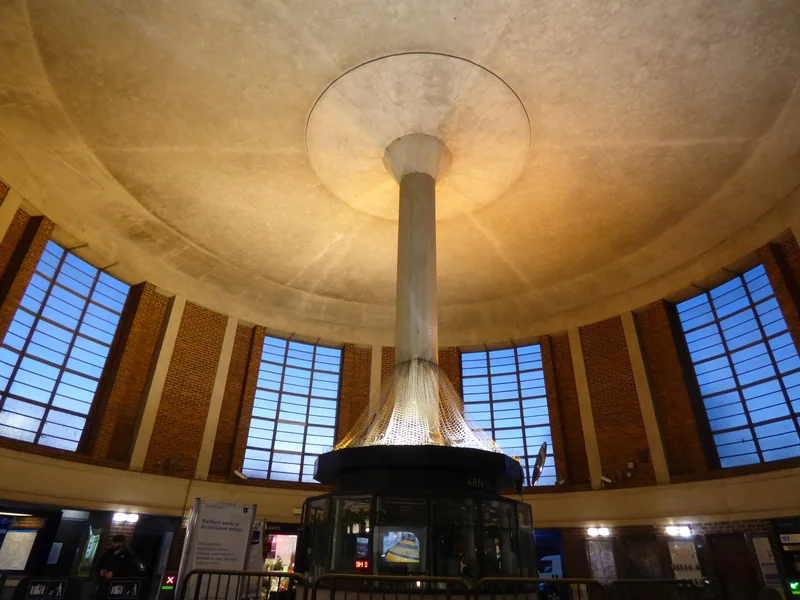
Photo: James Cracknell · CC BY-SA 4.0 · Wikimedia Commons · resized
Sudbury Town: the prototype, and the mistake that changed everything
Sudbury Town was built in seven months between December 1930 and July 1931, and it is the design the others come from. Historic England calls it the "Sudbury box": a tall rectangular brick booking hall with a flat concrete roof, big windows and lower side wings. Holden's first idea for the site, a narrow three-storey building with a single arched window in the manner of contemporary Dutch stations, was rejected, and the brick work of Willem Marinus Dudok (1884-1974) in Holland is the influence the listing names.
What to look at when you get off: the passimeter, the little glazed island ticket kiosk in the middle of the booking-hall floor, which dates from the First World War period and is one of the few left anywhere; the integral shop unit and refreshment area; and the enamel London Underground roundels set into the windows, which the list entry calls unique.
The failure is also worth knowing, because it changed every station after it. The concrete roof and canopies were cast in place, and the shuttering leaked and stained the brickwork. The method was not repeated. Sudbury Town sits between Wembley and Harrow on the Piccadilly's western arm, which runs on to Uxbridge and Ruislip.
Arnos Grove: the one to see if you see only one
Arnos Grove is the most highly regarded of them, and Historic England says so in those words: "probably the most highly regarded example of Charles Holden's ground-breaking Modernist designs". It is a tall brick cylinder ringed with windows set on a square base, the first of Holden's circular ticket halls, and it was designed to be lit up at night like a lantern.
Two stories about where the shape came from sit side by side in the list entry, and both are worth having. Charles Hutton (1907-95), Holden's chief assistant, who did much of the practical detail, said the cylinder-in-a-square derived from a groundsman's lodge at Midhurst Sanatorium that the practice had designed in 1904-6. Others point to Erik Gunnar Asplund's Stockholm City Library of 1920-28, which Pick and Holden saw on their 1930 tour. Historic England prints both. So do we.
The leaking shuttering at Sudbury Town caught up with Arnos Grove during construction. The load-bearing brick walls were abandoned part way through in favour of a reinforced-concrete frame with brick infill, which is why the entrances sit where they do: they had to be fitted around sixteen concrete stanchions grouped in pairs between the windows. Inside, the passimeter and the original telephone kiosks survive.
Southgate: a drum in a roundabout, with the best interior
Southgate is the strange one and the one that rewards standing still. The surface building is a low circular drum on an oval island in the middle of a roundabout, a high booking hall ringed by lower shops and offices, on a plinth of Cornish granite. On the roof sits a finial of five swirling bands between opal light fittings with a ball on top, which the listing describes as distinctively Scandinavian and which looks, from the pavement, like a piece of 1930s science fiction.
Go through the booking hall rather than straight down. The passimeter here wraps around a central concrete pier that throws light both up and down, the concrete roof above the clerestory ripples around the top of that pier, and a sign over the head of the escalators still reads "TO THE TRAINS". The escalator hall itself, modernised in 1991, kept eight pairs of bronze uplighters and the bronze escalator casings, and the list entry calls those uplighters a special feature of Southgate specifically.
Oakwood and Cockfosters: the last two, and the separately listed sign
Oakwood, which opened in March 1933 as Enfield West, is a variant of the Sudbury box designed by Holden with Charles H. James, and it is one of the best preserved of them all: the passimeter is still there, and so are the integral shop units and the platform structures. A step-free access gantry was added in 2006-7, which is why this is the one Holden station on the northern extension you can use in a wheelchair.
Outside it, the station sign to the north of the entrance has its own list entry, 1358982, Grade II in its own right. A listed signpost is an unusual thing, and it tells you how seriously the 1971 listings took Pick's insistence that the lettering and the roundel were part of the architecture.
Cockfosters, the terminus of 31 July 1933, is different in kind from the others: the interest is not the booking hall but the train shed behind it. A concrete frame in alternating wide and narrow bays leans inwards above the platform canopies to form a clerestory over the central track, so the whole shed is lit from above. The booking hall is prow-shaped, there are towerlets at either end with Underground sign finials, and the original light fittings and signs survive. Two stops back along the line at Oakwood, a free shuttle runs to the mansion at Trent Park, which makes a sensible second half to the day.
Turnpike Lane, and the ones nobody looks at
Turnpike Lane, listed in 1994, is the Holden station most Londoners pass through without noticing. It is red brick with grey diaper infill on an exposed concrete frame, using a corner site boldly, with two ventilation towers, the one on Green Lanes carrying the word "Underground".
Inside, the booking-hall floor is sunken and tiled in brown, with a central bronze uplighter shaped like a half-sphere on a tapered fluted column, and an original sign still points to the "BUS STATION". At platform level the tiling is cream and deep yellow, with incised ventilation covers designed by Harold Stabler over fully lined-out roundels. Green Lanes runs north from the station towards the restaurants on our Suffragette line page, so this is the one to combine with a meal.
Bounds Green (listed 2010), Wood Green (2011) and Boston Manor (2002) were listed much later than the famous four. All three are Grade II, all three are variants rather than originals, and all three are for completists.
55 Broadway: the Grade I building above a station
The building most visitors walk under without knowing whose it is sits directly on top of St James's Park station, and its list entry is called "London Underground Headquarters including St James's Park Underground Station". It is Grade I, listed on 9 January 1970, and it was built in 1927-9 as the head office of the Underground Electric Railways of London, under Lord Ashfield and Frank Pick.
The facts worth carrying: a cruciform plan on a tapering corner site, faced in Portland stone over a steel frame; a tower of 175 feet, or 53.3 metres; and four wings that rise to exactly 80 feet, because that was the limit the 1894 Building Act imposed. The rainwater hoppers carry the figures "U 1929 D" set inside a roundel, and at street level there is a screen of blue-grey Norwegian granite columns with capitals of black Belgian marble.
Then the sculpture, which is the reason to stand on the pavement and look up. The building carries ten pieces: Jacob Epstein's two figures, Day and Night, above the secondary entrances on the south-east and north-east faces, and eight figurative reliefs of the Winds, one for each cardinal point. The list entry names the sculptors as Epstein, Eric Gill, Allan Wyon, Henry Moore, Samuel Rabinovitch, Eric Aumonier and Alfred Gerrard. Our guides to Westminster and London's blue plaques cover the streets around it.
Doing it in a day: don't
The stations are at opposite ends of a very long line, and the journey times are the reason to split them. These are TfL Journey Planner times for a Wednesday late morning:
| Leg | Time | Changes |
|---|---|---|
| St James's Park to Boston Manor | 31 minutes | 1 |
| Boston Manor to Sudbury Town | 28 minutes | 1, at Acton Town |
| Sudbury Town to Arnos Grove | 66 minutes | None, and it feels like it |
| Arnos Grove to Southgate, Oakwood and Cockfosters | 11 minutes for all three | None |
That is two hours and sixteen minutes of travelling before you have looked at anything. Do the northern four in one afternoon, which is eleven minutes of riding plus however long you stand about, and give the western two a separate trip on a day you are already going west; our page on how the zones work explains where the fare boundaries fall.
Step-free access, and it is poor
Of the ten listed stations above, TfL's station data records step-free access at only two. Oakwood is step-free by lift, thanks to the 2006-7 gantry. Sudbury Town is step-free but only from the correct entrance for your platform, so check which side you need before you arrive. Arnos Grove, Southgate, Cockfosters, Turnpike Lane, Wood Green, Bounds Green and Boston Manor have no recorded step-free route; Southgate has two escalators and no lift, and Turnpike Lane and Wood Green have three escalators each and no lift.
That is the honest position on a set of buildings designed in the 1930s and protected in their original form. Our page on accessible transport covers what staff will do, and the London Transport Museum in Covent Garden is the place to see the design programme explained indoors.
After Holden: what happened next
Holden's last designs for London Underground were not on the Piccadilly line at all. Historic England's list entry for Redbridge station names Gants Hill, Wanstead, Redbridge and Ruislip Manor as the last group he worked on, designed under the 1935-40 New Works Programme and delayed by the Second World War, so that none of them opened until 1947. The strangest of them is the barrel-vaulted concourse at Gants Hill, which is on the Central line in suburban Essex and looks like nothing else in London.
Frequently asked questions
Which Charles Holden station should I visit first?
Arnos Grove, on the Piccadilly line in Zone 4. Historic England calls it probably the most highly regarded of Holden's designs, it is listed at Grade II*, and the circular brick booking hall with its original passimeter and telephone kiosks is on the public side of the ticket barriers. Southgate, two stops further, is the best interior of the group.
Do I have to pay to see Holden's station buildings?
Not to see the booking halls, which is where most of the architecture is. For the platforms and the train shed at Cockfosters you need a valid fare like any other passenger, and the ordinary daily cap applies however many of the stations you visit in one day.
What is the Grade I Charles Holden building in central London?
55 Broadway, the block above St James's Park Underground station, built in 1927-9 as the headquarters of the Underground Electric Railways of London. It carries ten sculptures, including Jacob Epstein's Day and Night and eight reliefs of the Winds, by sculptors including Eric Gill and Henry Moore.
How many Holden Underground stations are listed?
Ten appear in this guide: Grade I at St James's Park, Grade II* at Sudbury Town, Arnos Grove, Southgate and Oakwood, and Grade II at Cockfosters, Turnpike Lane, Boston Manor, Bounds Green and Wood Green. The station sign outside Oakwood has a separate Grade II listing of its own.
Can I visit Holden's stations with a wheelchair?
Oakwood and Sudbury Town only, and at Sudbury Town the step-free route depends on using the right entrance for your direction of travel. The other eight have no step-free route recorded in TfL's station data; Southgate, Turnpike Lane and Wood Green have escalators but no lifts.
Sources
- Historic England - Arnos Grove Underground Station, list entry 1358981, Grade II* (checked September 2026)
- Historic England - Southgate Underground Station, list entry 1188692, Grade II* (checked September 2026)
- Historic England - Sudbury Town Underground Station, list entry 1294594, Grade II* (checked September 2026)
- Historic England - Oakwood Underground Station, list entry 1078930, Grade II* (checked September 2026)
- Historic England - London Underground Headquarters including St James's Park Underground Station (55 Broadway), list entry 1219790, Grade I (checked September 2026)
- Historic England - Cockfosters station including platforms and platform canopies, list entry 1358718, Grade II (checked September 2026)
- Historic England - Turnpike Lane Underground Station, list entry 1263624, Grade II (checked September 2026)
- Transport for London - detailed station data: lifts, escalators and step-free routes (checked September 2026)