
The Victoria line is the light blue one: sixteen stations from Walthamstow Central in north-east London to Brixton in the south, the whole route in tunnel, and the quickest way to cross the middle of the city. Brixton to Walthamstow Central takes 30 or 31 minutes, and in the evening peak a southbound train leaves Oxford Circus every hundred seconds.
There is nothing to look at and nothing complicated to work out. No branches, no splitting trains, no choice of route; you pick a direction and get on. What makes it worth a page of its own is how much it does with sixteen stops, and how thin its step-free coverage is in the places visitors actually use. The fares, the map and the business of standing on the right on an escalator belong to our introduction to the London Underground.
Victoria line, the short version
- Colour on the map
- Light blue
- Stations
- 16, all of them underground
- Northern end
- Walthamstow Central, Zone 3
- Southern end
- Brixton, Zone 2
- End to end
- 30-31 minutes
- Trains an hour, evening peak
- 36 southbound through Oxford Circus (TfL timetable data)
- Trains an hour, Sunday afternoon
- 26-27
- Step-free from street to platform
- 7 of the 16 stations
- Night Tube
- Friday and Saturday nights, the whole line
- Air conditioning
- None, and none planned as at September 2026
Sixteen stops, fifteen of them useful for changing trains
From the north the order runs Walthamstow Central, Blackhorse Road, Tottenham Hale, Seven Sisters, Finsbury Park, Highbury & Islington, King's Cross St Pancras, Euston, Warren Street, Oxford Circus, Green Park, Victoria, Pimlico, Vauxhall, Stockwell and Brixton. That is the entire line. Nothing is signed "via" anything, and no train terminates short except during engineering work.
Look at that list again and one thing stands out: every station on it is an interchange with another railway, except Pimlico. Walthamstow Central has the Overground's Weaver line, Blackhorse Road the Suffragette line, Tottenham Hale and Seven Sisters have main-line platforms for Stansted and Cambridge, and the seven stations from Finsbury Park to Victoria between them touch nine other lines. Pimlico, between Victoria and Vauxhall, is the one stop that exists purely to serve the streets above it, which happen to include Tate Britain.
Because it links four main-line terminals (Walthamstow Central and Highbury & Islington aside, it calls at King's Cross St Pancras, Euston, Victoria and Vauxhall), the Victoria line does more work per mile than anything else on the map. It is also the reason a Gatwick passenger and a Stansted passenger can meet in the middle without changing twice.
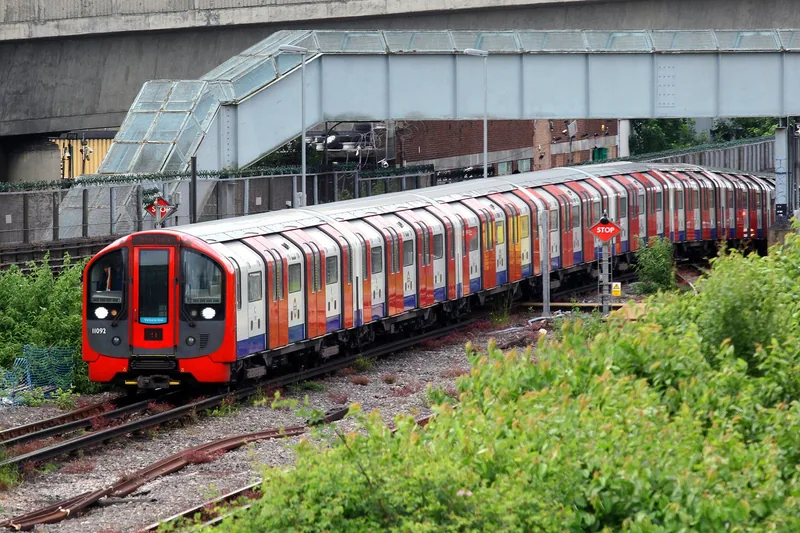
Photo: Samson Ng · CC BY-SA 4.0 · Wikimedia Commons · resized
The trains: newest of the deep-tube fleets, and it shows
The eight-car trains date from 2009 and 2010 and replaced stock built in the 1960s. They are the most recent deep-level Tube trains in London, at least until the Piccadilly line's new fleet enters service, and they feel it: wide double doors, bright lighting, a recorded announcement and a dot-matrix display for the next station, and grab poles rather than a scramble for a strap.
What they do not have is a walk-through interior or a corner for a large suitcase. Seating is mostly along the sides of the car, which leaves a broad standing space down the middle and works well for a two-minute hop between Green Park and Victoria. It works less well if you are guarding two cases, and our notes on taking luggage on the Tube are worth a look before you try it at 18:00.
The other thing the line is known for is the service interval. In TfL's own working timetable there are 36 southbound trains an hour through Oxford Circus between 08:00 and 10:00 and again between 16:00 and 19:00 on a Monday to Thursday, which is one every hundred seconds. Off-peak it drops to 26 or 27 an hour, still a train every two minutes or so. You do not need to know the time of the next train on this line. You need to know which end of the platform you want.
A two-minute service changes how you plan a day. On lines where trains come every ten minutes it is worth checking a departure board before you leave a museum. On the Victoria line it is not: walk to the platform and a train will be along before you have finished reading the adverts.
The heat, in one paragraph
No Victoria line train has air conditioning, and none is on order. On TfL's own platform temperature figures this is the hottest line on the Underground in every month of the year, averaging 31.1 °C at the evening peak in August 2024. Our page on which Tube lines have air conditioning has the numbers line by line and the cooler routes across the centre; in July, if you have a choice between the Victoria line and a walk of fifteen minutes, take the walk.
Where the change of line is longer than the map suggests
A white interchange circle on the Tube map says nothing about distance. Four of these deserve a warning, and one deserves praise.
- Green Park, Victoria line to Jubilee line: 380 metres. That is the figure in TfL's station data for the step-free route, and even by escalator it is two long passages and a change of level. Green Park is a fine interchange from the Piccadilly line (160 metres) and a poor one to the Jubilee.
- Oxford Circus. Three lines meet in a warren of narrow passages under the busiest shopping crossroads in Britain, and at peak times staff close the entrances to control the crowd. Changing here works; arriving here with luggage does not.
- King's Cross St Pancras. The Victoria line platforms sit at the southern end of an enormous ticket hall shared with five other lines and two main-line stations. Allow more time than the app says, and read our guide to King's Cross and St Pancras before a tight connection.
- Euston. The Underground here is not part of the main-line concourse, and the official station map says so in plain words: no concourse interchange. Coming off a train from Manchester you walk out of the station and down a separate staircase. Our Euston station guide has the layout.
The praise goes to Finsbury Park. Southbound Victoria line and westbound Piccadilly line trains share an island platform, and so do the northbound and eastbound; you change by walking ten steps across the same platform. Anyone going between the West End and north London should treat it as the default place to swap lines, and the neighbourhood above it is covered in our page on Angel and Finsbury Park.
Step-free access: seven stations out of sixteen
Seven Victoria line stations have a step-free route from the street to the platform: Tottenham Hale, Finsbury Park, King's Cross St Pancras, Green Park, Victoria, Vauxhall and Brixton. That is not a bad list, because it includes both a main-line terminal in the centre, a southern terminus and the airport interchange at Tottenham Hale.
The nine that are not step-free are Walthamstow Central, Blackhorse Road, Seven Sisters, Highbury & Islington, Euston, Warren Street, Oxford Circus, Pimlico and Stockwell. Two of those are worth spelling out because the station symbol misleads. Blackhorse Road and Highbury & Islington both have lifts, and at both of them the lifts serve the Overground and main-line platforms only; the Victoria line platforms underneath are reached by stairs and escalator. A lift symbol on a station is not a promise of step-free travel anywhere on this network.
Where the line does have step-free access, it is unusually good at the last step of all. TfL's station data records a designated level-access boarding point on the Victoria line platforms at ten stations, including Oxford Circus, Euston and Stockwell, marked on the platform edge; at most of them the spot to wait is the double doors of cars 4 and 5. Staff help is turn-up-and-go with no booking, as our guide to step-free and accessible transport in London explains.
Weekends: the line that mostly stays open
Because there are no branches and no junctions to rebuild, the Victoria line suffers fewer weekend closures than the deep lines with complicated track layouts. When it does shut, it usually shuts in a block: Seven Sisters to Walthamstow Central, or Victoria to Brixton, with the rest running normally.
That matters because the substitutes are decent. For the northern end, main-line trains from Liverpool Street serve Tottenham Hale and Seven Sisters, and the Weaver line reaches Walthamstow Central. In the south, Vauxhall and Brixton both have their own main-line stations, so a closure between Victoria and Brixton is a change of train rather than a lost morning. Check the status on the Friday on TfL's live status page, and see getting around when the Tube is not running for the days when nothing is moving.
The Night Tube runs over the whole line
On Friday and Saturday nights the Victoria line runs all night from Walthamstow Central to Brixton, calling at all sixteen stations. There are no gaps and no branch left out, which is not true of every night line, and the timetable data shows about six trains an hour through the small hours, so roughly every ten minutes.
Night fares are charged at the off-peak rate and count towards the daily cap. The other lines that run, and the hours they keep, are in our guide to the Night Tube; if your night is not a Friday or Saturday, first and last Tube trains has the ordinary last departures.
Stansted, in one paragraph
Tottenham Hale is a Victoria line station with main-line platforms above it, and a train from Stansted Airport reaches it in about 37 minutes, eleven minutes faster than the run into Liverpool Street. Change there and you are on the Victoria line for King's Cross, Euston, Oxford Circus, Green Park or Victoria without another change. The fares, the tapping rules and the overnight gap are all in our guide to getting from Stansted into central London.
The journey this line owns: Brixton to Walthamstow, market to market
Here is the trip no other page on this site covers, and no other line could offer. The Victoria line connects two of the best street markets in London, at opposite ends of the city, in half an hour and for one fare. It is also the cheapest way we know to see how little the middle of London resembles either end of it.
| From Brixton, northbound | Time | What you get out for |
|---|---|---|
| Vauxhall | 4 minutes | Main-line trains, the bus station, the river |
| Victoria | 8 minutes | Gatwick trains, the coach station, Westminster on foot |
| Green Park | 10 minutes | St James's, Mayfair, the royal parks |
| Oxford Circus | 13 minutes | Oxford Street and Regent Street |
| King's Cross St Pancras | 17 minutes | Eurostar, the north, Granary Square |
| Finsbury Park | 21 minutes | Cross-platform change to the Piccadilly line |
| Walthamstow Central | 31 minutes | The market, and a ten-minute walk to the William Morris Gallery |
Times are from TfL's Journey Planner, sampled across several consecutive departures on a weekday late morning rather than a single query. At the southern end, Brixton gives you a covered market, a record shop and Caribbean food; at the northern end, Walthamstow gives you the longest outdoor market in Europe on a weekday and the William Morris Gallery for nothing. Neither is in the guidebooks' first ten pages. Both are on the same train.
Northbound in the morning, southbound in the evening, and you will sit down. The commuter flow is into the centre before 09:00 and out of it after 17:00. Doing the opposite on the Victoria line is the difference between a seat for half an hour and standing in the hottest air on the Underground.
One small warning for the return trip. Southbound trains from Walthamstow are already full of people by Highbury & Islington on a weekday morning, and Oxford Circus empties and refills in the same ten seconds. Half an hour either side of the peak changes the journey completely, which is the whole argument of our page on avoiding the London rush hour.
Frequently asked questions
How long does the Victoria line take from end to end?
Brixton to Walthamstow Central takes 30 or 31 minutes on TfL's Journey Planner at a weekday late morning, and the time barely changes across the day because the line has no junctions to wait at. Sixteen stations in half an hour makes it the fastest way to cross London from south-west to north-east.
Which Victoria line stations are step-free?
Seven of sixteen: Tottenham Hale, Finsbury Park, King's Cross St Pancras, Green Park, Victoria, Vauxhall and Brixton. Blackhorse Road and Highbury & Islington have lifts, but they reach only the Overground and main-line platforms, not the Victoria line ones, so do not plan a step-free journey from a lift symbol.
Does the Victoria line have air conditioning?
No, and none is planned as at September 2026. It is the hottest line on the Underground on TfL's own platform temperature data, averaging 31.1 °C at the evening peak in August. The four air-conditioned lines are the Circle, District, Hammersmith & City and Metropolitan, which run near the surface.
Does the Victoria line run all night?
On Friday and Saturday nights, yes, along the whole line from Walthamstow Central to Brixton with every station open, about every ten minutes. Fares are off-peak and count towards the daily cap. On other nights the line follows the ordinary Underground closing times.
How often do Victoria line trains run?
TfL's timetable shows 36 an hour through Oxford Circus at the busiest times, which is one every hundred seconds, and 26 to 27 an hour in the middle of the day. On a Sunday afternoon it is still a train every two to three minutes. It is the most frequent line on the Underground.
Sources
- Transport for London - Victoria line working timetable data (Unified API) (checked September 2026)
- Transport for London - Victoria line route sequence (Unified API) (checked September 2026)
- Transport for London - Stations, platforms, lifts and step-free data (checked September 2026)
- Transport for London - The Night Tube (checked September 2026)
- Transport for London - Step-free access (checked September 2026)
- Transport for London - Daily and weekly capping (checked September 2026)
- Transport for London - Tube, DLR and Overground status (checked September 2026)