
You do not need a train ticket to see the best of St Pancras. Everything that makes the building extraordinary — Barlow's single-span roof, the Gothic front on Euston Road, the Grand Terrace, the clock, the statues and a Victorian drinking fountain that still works — is on the public side of the ticket barriers. Allow an hour, and bring no luggage.
Two men made it. William Henry Barlow, the Midland Railway's chief engineer, designed the layout and the train shed with Rowland Mason Ordish. George Gilbert Scott designed the hotel and the station buildings that wrap around it. The station opened on 1 October 1868; the hotel opened in 1873 and was finished in 1876. The whole thing is listed Grade I.
Our guide to King's Cross as a neighbourhood covers what to do around the station, and London's main railway stations explains which trains go from where. This page is about the building: what to look at, what the numbers are, and the two occasions when it nearly did not survive.
The building in numbers
- Train shed
- 689 feet (240m) long, spanning 245 feet (75m), 100 feet (30m) high. The largest single-span roof in the world when it was built
- Roof structure
- 25 principal arched trusses, each weighing 55 tons, built into brick piers
- Undercroft
- The platform deck stands on 688 cast-iron columns, spaced 14 feet apart
- Bricks
- About 60 million, most of them red facing bricks from Nottingham
- Opened
- Station 1 October 1868; hotel 1873, completed 1876; reopened as an international station in 2007
- Architect and engineers
- George Gilbert Scott (hotel and station buildings); William Henry Barlow and Rowland Mason Ordish (train shed)
- Cost to look
- Nothing. The concourse, Grand Terrace and undercroft level are all public
Barlow's roof, and why it has a point at the top
Stand on the Grand Terrace at the top of the escalators and look up. The roof is a single arch from one side of the station to the other, with nothing holding up the middle. In 1868 that was unprecedented: every other great station roof of the period needed rows of columns down the platforms.
Twenty-five arched trusses do the work, each weighing 55 tons, set at intervals and bedded into massive brick piers along the sides. They were put up using a timber scaffold running on rails, which was rolled north one bay at a time; each rib took over a week to assemble. When the roof was finished, the scaffold was taken apart and the timber reused for the platform surfaces.
The detail worth knowing is the shape. Earlier iron train sheds used a plain rounded arch. Barlow's rises to a slight point at the crown, which he adopted mainly to resist sideways wind loading, though he admitted it also improved the look of the thing. Once you have seen it, the profile is unmistakable from outside on Pancras Road.
The ironwork came from the Butterley Iron Company in Derbyshire. So did almost everything else: a large share of the bricks from Edward Gripper's Nottingham Patent Brick Company, with extra from Tucker and Sons of Loughborough when demand outran supply, gritstone from Bramley Fell and Derbyshire for the foundations, Ancaster and Ketton limestone and Mansfield red sandstone for the facings. Even the mortar came from the Midlands. The Midland Railway was building a showroom for its own region, and it wanted every visitor arriving in London to notice.
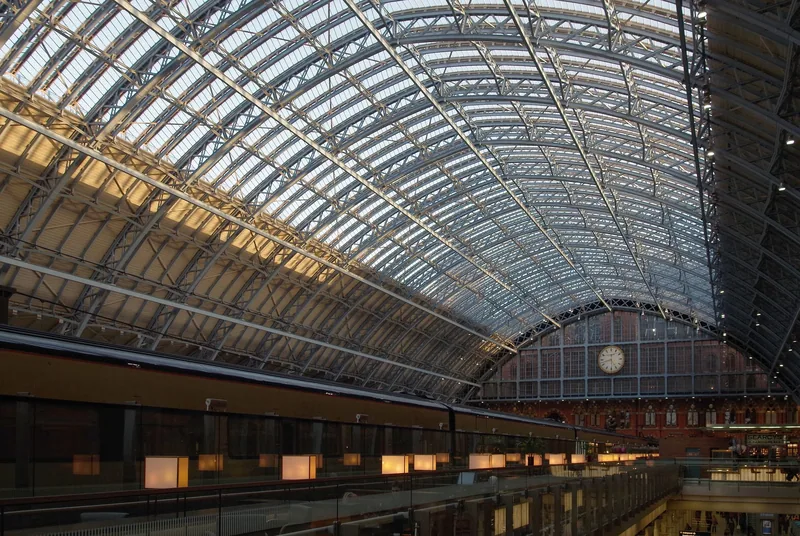
Photo: mattbuck (category) · CC BY-SA 4.0 · Wikimedia Commons · resized
The floor under the platforms was built to hold beer
This is the part of St Pancras most people walk through without seeing, and it explains the whole shape of the building.
The site was awkward. Euston Road to the south was the boundary beyond which no new terminus could come, with the Metropolitan Railway already running underneath it. The Regent's Canal lay to the north, the River Fleet to the east. To get trains over the canal without a punishing gradient, Barlow raised the platform deck above street level on a grid of 688 cast-iron columns.
That created an enormous covered space underneath, and the Midland Railway had a customer for it before a brick was laid. Burton-on-Trent's pale ales had become London's favourite beer, and in the early 1860s the brewer Bass agreed to send all its beer to London by Midland in exchange for ale stores at St Pancras. So the cellars were designed to Burton's own dimensions: the columns stand 14 feet apart because that is the width of a set number of beer barrels laid out as they were in the Burton warehouses.
Loaded wagons were hauled into the station, reversed onto a hydraulic lift just outside the train shed and lowered to the cellars, where two railway lines and three wagon turntables let them be shunted about. By 1874 Bass alone sent 292,300 barrels a year to London, and it stabled a hundred horses here by 1904 to get the beer out to the pubs. The beer traffic finally stopped in the mid-1960s.
The same undercroft now holds the shops and the departure area, and the columns are still there, still 14 feet apart. Underneath it all, a tunnel dug as part of the original foundations to link the Midland line with the Metropolitan Railway is in use today by Thameslink.
Go down to the lower level and look at the column spacing. The undercroft is where the station's logic is visible: the cast-iron grid that was sized for beer barrels now sets out the shop fronts and the Thameslink entrance. It takes two minutes, it is free, and it is the one thing almost every visitor to St Pancras misses while queuing upstairs.
A hotel, and the neighbourhood that was cleared for it
The red-brick front on Euston Road is not the station. It is the former Midland Grand Hotel, Scott's Gothic Revival building, which screens the train shed from the road and contains the station's booking hall and offices as well as the hotel rooms.
Getting the site cost the neighbourhood. Around 3,000 houses in Somers Town and Agar Town were demolished to make room for the approach lines and the station. Agar Town in particular had been written up by Victorian journalists as a slum, a description that recent research into deeds, parish records and censuses suggests was exaggerated; it was largely home to skilled and semi-skilled workers, many of them in the local piano trade. The reputation made it easy to clear, and in 1868 the Midland Railway did so, with no obligation to rehouse anyone.
The hotel closed in 1935 and spent decades as railway offices. It is now a hotel again, with flats in the upper floors, and its interiors are private: the grand staircase and the decorated rooms are not on open public access, so do not plan your visit around them. What you can walk into, freely, is the station.
Behind the station, the old goods yards that held the beer warehouse have become the squares and canal frontage described in our King's Cross guide, and the burial ground the Midland cut through is covered in our page on St Pancras Old Church and its churchyard, five minutes north.
Three clocks, a Nottinghamshire barn and £25
The clock at the south end of the train shed has the best story in the building, and it is not the original.
The first one was installed with the station: a slate dial 16 feet 9 inches across, said to be the largest clock at any railway station in England, with an hour hand 4 feet 5 inches long and a minute hand of 7 feet 3 inches. All the clocks at St Pancras, including the four faces on the hotel tower, were made by John Walker of Cornhill.
It stayed for nearly a century. In the late 1960s British Rail decided to replace it, and while it was being lowered it was dropped and broke into pieces. A Midland train guard named Roland Hoggard, who collected clocks, offered £25 for the wreckage. Over a week he carted the parts into his guard's van, took them up the Midland line to his farm at Thurgarton in Nottinghamshire, and rebuilt the clock on the end of his barn, remaking by hand the pieces that were beyond repair.
British Rail, meanwhile, needed a clock. Its staff visited Hoggard's barn and took casts of the segments to make a replica in glass-reinforced plastic, which hung in the station from the 1970s until the rebuilding in the early 2000s. The plastic clock was restored and ready to go back when Hoggard's story surfaced again, and a third clock was made instead, this time in metal plate with slate hour markers and Roman numerals, by Dent working with Smith of Derby. Dent had made the clock at the Royal Observatory at Greenwich and the one in the Elizabeth Tower; Smith of Derby had supplied the Midland Railway since 1856.
So the clock you photograph under the roof is the third, made from casts taken from the first, which spent thirty years on a farm.
Betjeman, and how close it came to demolition
By the 1960s the building was unfashionable, filthy and, to British Rail, surplus. Euston's great arch had just been pulled down. St Pancras was next in line.
The poet John Betjeman led the campaign that stopped it, and the statue of him on the Grand Terrace is the thank-you. It is 8.5 feet tall, by the sculptor Martin Jennings, and it has a detail worth crouching to see: the shape of the coat-tail was designed to echo the curve of Barlow's roof. He is looking up at it.
The second rescue was the conversion for Eurostar. The train shed was restored and the station reopened in 2007, with Queen Elizabeth II inaugurating the 9-metre bronze of an embracing couple by Paul Day at the same time. The brief for that commission, from the company running the restoration, asked for something romantic, democratic and as recognisable as the Statue of Liberty. Whether it managed that is a matter of taste, but the frieze running round its base, with its scenes of railway life, rewards a closer look than most people give it.
The drinking fountain at the south end of Pancras Road is free, working and nearly always empty. It was put up in 1877 by the Metropolitan Drinking Fountain and Cattle Trough Association, in memory of Captain Robert Hansler, and restored by the station's owners in 2018 after years out of use. Fill a bottle there before a long train journey instead of paying station prices for water.
The other things on the Grand Terrace
Three more pieces are worth finding while you are up there, and none takes more than a minute.
- The war memorial. Unveiled on 8 November 2018, on the station's 150th anniversary and the centenary of the end of the First World War.
- The public pianos. St Pancras keeps pianos on the concourse for anyone to play, and on a good afternoon somebody will be. Our guide to free live music in London covers where else to hear music without a ticket.
- The Minton tiles. The head of the train shed wall is finished with a decorative band of ceramic tiles, easy to miss against the ironwork.
And look at the doorways. The limestone around the portals on the Euston Road and Midland Road elevations is carved into foliage designs that repay a slow walk along the outside of the building, which almost nobody does because everyone arrives by Tube and comes up inside.
Seeing it properly in an hour
Start outside, on the pavement of Euston Road opposite the hotel, where you can take in the whole Gothic front and the clock tower at once. Walk east along the front and round into Pancras Road for the drinking fountain and the side elevation, where the pointed profile of the roof is clearest.
Go in by the Pancras Road entrance rather than the main one, which brings you into the undercroft level. Spend ten minutes on the columns and the shop level, then take the escalator up to the Grand Terrace. That is where the roof reads properly: the Betjeman statue, the bronze couple, the war memorial and the clock are all within fifty metres of each other, and from here you can see the whole span in one view.
Finish by walking north along the platform-level concourse to where the Victorian shed ends and the 2000s extension begins. The join is obvious once you look for it, and it tells you how much longer trains are now than they were in 1868.
If you are catching a Eurostar afterwards, our Eurostar guide covers check-in times, and our page on breakfast before an early train deals with the hour before that. With bags, see left luggage in London and taking luggage on the Tube; sightseeing a station while towing a case is miserable.
For buildings in the same register, the Royal Courts of Justice on the Strand and the Palace of Westminster are the other two great Gothic Revival set pieces in London. For the opposite pole, our guide to Art Deco London covers what came sixty years later. The Open House Festival in September sometimes opens interiors around King's Cross that are shut the rest of the year, and the canal-side nature reserve in our guide to Camley Street Natural Park is a five-minute walk from the concourse. If you are staying nearby, see staying near King's Cross, St Pancras and Paddington.
Frequently asked questions
Can you visit St Pancras station without a train ticket?
Yes. The concourse, the shops, the undercroft level and the Grand Terrace with its statues and clock are all open to anyone, free of charge, and that is where nearly everything architectural is. Only the Eurostar departure area is behind barriers, and you need a ticket for that.
Who designed St Pancras station?
The train shed and station layout were designed by William Henry Barlow, chief engineer of the Midland Railway, with Rowland Mason Ordish. The hotel and station buildings facing Euston Road were designed by George Gilbert Scott. The station opened in 1868 and the hotel in 1873, with work completed in 1876.
Why are the columns under St Pancras spaced the way they are?
Because the space beneath the platforms was designed to store beer from Burton-on-Trent. The Midland Railway spaced the 688 cast-iron columns 14 feet apart to match the arrangement used in the Burton warehouses, that distance being the size of a set number of beer barrels.
Is the St Pancras clock the original one?
No, it is the third. The original slate dial of 1868 was dropped and smashed during removal in the late 1960s, bought for £25 by a train guard and rebuilt on his barn in Nottinghamshire. A plastic replica followed, and the present clock was made by Dent with Smith of Derby from casts of the first.
Can you go inside the old Midland Grand Hotel?
Not as a sightseer. The building is now a working hotel with flats above, and its staircase and decorated rooms are private. Everything described on this page is in the station itself, which is free to walk around at any time the station is open.
Sources
- London St Pancras Highspeed - The creation of an icon: Barlow, Scott and the building of the station (checked September 2026)
- London St Pancras Highspeed - St Pancras: built on beer (checked September 2026)
- London St Pancras Highspeed - A tale of three clocks (checked September 2026)
- London St Pancras Highspeed - The drinking fountain at St Pancras (checked September 2026)
- London St Pancras Highspeed - St Pancras artefacts: statues, memorial and clock (checked September 2026)
- London St Pancras Highspeed - The history of St Pancras International (checked September 2026)