
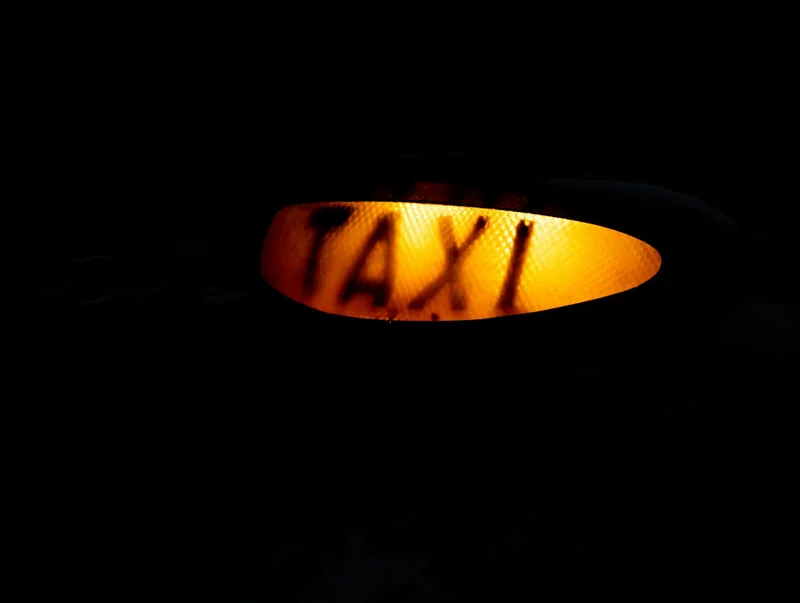
A London black cab is available when the yellow sign on its roof is lit. If the light is off, it is hired and will not stop however hard you wave. The quickest way to get one is not to stand in the road at all: every main-line station has a marked rank, and this page names where each one is, because at King's Cross it is on Pancras Road and at Waterloo it is outside exit 3, and neither is signposted from where you arrive.
The difference between a taxi and a minicab, what the Knowledge is, how to check a driver is licensed and how fares are calculated are all covered in our guide to black cabs, minicabs and Uber in London. This page is the narrower, practical one: where to stand, what stops, what does not, and when to give up and take a bus.
Two things worth knowing before anything else. Black cabs can be any colour, so look at the roof sign rather than the paintwork. And a cab that is genuinely free will usually see you before you see it, because spotting a raised arm is the driver's job.
Reading a black cab
- Yellow roof sign lit
- Free. Put your arm out
- Roof sign off
- Hired or off duty. It will not stop
- Green driver's badge
- All London: can pick up anywhere in the city
- Yellow driver's badge
- Suburban: licensed for particular outer areas
- White plate at the rear
- Carries the licence number for the vehicle, when it runs out, and the permitted number of passengers
- Minimum fare
- £4.40 at all times
- Card payment
- Compulsory, contactless accepted, no surcharge
Where the ranks are at the main stations
Every London terminus has at least one rank, and the walk to it is rarely obvious from the concourse. These are the locations published by Network Rail, which manages the stations.
| Station | Rank location | Worth knowing |
|---|---|---|
| King's Cross | Pancras Road | Partly covered; pick-up only; staff assistance available to and from the rank |
| Paddington | Off Bishop's Bridge Road; a second rank on the upper Taxi Deck above platform 12 | The Bishop's Bridge Road rank is pick-up only; the upper deck is the accessible one, with a Passenger Assistance meeting point beside it |
| Euston | Euston Station rank, plus a separate accessible rank | Both have Help Points that connect you to staff |
| Waterloo | Cab Road, on the roadway outside exit 3 | Fully covered; pick-up only; accessible bays nearby on Cab Road and Station Approach |
| Victoria | Wilton Road, plus a rank at Victoria Coach Station | Uncovered, and reached across a controlled road crossing |
| Liverpool Street | Separate pick-up and drop-off ranks on Liverpool Street | Uncovered, reached across a controlled road crossing |
| London Bridge | Tooley Street and Bermondsey Street | Tooley Street is partly covered; Bermondsey Street is not |
| Charing Cross | Embankment Place and the station forecourt | Embankment Place is fully covered and the better choice in rain |
Three things follow from that table. Ranks marked pick-up only cannot be used to be dropped off, so a driver bringing you to King's Cross or Waterloo will set you down elsewhere. The covered ranks are worth the extra 60 seconds of walking when it is raining, which is precisely when the queue is longest. And where a station has two ranks, the second is usually quieter.
The layouts of each terminus are set out in our guide to the main railway stations, and the coach station rank is covered in Victoria Coach Station and coach travel.
Take the first cab in the line, not the one you like the look of. A rank is a queue at both ends. Walking down the line to a cab further back is a small rudeness that London drivers notice, and the front driver will usually wave you back anyway. The exception is if you need a specific feature, such as a ramp deployed from the rear, in which case say so to the first driver and they will sort it out between them.
The other places a rank always is
Beyond the termini, ranks cluster where people reliably arrive with luggage or leave in a hurry: airports, the big hospitals, major hotels, and the streets around theatreland. Transport for London counts more than 600 across the capital.
Airport ranks are signed from arrivals, and they are the only lawful place to pick up a taxi there. Surcharges apply. A cab taken from a Heathrow rank adds £1.60 to the fare, and being set down on a Heathrow terminal forecourt attracts an airport charge of as much as £6.00. The rank at London City Airport carries no pick-up supplement, though that same £6.00 forecourt charge exists for drop-offs. Arrivals generally are covered in our guide to Heathrow Airport.
Around the West End, the moment to know is turning-out time. Theatres empty between about 22:00 and 22:30, and for those 30 minutes every free cab within half a mile is taken. Walking two streets away from the theatre district, or waiting 20 minutes in a bar, will get you a cab faster than standing outside the theatre will. Our guide to West End theatre has the curtain times.
Hailing one that will actually stop
- Stand where a cab can legally pull in. Not on a red route with double red lines, not in a bus lane during its hours, not at a bus stop, not on a pedestrian crossing or its zig-zags.
- Get on the correct side of the road. A driver going the other way has to turn, and in central London that often means a one-way system and five minutes of meter time.
- Stand just before a junction, not just after. Cabs slow down approaching junctions, which gives the driver time to see you and pull over.
- Arm out and level. A raised hand works; frantic waving does not work better.
- Say the destination through the window first. This is the London convention and it is not a negotiation: the driver will tell you to get in.
- Remember the rule that favours you. Within Greater London a driver has to take any fare of 12 miles or less, or lasting an hour or less. From Heathrow that distance rises to 20 miles.
Why that cab did not stop for you
Usually the light was off and you did not notice in the rain. But there are other reasons, and none of them is personal.
- It is already hired. Passengers are not always visible from the pavement.
- It is on a booking. Cabs booked by phone or app are on their way somewhere.
- The driver is going home. London cabbies work long shifts and finish on the far side of town, so a cab heading out of the centre late in the afternoon may be on its way back to the garage.
- Shift change. Mid-to-late afternoon is when many drivers hand over, which is why cabs feel scarce between about 15:00 and 17:00.
- It cannot stop where you are standing. Drivers will not pull into a bus lane or across a red route for you, and are right not to.
When a cab is the wrong choice
The meter runs whether the wheels are turning or not, which makes central London traffic expensive. A two-mile daytime journey costs roughly £12.60 to £20.20; the same journey by Tube is inside the £8.90 daily cap and by bus is £1.75.
Avoid a cab in Zone 1 at morning and evening peak, in heavy rain when demand triples, and immediately after any large event. Our guide to avoiding rush hour has the times. Note also that black taxis are exempt from the Congestion Charge but the traffic it is designed to reduce is still there; see the Congestion Charge and ULEZ.
A cab makes clear sense in four cases: late at night when the Tube has stopped, with luggage, with small children, and when you are going somewhere the network does not serve directly. For the first of those, see our guides to getting home late in London and the Night Tube. For the second, our guide to luggage on the Tube explains the alternative.
What it costs
| Item | Amount |
|---|---|
| Minimum fare, all times | £4.40 |
| 1 mile, weekday daytime | £8.40 to £13.00 |
| 2 miles, weekday daytime | £12.60 to £20.20 |
| 4 miles | £21 to £31 |
| 6 miles | £33 to £42 |
| Heathrow to central London | £70 to £120, 30 to 60 minutes |
| Booking by phone or app | Up to £2 extra |
| Christmas and New Year, set times | £4 extra |
| Soiling the vehicle | Up to £60 |
Evening, weekend and overnight tariffs are higher than the daytime ones. There is no charge for luggage, for extra passengers or for an assistance dog. Every taxi must carry a working card machine and accept contactless without a surcharge, so refusing card is not allowed. Fares to Gatwick, Luton and Stansted, which are outside Greater London, can be agreed before you set off; otherwise the meter applies. Whether to round the fare up at all is dealt with in our guide to tipping.
Wheelchairs, assistance dogs and access
Ramps come as standard: the whole London taxi fleet takes wheelchairs. Transport for London also requires a hearing loop, grab handles in a contrasting colour, and a minimum size inside the cab. Most vehicles add a mid-height step and a seat that swings out for anyone able to move across to it.
Assistance dogs must be carried free of charge. Under the Equality Act 2010 a taxi driver must carry a disabled passenger's assistance dog, let it remain with them, and not make or propose any additional charge; failing to do so is a criminal offence. The only exception is a driver with a medical exemption, who must display the exemption notice.
Ramps cannot be deployed the same way at every rank: Network Rail notes that at several London station ranks a ramp can only come out of the side of the vehicle, not the rear. If that matters to you, say so to the driver at the head of the queue. Our guide to visiting London with a disability covers the wider rules.
Anyone approaching you offering a cab is not a licensed cab. A black taxi is one you flag down yourself or take from a rank. A minicab has to be reserved beforehand with an operator TfL has licensed, and touting for trade in the street is against the law. Someone in a station forecourt, outside a club or at an airport asking whether you want a taxi is committing an offence, and the vehicle may be uninsured for carrying passengers. Walk to the marked rank instead. Our guides to common tourist scams and whether London is safe cover the rest.
Booking instead of hailing
You can also order a black cab ahead of time: by telephone, in an app, or through a website. Expect as much as £2 added on top of the metered fare. Pay it when certainty matters: an early flight, a fixed appointment, or a street where nothing passes.
Ordering a minicab instead brings a different set of safeguards, set out in full in our main taxi guide. The short version: a licensed operator has to send you written confirmation before the car moves, and that confirmation names the vehicle, the driver and their licence number. Compare the registration with whatever pulls up. Drivers, cars and operators can all be checked on Transport for London's online licence checker.
If something goes wrong
Complaints about licensed taxis and private hire in London go to Transport for London, not to the driver's company, and the useful details to have are the vehicle licence number from the white plate on the back, the driver's badge number, and the time and route of the journey. Property left in a black cab, the cable car, a bus or a station goes into TfL's lost property system: see lost property on London transport. Our guide to complaining, returning and consumer rights explains how complaints work in Britain generally.
Frequently asked questions
How do I know if a London taxi is free?
The yellow "TAXI" sign on the roof is lit when the cab is available for hire. If it is off, the cab is hired or off duty and will not stop. Black cabs can be any colour, so check the roof sign rather than the paintwork, and look for the white licence plate on the back of the vehicle.
Where is the taxi rank at King's Cross station?
On Pancras Road, on the same side as the station. It is partly covered and is a pick-up rank only, so a taxi bringing you to the station will set you down elsewhere. Staff assistance is available to and from the rank, and there are customer help points at the rank itself.
Can a London black cab refuse to take me?
Only with good reason. Inside Greater London a driver is obliged to take any fare of 12 miles or less, or lasting up to an hour, and from Heathrow that limit stretches to 20 miles. Drivers must also take assistance dogs at no charge, and must accept a contactless payment without adding anything for it.
Is it cheaper to hail a cab or book one?
Hailing is cheaper. Booking a black cab by phone, app or website adds up to £2 to the metered fare. Booking is still worth it for an airport run, for a fixed appointment, or anywhere with no passing cab trade, because a hailed cab is never guaranteed.
Why can I never find a taxi when it rains?
Demand rises sharply and supply does not, and the same happens after big events and at theatre turning-out time. The reliable answer is to walk to the nearest marked rank, or to move two or three streets away from the crowd, rather than standing on the same pavement as everybody else.
Sources
- Transport for London - Guide to taxis and private hire (checked September 2026)
- Transport for London - Find a taxi or minicab (checked September 2026)
- Transport for London - Taxi fares, effective from 25 April 2026 (checked September 2026)
- Network Rail - London King's Cross station facilities (checked September 2026)
- Network Rail - London Paddington station facilities (checked September 2026)
- Network Rail - London Waterloo station facilities (checked September 2026)
- legislation.gov.uk - Equality Act 2010, section 168 (assistance dogs in taxis) (checked September 2026)