
Two buildings make this borough worth a visitor's morning: the surviving gate of a Saxon abbey in the middle of Barking town centre, and a moated manor house in Dagenham with a free museum inside it. Everything else here is a place where 220,000 people live, and we will not pretend otherwise.
Barking and Dagenham is the far east of London, on the north bank of the Thames between Newham and Havering. Barking is the old market town, with a church, an abbey precinct and a busy shopping street. Dagenham is what the London County Council built on the fields behind it between the wars, plus the Ford works on the river. Along the water, a new district called Barking Riverside is being built from nothing.
It is close: Barking to Liverpool Street takes twenty-two minutes. What it lacks is a reason to spend a whole day. The honest plan is a half-day — the abbey ruins and the church, then a Tube ride out to Dagenham for Valence House.
Barking and Dagenham at a glance
- Where
- IG11 and RM8-RM10, on the north bank of the Thames, east London
- Stations
- Barking (District, Hammersmith & City, Suffragette line, c2c), fare Zone 4; Upney, Becontree, Dagenham Heathway and Dagenham East on the District line; Barking Riverside on the Suffragette line
- Journey time
- Barking to Liverpool Street 22 minutes off-peak, 23-24 in the peak; Barking to Tower Hill 23 minutes
- Fare
- Barking to Zone 1: £3.60 off-peak, £4.80 peak, contactless or Oyster
- Two things to see
- Barking Abbey ruins and the Fire Bell Gate (free); Valence House Museum, Dagenham (free)
- Open only two days a week
- Eastbury Manor House: Fridays 10:00-16:00 and Sundays 11:00-16:00
| Day | Barking Abbey and St Margaret's | Eastbury Manor House | Valence House |
|---|---|---|---|
| Monday | Ruins open ground | Closed | Closed |
| Tuesday to Thursday | Ruins open ground | Closed | 10:00-16:00, free |
| Friday | Ruins open ground | 10:00-16:00, £9.00 | Closed |
| Saturday | Ruins open ground | Closed | 10:00-16:00, free |
| Sunday | Church services | 11:00-16:00, £9.00 | Closed |
The abbey ruins, and the gate you can still walk through
Five minutes' walk from Barking station, behind the shops on East Street, is a walled green space with low flint footings laid out across it. This is Barking Abbey, a Benedictine nunnery founded in the seventh century, sacked by a Viking army, refounded, and dissolved in 1539. Almost nothing stands above knee height, because the buildings were pulled down for their stone within about three years.
It is a scheduled monument covering five hectares, protected since February 1954, and it is open ground with no gate and no charge. The footings are labelled, and you can read the shape of the church and the cloister in twenty minutes. Whether that is interesting depends on whether you enjoy reading a floor plan out of grass.
What survives standing is the gatehouse, and it is the best thing in the borough. Historic England lists it as the Fire Bell Gate — locally it is usually called the Curfew Tower — at grade II*, and dates it to the late fifteenth or early sixteenth century. It is a two-storey gateway of coursed rubble with a crenellated parapet and an embattled octagonal stair turret at one corner, with four-centred arches front and back and an ogee niche above each. You walk through it to reach the church.
The upper floor was the Chapel of the Holy Rood, and it holds the one object here that stops people: a late twelfth-century stone rood, a carved crucifixion with the Virgin and St John, set below and to the north of the east window. It is three centuries older than the gate around it. The upper storey itself was largely rebuilt in the late nineteenth century.
The abbey chapel is only open when a volunteer is there. The ruins and the gateway passage are always accessible, but the Chapel of the Holy Rood upstairs is not. If seeing the twelfth-century rood is the point of your trip, telephone the parish office before you travel rather than turning up and hoping.
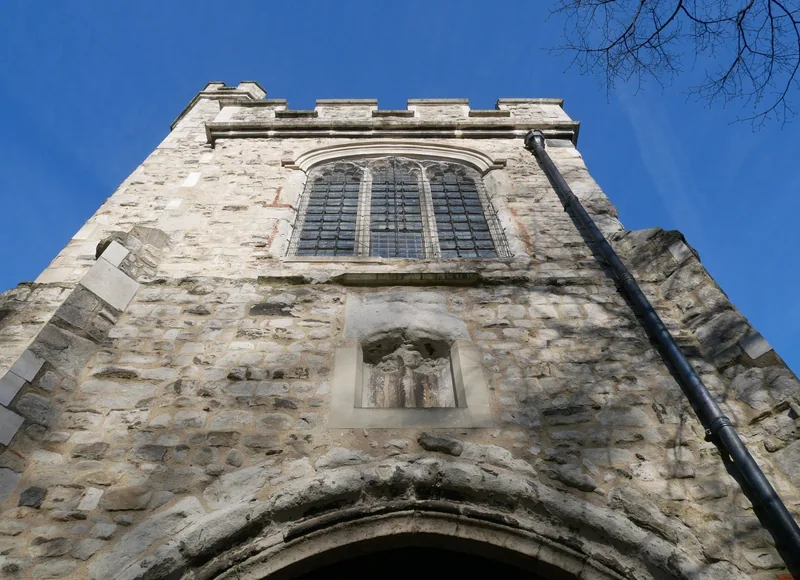
Photo: Doyle of London · CC BY-SA 4.0 · Wikimedia Commons · resized
St Margaret's, and the wedding of 1762
Inside the abbey precinct stands the parish church of St Margaret, listed grade I. It is thirteenth century and later, mostly fifteenth, with flint and ragstone rubble walls and a Reigate stone tower of the mid-fifteenth century. The chancel is the oldest part; the nave and aisles reuse twelfth-century columns from an earlier building.
The detail worth knowing is in the list entry: the outer north aisle and chapel were added in stages during the sixteenth century using debris from the destroyed abbey. The stone of the nunnery is in the wall of the church next door. Inside there are medieval roofs, a plaster ceiling of 1772 in the chancel, an early seventeenth-century octagonal font, brasses and a late sixteenth-century funeral helm. James Cook was married here in 1762, the fact every leaflet in Barking leads with; there is a memorial in the church, and appreciating it takes about ninety seconds.
Eastbury Manor House: two days a week, and worth the seven minutes
Seven minutes' walk from Upney station, one stop east of Barking on the District line, is a red-brick Elizabethan house standing in a garden in the middle of an interwar housing estate. Eastbury Manor House is listed grade I and dated by Historic England to the sixteenth century, with a rainwater head carrying the date 1572. It is H-plan, three storeys, with mullioned windows of plastered brick, tall gables, ornamental chimney stacks, and a three-storey porch with an early Renaissance pedimented archway.
The courtyard behind it originally had two octagonal brick stair turrets; one survives, and you can climb it. Upstairs there are early seventeenth-century wall paintings. It belongs to the National Trust and is run by the council.
It opens on Fridays from 10:00 to 16:00 and Sundays from 11:00 to 16:00, and on no other day. Admission when we read the price list on 28 September 2026 was £9.00 for an adult, £4.50 for a child aged 6 to 16, £6.00 concession, £24.50 for a family of two adults and up to three children, and £16.50 for one adult and up to three. Under-fives go free; under-16s must be with an adult. A board by the entrance says when the next guided tour starts. There is a café and no car park.
Eastbury and Valence House are never open on the same day. Eastbury opens Fridays and Sundays; Valence House opens Tuesday to Thursday and Saturday. If you want both Tudor houses, you need two trips, or you pick Friday for Eastbury and accept that Dagenham's museum is shut. This catches people out constantly.
Valence House, the moated manor with a free museum in it
Valence House on Becontree Avenue in Dagenham is the only surviving manor house in Dagenham and the only building in Greater London we know of where you can walk round a medieval moat and then into a free museum. Historic England lists it grade II* and describes it as seventeenth century, possibly partly earlier, on a site that has carried a house "certainly since the C13". It is timber-framed, plastered and colourwashed, two storeys, L-shaped, with old tile roofs — it looks more like a Essex farmhouse than a manor, which is part of its charm.
The moat still holds water on part of the circuit. Inside, the list entry singles out a painted panelled room on the ground floor with small early seventeenth-century panels, a late Stuart marble fireplace surround, a late seventeenth-century staircase with turned balusters, and a second panelled room in oak upstairs. In the fourteenth century the house belonged to Aymer de Valence and his sister, which is where the name comes from.
The museum is free and holds nearly 30,000 items, including the Fanshawe family portraits and the Dagenham Idol, a wooden figure on loan from Colchester and Ipswich Museum. There is a herb garden, a wartime "Dig for Victory" garden with a replica Anderson shelter, the borough archives, and the Tulip Tree Tearoom, which held a hygiene rating of 5 at an inspection in November 2025.
Hours to get right: the museum's own website gives Tuesday to Thursday and Saturday, 10:00 to 16:00, with the museum building shut between 12:00 and 13:00 every day while the tearoom, shop, gardens and archive stay open. The council's page says "Tuesday to Saturday", which contradicts it. Trust the museum. Grounds and tearoom run to 16:30.
Getting there is the fiddly part. Becontree station on the District line is nearest, but the museum's own advice is to take the 62 bus from outside it to the junction of Becontree Avenue and Valence Avenue. Parking in Valence Park is free. Our guide to Valence House and the museums of outer London covers the collection in detail, and the borough museums nobody visits sets it beside its equivalents elsewhere.
Becontree, and what the largest council estate in the world looks like now
Between Barking and Dagenham there is nothing to see and something to understand. The Becontree estate was built by the London County Council between 1921 and 1935 on farmland, and when it was finished it was the largest public housing estate in the world. Four District line stations — Upney, Becontree, Dagenham Heathway and Dagenham East — serve it.
For a visitor it is mile after mile of near-identical houses in long curving avenues, with grass verges, hedges and almost no shops. There is no viewpoint and no museum. The walk from Becontree station to Valence House goes straight through it and makes the point in fifteen minutes; if housing does not interest you, take the bus.
Barking Riverside, and what is being built on the marsh
South of the A13, on former power-station and industrial land on the Thames, a whole new district is going up. Barking Riverside is a joint venture between the housing association L&Q and the Mayor of London, and it is one of the biggest residential building sites in Britain: thousands of homes are finished and occupied, thousands more are consented, and construction is continuous.
The reason a visitor might notice is the railway. Barking Riverside station opened in 2022 at the end of a new extension, and it is the eastern terminus of the Suffragette line, which runs right across north London from Gospel Oak. Barking Riverside to Barking takes six minutes and costs £2.20 off-peak. The six Overground line names arrived in 2024, and this is the one visitors have least often heard of.
Go only if new towns interest you as a subject. There is a riverside path with a large view across to Thamesmead, a few cafés, and building hoardings. No pub on the water, no market, no museum: a good forty-minute walk and a bad afternoon.
Barking town centre, the market and where the food is
Barking's shopping streets are East Street and the Vicarage Field area, with a street market on East Street. It is a working market — fruit, fabric, phone cases, halal butchery — rather than a destination, and the comparison is with Romford's market further east, which is bigger and older. The listed building nobody looks at is the station: Barking's post-war booking hall is listed grade II, which is rare for a building of its date.
The food here is East African, South Asian and Eastern European, with a strong thread of Lithuanian and Romanian grocery. There is also a substantial Filipino population in this corner of east London, and our guide to Filipino food in London explains what to look for in the supermarkets. We have not named individual restaurants: the hygiene ratings on East Street and Ripple Road run from 1 to 5, and we do not send visitors to a street without checking each address. Look a place up on the Food Standards Agency register before you sit down.
Is it worth the journey?
Come if
- Medieval buildings interest you and you want two free ones almost nobody visits
- It is a Friday or a Sunday and you can get into Eastbury Manor House
- You are staying in the east and want a cheap half-day that is not a tourist site
Do not come if
- It is Monday: the ruins are open ground, but both museums are shut
- You want a riverside walk with pubs on it — try Woolwich instead
- You have one spare day in London: this is a fourth-visit kind of place
The sensible pairings are Ilford to the north on the Elizabeth line, Rainham Marshes to the east for birds, or Stratford to the west for the Olympic park and two free museums. The Superloop express buses are the practical way of moving sideways across this side of London.
Frequently asked questions
Is Barking worth visiting as a tourist?
For half a day, if medieval buildings interest you. The abbey ruins, the grade II* Fire Bell Gate with its twelfth-century stone rood, and the grade I parish church of St Margaret sit together five minutes from the station and cost nothing. Beyond those three things, Barking is a busy suburban shopping centre with no visitor attractions.
How long does it take to get to Barking from central London?
Twenty-two minutes from Liverpool Street off-peak, changing from the District line to the Central at Mile End, and twenty-three or twenty-four in the morning peak. Barking to Tower Hill is about the same, either direct on the District line or by c2c to Fenchurch Street and a short walk. Barking is in fare Zone 4, so a journey to Zone 1 costs £3.60 off-peak and £4.80 peak.
When is Eastbury Manor House open?
Fridays from 10:00 to 16:00 and Sundays from 11:00 to 16:00 only. Adult admission was £9.00 when we checked in September 2026, with a family ticket at £24.50 for two adults and up to three children. It is a seven-minute walk from Upney station on the District line, one stop east of Barking, and there is no car park.
Is Valence House Museum free?
Yes, and so is the archive and local studies centre in the same grounds. The museum's own site gives its 2026 hours as Tuesday to Thursday and Saturday, 10:00 to 16:00, with the house itself shut between 12:00 and 13:00 each day while the tearoom, shop and gardens stay open. The moat and the gardens are free to walk round.
Sources
- Historic England - National Heritage List for England open data (Barking Abbey scheduled monument 1003581; Fire Bell Gate 1064407; Parish Church of St Margaret 1064408; Valence House 1064404; Eastbury Manor House 1359303; Barking Station Booking Hall 1242678) (checked September 2026)
- Eastbury Manor House - opening days, admission prices and how to get there (checked September 2026)
- Valence House - 2026 opening hours, the midday closure and travel directions (checked September 2026)
- London Borough of Barking and Dagenham - Valence House Museum, collection and address (checked September 2026)
- Transport for London Journey Planner - measured Barking journey times (checked September 2026)
- Transport for London - Single Fare Finder, for the Barking and Barking Riverside fares (checked September 2026)
- Barking Riverside Limited - the joint venture behind the new riverside district (checked September 2026)
- Food Standards Agency - food hygiene rating search (Tulip Tree Tearoom, Becontree Avenue RM8 3HT, rated 5 in November 2025; Eastbury Manor House, Eastbury Square IG11 9SN, rated 5 in July 2026) (checked September 2026)