
The Pearly Kings and Queens Harvest Festival is a free procession held on a Sunday afternoon in late September, when London's pearly families gather in Guildhall Yard in the City, dance and sing for an hour, and then walk to St Mary-le-Bow on Cheapside for a harvest service. You do not need a ticket. You only need to be in the yard by about half past one.
Pearly kings and queens are Londoners who wear clothes covered in mother-of-pearl buttons and spend their spare time collecting money for charity. The titles pass down through families, and each one belongs to a district of London: there is a Pearly King of Islington, a Pearly Queen of Dagenham, a Pearly King of Woolwich. The harvest festival is the one day of the year when most of them appear in the same place, which is why it is the event to choose if you want to see them. It sits well with the other free things to do in London, and it costs nothing beyond the coins you drop in a collecting cap.
The pearly harvest festival at a glance
- When
- A Sunday in late September, early afternoon. In 2026 it was Sunday 20 September (Londonist listing, checked November 2026)
- Where it starts
- Guildhall Yard, off Gresham Street, City of London
- Where it ends
- St Mary-le-Bow church, Cheapside
- Timings in 2026
- Gathering from 1.30pm, procession 2.30pm, service 3pm, pearlies leave the church around 4pm
- Cost
- Free. Bring coins or a small note for the collecting caps
- Organised by
- The London Pearly Kings and Queens Society (a separate October service at St Martin-in-the-Fields is run by another pearly association)
- Nearest stations
- Bank, St Paul's, Moorgate and Mansion House
What happens in Guildhall Yard, hour by hour
The pearlies start arriving in Guildhall Yard from about 1.30pm. The yard is the open stone square in front of the medieval Guildhall, the City of London's town hall, and on a September Sunday it is otherwise almost empty. Our page on the Guildhall and the Roman amphitheatre under it explains the buildings around you; the dark curved line in the paving marks where the amphitheatre stood.
For the first hour the yard is a sort of street party. In 2026 the published programme included maypole and morris dancing, a marching band, an 80-strong rock choir and pearly members leading old music-hall songs such as "The Lambeth Walk" and "Knees Up Mother Brown". This is the best hour for looking closely at the suits, because the pearlies are standing still, talking to each other and, very often, to anyone who asks a question.
At around 2.30pm the procession forms. It walks south and west along Gresham Street and St Martin's le Grand and then into Cheapside, accompanied in recent years by local mayors, Scouts and Chelsea Pensioners in their scarlet coats. The walk is short, under ten minutes at procession pace, so if you want a second look, walk ahead to Cheapside rather than following behind.
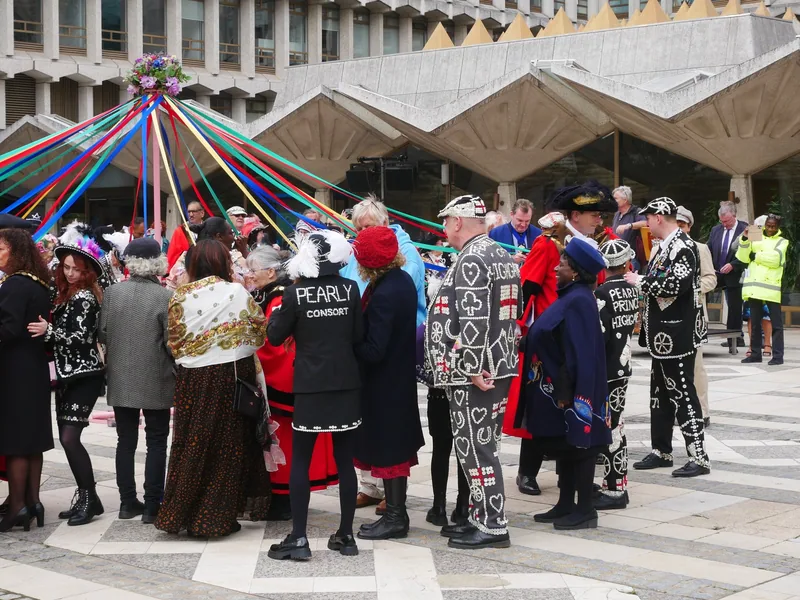
Photo: Doyle of London · CC BY-SA 4.0 · Wikimedia Commons · resized
The service at St Mary-le-Bow, and why it gets so full
The procession ends at St Mary-le-Bow, the church whose bells define who counts as a Cockney. A thanksgiving service begins at about 3pm, during which the pearlies present a large plaited harvest loaf. Members of the public may attend, but the church fills quickly with pearly families and their guests, so expect to stand at the back or not get in at all.
If you would rather watch than worship, the most rewarding place to be is outside on Cheapside at about 4pm, when the pearlies file out of the church and pose for photographs on the pavement. The light is usually better than in the yard, and the crowd is smaller. Our guide to St Mary-le-Bow and its bells covers the church on an ordinary day, including the eleventh-century crypt.
Bring a tin of food, not just coins. The festival is a real harvest collection. Non-perishable food and toiletries are welcomed, and in 2026 the gifts went to the Whitechapel Mission, a charity for homeless people in east London. A packet of pasta or a bar of soap is a better contribution than a photograph.
A smother suit and a skeleton suit are not the same thing
The clothes are the reason most people come, and there are two main styles. A smother suit is covered all over, so that hardly any of the cloth beneath shows; it is the style the first pearly king is said to have invented, and it is very heavy to wear. A skeleton suit uses far fewer buttons, sewn in lines along the seams and edges and in a few motifs, which is how the street traders decorated their working clothes before the pearlies existed.
Look at the patterns rather than the shine. The buttons are arranged into designs, symbols and slogans chosen by the wearer, and very often the title and district are spelled out in buttons across the back of the jacket. No two suits are alike, and the pearlies will usually explain theirs if you ask. The London Museum holds a suit worn by Fred Bliss, Pearly King of Islington, which has "F. Bliss. Pearly King of Islington" on the back in exactly this way.
Nobody agrees on how many buttons go into a smother suit. The Original Pearlies of King's Cross and St Pancras say the first suit carried 60,000. Other accounts give figures in the tens of thousands. Each suit is sewn by hand, often over years, and many are repaired and passed down with the title, so the honest answer is "thousands, and it depends on the suit".
Henry Croft, the road sweeper who started it
The story always begins with Henry Croft. According to the London Museum, he was born in 1861 in the St Pancras workhouse, grew up an orphan, and worked as a street sweeper. Sometime in the second half of the 1870s he covered an old suit and a top hat completely in pearl buttons, with slogans such as "All for Charity", so that he would stand out when collecting money for hospitals and orphanages.
The sources do not agree on the year. The London Museum's collection records give 1875, and its longer history says the mid to late 1870s. The Horniman Museum, which holds a Pearly King of Dulwich suit, places the first pearlies in the 1880s, and so does the history published by the Original Pearlies of King's Cross and St Pancras. A safe summary is that the tradition began in late Victorian London, a little under a century and a half ago.
Croft did not invent the buttons. He borrowed them from the costermongers, the fruit, vegetable and fish sellers who worked London's streets from barrows. Costers already sewed rows of pearl buttons down their trouser seams and waistcoats as a sign of pride, and each coster community chose a "king" to speak for it and to collect for families who had fallen on hard times. Croft took the costers' style and their charity and joined the two. His success encouraged coster families across London to do the same, and by 1911, the London Museum says, all 28 London boroughs of the time had a pearly family, around 300 people in all.
How the titles work today
You cannot simply buy a suit and call yourself a pearly king. Titles are inherited, usually from parent to child, sometimes to a cousin or another relative, and children of pearly families are raised in the tradition and later "crowned" with the family title. Occasionally someone with a long record of charity work is invited to take a title that has no heir. Each title is tied to a place, which is why the names you see on the backs of jackets read like a map of London and its suburbs.
There is no single pearly organisation. Several associations exist, and they do not always work together. The London Pearly Kings and Queens Society runs the Guildhall Yard festival. The Original Pearly Kings and Queens Association holds its own harvest celebration at St Martin-in-the-Fields on Trafalgar Square, traditionally the festival's home, and the Original Pearlies of King's Cross and St Pancras form a third group. For a visitor this matters only because it means there are two harvest events in the autumn, not one.
| Guildhall Yard and St Mary-le-Bow | St Martin-in-the-Fields | |
|---|---|---|
| Usual timing | A Sunday in late September | A Sunday in early October |
| In 2026 | Sunday 20 September | Sunday 4 October |
| Run by | London Pearly Kings and Queens Society | Original Pearly Kings and Queens Association |
| Outdoor part | Yes: dancing, music and a procession through the City | Mostly a church service, with pearlies on the steps before and after |
| Best for | Seeing the most pearlies, outdoors, with children | A shorter visit combined with the West End |
Dates are from Londonist's 2026 listing, checked November 2026. Neither association publishes a fixed rule for the date, so check nearer the time. If you are in London for both, the City event is the bigger spectacle; the Trafalgar Square one is easier to fit into a day of sightseeing. Our page on St Martin-in-the-Fields has the church's usual opening hours and the café in the crypt.
Getting to Guildhall Yard on a Sunday
The City of London is very quiet at weekends, and that works in your favour: there is room to stand, and the streets around Guildhall are not crowded. Bank, St Paul's, Moorgate and Mansion House stations are all within about five to ten minutes' walk. From St Paul's, walk east along Cheapside and turn left up King Street, which leads straight into the yard.
The downside of a Sunday in the City is that many cafés and sandwich shops are shut. Eat before you come, or plan to eat afterwards. Our guide to the City of London explains how empty the Square Mile is at weekends and what does stay open, and our page on spending a Sunday in London has the wider pattern of Sunday opening hours.
Weekend engineering works hit the City lines. Several of the Tube lines serving Bank and Moorgate close for engineering work on some Sundays. Check TfL's status page on the morning of the festival, and have St Paul's on the Central line as your fallback.
Watching with children, and taking photographs
This is one of the easiest London events to bring children to. It is short, free and outdoors, and the pearlies are used to being photographed and generally happy to pose if you ask first. Children are often fascinated by the suits up close and by the pearly children, who wear smaller versions.
Taking photographs in Guildhall Yard and on the street is normal and expected. Inside the church during the service, put the camera away: it is an act of worship, and the people in the pews are there to give thanks rather than to perform. A coin in the cap is the customary way to say thank you for a picture.
Make a day of it in the City. St Paul's Cathedral is five minutes' walk west of Cheapside. For a meal with the right associations, the shops in our guide to pie and mash and jellied eels serve the working-class London food of the coster era, though they are in east and south London rather than the City, and few open on Sunday afternoons.
Where else to see pearlies, and their suits
The pearlies turn out at many London events through the year, especially those with a charity side: fêtes, street parties, jubilees and royal weddings, and they were part of the opening ceremony of the London 2012 Olympics. None of these appearances is announced in advance in any one place, and the harvest festival remains the only reliable chance to see dozens at once. The City's other great procession, the Lord Mayor's Show in November, covers much of the same ground.
If you miss the festival, you can still see the suits. The London Museum holds a large collection of pearly costume, including the Bliss family suits from Islington; our page on the museum gives the current state of its move to a new home at West Smithfield. The Horniman Museum in Forest Hill holds the suit of Frederick Booth, Pearly King of Dulwich, with 32 detachable badges from the groups he supported.
Our guide to London in September has the other events of the month. If old customs are what you are after, the summer equivalent is Swan Upping on the Thames in July, another free tradition that you watch from the public side of the fence.
Frequently asked questions
When is the Pearly Kings and Queens Harvest Festival?
It is held on a Sunday afternoon in late September, starting at about 1.30pm in Guildhall Yard in the City of London. In 2026 it was on Sunday 20 September. The date changes each year, so check a current listing in August or early September.
Is the pearly harvest festival free?
Yes. There are no tickets and no charge for watching the gathering, the procession or the pearlies leaving the church. The pearlies collect for charity, so bring some coins, and if you want to join in properly, bring a tin of food or a toiletry for the harvest collection.
What is a smother suit?
A smother suit is a pearly suit covered almost completely in mother-of-pearl buttons, arranged in patterns, symbols and the wearer's title. A skeleton suit is the lighter style, with buttons only along the seams and edges. Smother suits are sewn by hand and are heavy to wear.
Who was the first Pearly King?
Henry Croft, an orphan and street sweeper born in the St Pancras workhouse in 1861, is generally accepted as the first. He covered a suit in pearl buttons in the late nineteenth century to raise money for hospitals and orphanages. Sources date this between 1875 and the 1880s.
Can anyone become a Pearly King or Queen?
Not by choice alone. Titles are passed down through families and tied to a particular area of London. Occasionally a person with a long record of charity work is invited to hold a title, but there is no way to apply for one as a visitor or newcomer.
Sources
- London Museum - Who are the pearly kings and queens? (checked November 2026)
- London Museum - London's folk customs and traditions (checked November 2026)
- London Museum - Pearly king suit ensemble worn by Fred Bliss (checked November 2026)
- Horniman Museum - Pearly King of Dulwich suit (checked November 2026)
- The Original Pearlies of King's Cross and St Pancras - History (checked November 2026)
- Londonist - Pearly Kings and Queens Harvest Festival 2026 (checked November 2026)
- St Mary-le-Bow - church website (checked November 2026)