
Whitechapel Gallery is free to walk into, and its free displays are worth the journey on their own. The charge comes in one place only: the headline exhibition mounted for each new season, £16.50 at the standard rate, £9.50 on a concession, nothing for anyone under 16. Come on a Thursday after six and even that is pay what you can.
That distinction matters, because London's national galleries have trained visitors to expect everything to be free. This one is a charity in Tower Hamlets, not a national museum, and the model is different: an entrance and a programme of free displays that anyone can see, paid for in part by the season's headline show.
Our guides to the National Gallery and the National Portrait Gallery cover the free, state-funded end of the London art world. This page is about the other kind: a gallery with no permanent collection, which has spent 125 years showing artists in Britain for the first time.
Whitechapel Gallery at a glance
- Address
- 77-82 Whitechapel High Street, London E1 7QX
- Entrance and free displays
- No charge
- Ticketed exhibition
- £16.50 standard, £9.50 concession, free for under-16s (September 2026)
- Pay what you can
- Every Thursday, 6pm to 9pm, for all exhibitions
- Open
- Tuesday to Sunday 11am to 6pm, Thursday until 9pm; closed Monday
- Nearest station
- Aldgate East, next door; Liverpool Street, ten minutes
What costs money, and how to pay less
One exhibition per season carries a charge. Everything else in the building, including the displays in the smaller rooms, the Common Rooms and whatever has been installed in the foyer, is open to anyone without a ticket.
| Ticket | Price | With 10% donation |
|---|---|---|
| Standard | £16.50 | £18.15 |
| Concession | £9.50 | £10.45 |
| National Art Pass | £8.25 | £9.07 |
| Under 16 | Free | — |
| Members | Free | — |
The concession list is unusually wide. It covers students with a valid card, NHS staff, people receiving Universal Credit, anyone aged 60 or over, disabled visitors with a carer going free, and residents of the London borough of Tower Hamlets. If you fall into any of those, the price drops by £7.
Booking online is advised but not required, and tickets are sold at the desk on the day. The desk does not take cash.
Thursday from 6pm is pay what you can, for everything. The gallery stays open until 9pm on Thursdays and admission to all its exhibitions is set by you on that evening. It is the single best-value art evening in east London, and the East End's bars and curry houses are a few minutes' walk away afterwards.
What the gallery actually is
Canon Samuel and Henrietta Barnett founded it in 1901 with the stated aim of bringing the finest art in the world to the people of the East End. It has no collection of its own and never has: every show is temporary, and the building exists to put work in front of a neighbourhood rather than to store it.
In its first decades it staged the first UK exhibition of Islamic art in 1908, mounted exhibitions on public health during the tuberculosis epidemic of 1909, and examined the role of women during the First World War. In 1939 it hosted Picasso's Guernica on its only visit to Britain; the price of entry was a pair of boots for the Republican side in the Spanish Civil War.
After that, a list of first British showings that reads like a history of modern art: Barbara Hepworth in 1954, Jackson Pollock in 1958, Lee Krasner in 1965, Hélio Oiticica in 1969, David Hockney in 1970, Gilbert & George in 1971, Eva Hesse in 1979, Frida Kahlo in 1982, Sonia Boyce in 1988, Cindy Sherman in 1991. The group shows are as well known, above all This is Tomorrow in 1956.
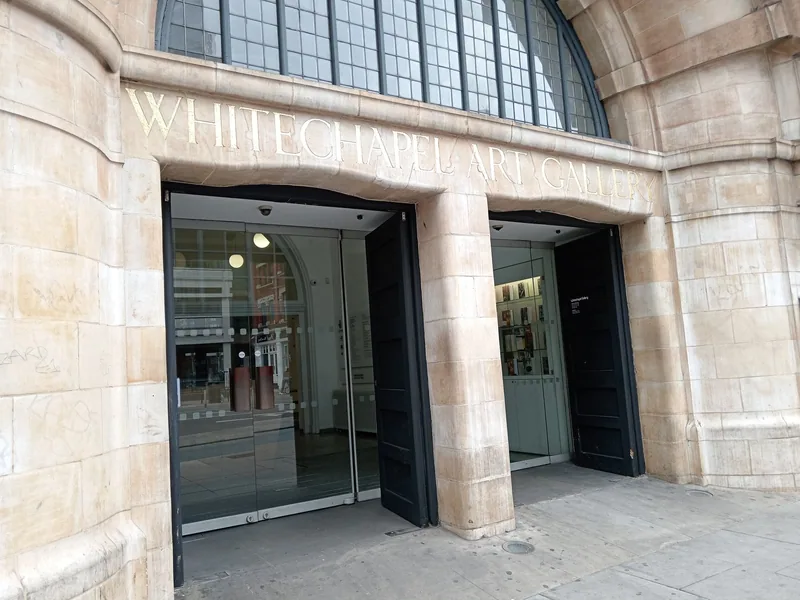
The gallery doubled in size in 2009 by buying the former Whitechapel Public Library next door, which is why the building now has nine exhibition spaces, an auditorium, studios and a specialist bookshop behind what looks from the street like one Edwardian frontage.
What is on in late 2026
The autumn season opens on 7 October 2026 with two exhibitions by the Chilean artist Cecilia Vicuña, Living Threads and Foraging Quipu, both running until 14 February 2027. Alongside them from 7 October to 8 November is This Must Be the Place: Artists for Whitechapel Gallery, and from 17 November to 13 December the gallery hosts the Film London Jarman Award 2026, which is its annual showcase of artists working with the moving image.
The Jarman Award show is a good introduction to what the gallery is for: several hours of artists' film, shown free, by people most visitors will not have heard of and some of whom will be well known in five years. If you have never spent an hour watching artists' film, this is the painless way to try.
Because the programme turns over entirely each season, check the exhibitions page before you travel. Between seasons some rooms are closed for installation, which is the one thing that can make a journey out here disappointing.
The building, and how to use it
You come in from Whitechapel High Street into a foyer with an information desk and the Alba Caffè on the ground floor. The exhibition spaces run over several floors, reachable by lift or stairs, and the Common Rooms are the part that repays knowing about: they have chairs, sofas and books, they cost nothing, and nobody will move you on.
The bookshop specialises in art publishing, exhibition catalogues and the gallery's own series of readers and anthologies, and it sells limited-edition prints by artists who have shown here. Members get ten per cent off in the shop and the café.
Eating is easy. Alba is a women-led café serving coffee, seasonal lunches and cakes baked in house. You may also bring your own food: two tables on the ground floor in the foyer are set aside for exactly that, which is rare in a London gallery and useful with children.
Families, access and groups
Under-16s go into every exhibition free. Baby changing is on the ground floor, near the café. Fidget spinners and other sensory tools are kept at the information desk and can be borrowed on request. The Common Rooms, with their sofas and books, work as somewhere to decompress halfway round.
Groups of more than nine count as a group booking and must be arranged at least a fortnight ahead, because the gallery is small. School and community groups are always free. For ticketed exhibitions, university groups pay £6.50 per person and independent groups £9.50. A guided exhibition tour starts at £150.
Aldgate East station has an exit almost at the door, but no lift. Wheelchair users and anyone pushing a buggy should use Whitechapel station instead, one stop east, which is step-free from street to platform on all four of its lines including the Elizabeth line, then walk back along the High Street.
The London Open, and how new artists get in
Two long-running schemes explain why the gallery matters to artists as well as to visitors. The London Open is an open-call exhibition held every three years, begun in 1932 under the name the East End Academy, through which artists early in their careers get their first significant showing. Anish Kapoor, Cornelia Parker, Grayson Perry, Rachel Whiteread, Julian Opie and Antony Gormley all appeared in it before they were famous.
The Max Mara Art Prize for Women, set up in 2005, gives a UK-based woman artist a residency in Italy and then a solo exhibition here. If you visit in a year when either is on, you are looking at work chosen by a process rather than by a market, and the rooms feel different for it.
How long to allow, and how to spend it
Ninety minutes is the right budget for a first visit: forty-five minutes in the ticketed show, thirty in the free displays, and fifteen in the bookshop, which is better than the exhibition shop at most London galleries. If a film programme is running, add an hour, because artists' film is usually shown on a loop and you want to catch a whole piece rather than the middle of one.
Two habits make the visit better. Ask at the information desk what is free that day, because the small displays are not always signposted from the foyer and visitors regularly walk past them. And do the free rooms before the ticketed show rather than after, while you still have the attention for them.
An east London afternoon built around it
The gallery sits on the boundary between the City and the East End, which makes it an efficient starting point. Old Spitalfields Market and the Brick Lane markets are ten minutes north, and Brick Lane's curry houses and bagel shops are the obvious place to eat afterwards. Shoreditch is fifteen minutes beyond that, and our guide to street art in Shoreditch covers the walls between here and there.
For the history of the area itself, see our guide to Whitechapel and the East End, and if you are here in the evening, the Ripper walking tours mostly start within a few streets. Dennis Severs' House in Spitalfields is the other unmissable interior in this part of London and needs booking.
If you want more contemporary art on the same day, Tate Modern is twenty minutes away on the District line and free, and the Serpentine Galleries in Kensington Gardens are free as well but at the other end of town. Our list of London's free museums has the rest, and for a Thursday-evening plan, our guide to museums that open late shows what else is on after six.
Frequently asked questions
Is Whitechapel Gallery free?
Partly. The main entrance and the free displays cost nothing, but the gallery charges for one main exhibition each season: £16.50 standard and £9.50 concession in September 2026. Under-16s are free to all exhibitions, and every Thursday from 6pm to 9pm admission to everything is pay what you can.
What days is Whitechapel Gallery open?
Tuesday to Sunday from 11am, closing at 6pm except on Thursdays, when it stays open until 9pm. It closes on Mondays. Check the exhibitions page before travelling, because rooms close for installation between seasons.
Which Tube station is best for Whitechapel Gallery?
Aldgate East is immediately next door, but it has no step-free access. If you need lifts, use Whitechapel station one stop further east, which is step-free from street to platform, and walk back. Liverpool Street is about ten minutes away on foot.
Does Whitechapel Gallery have a permanent collection?
No, and it never has. Everything shown is temporary, which is why the programme changes completely each season. Since 1901 it has specialised in giving artists their first British exhibition, from Jackson Pollock and Frida Kahlo to more recent names.
Can I take children to Whitechapel Gallery?
Yes. Under-16s enter free, there is baby changing on the ground floor, sensory tools can be borrowed from the information desk, and you may eat your own packed lunch at two tables in the foyer. The Common Rooms have sofas and books for a break.
Sources
- Whitechapel Gallery - Visit us, ticket prices and opening hours (checked September 2026)
- Whitechapel Gallery - About (checked September 2026)
- Whitechapel Gallery - History (checked September 2026)
- Whitechapel Gallery - Exhibitions (checked September 2026)