
Gunnersbury Park is a former Rothschild estate of about 185 acres in west London, free to enter every day, with a free local history museum in the main mansion that opens Tuesday to Sunday from 10am to 4.30pm. It is ten minutes' walk from Acton Town station on the Piccadilly and District lines.
The park sits on the boundary of Ealing and Hounslow, between Acton, Chiswick and Brentford, and the two boroughs bought it from the Rothschild family as a public park in 1926. A charity, the Gunnersbury Museum and Park Development Trust, now runs both the park and the museum. Our guide to Ealing and west London places it among the area's other houses and parks; this page walks you through the estate itself: the museum's rooms, the Georgian and Rothschild buildings scattered around the grounds, and how to fit it into a day.
Gunnersbury Park and Museum at a glance (checked November 2026)
- Park
- Every day, 7am to dusk. Free
- Museum and shop
- Tuesday to Sunday and bank holiday Mondays, 10am to 4.30pm. Closed other Mondays. Free; suggested donation £5 per person
- Historic kitchens
- Saturday and Sunday, 10am to 4.30pm. Weekdays only if a volunteer is available: ask at the desk
- Centenary exhibition
- "Gunnersbury Unlocked: From Private Grounds to Public Park", to 31 December 2026
- Address for the main car park
- Popes Lane, W3 8LQ. Charges apply at all times; Blue Badge parking free once registered
- Stations
- Acton Town (Piccadilly and District lines); South Ealing (Piccadilly line) plus bus; Kew Bridge (South Western Railway)
- Listing
- Registered park and garden, Grade II*; the museum building is listed Grade II*
Two houses, one estate: a short history
Gunnersbury is first recorded in 1347. The big house that made it famous was built in the 1650s for the lawyer John Maynard, and in 1762 the estate was bought by Princess Amelia, a daughter of George II. After her death the house was demolished in 1800 and the land split into plots for villas.
Two new houses went up in 1802. The larger one, Gunnersbury Park House, was built for the builder Alexander Copland and is today's museum. The smaller one, Gunnersbury House, was built for a timber merchant, Stephen Cosser. In the 1830s Nathan Mayer Rothschild, the founder of the British branch of the banking family, bought Copland's estate and had it remodelled by Sydney Smirke. The Rothschilds bought the smaller house in the 1880s, pulled down the wall between the two estates (its line is now a tree-lined path) and enlarged the park to the west.
Leopold de Rothschild died in 1917, and his son and heir Evelyn was killed in Palestine the same year. Rather than see the estate built over, the boroughs of Ealing and Acton bought it, and the park opened on 21 May 1926. The centenary is being marked through 2026 with an exhibition in the museum, listed in the box above.
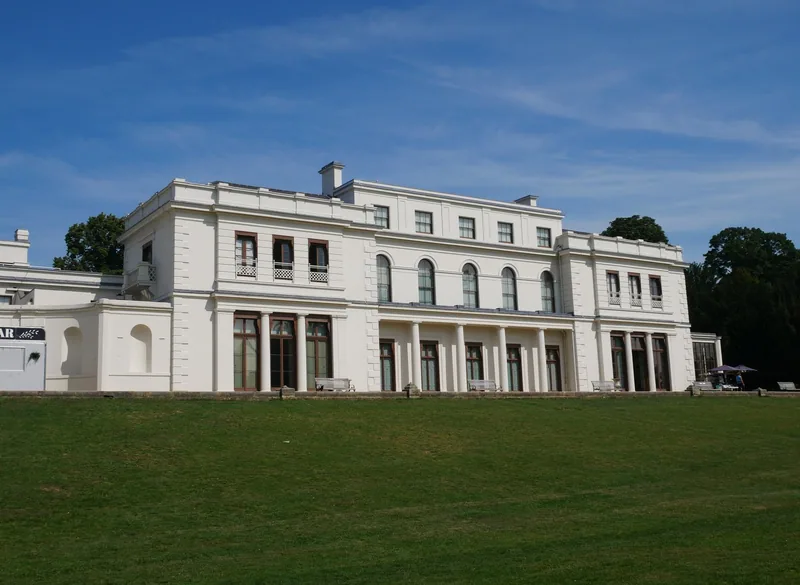
Photo: Ethan Doyle White · CC BY-SA 4.0 · Wikimedia Commons · resized
Inside the museum: the Rothschild rooms and the kitchens
The museum has been in the large mansion since 1929. Historic England's listing describes a three-storey Italianate house in stucco with a porch of paired Tuscan columns. Inside it is a mix of local history and country-house rooms:
- The Rothschild Rooms. The family's restored reception rooms, presented to show how they dined, danced and entertained.
- The Butler's Pantry. The staff who ran the house, and the objects they used.
- The historic kitchens. A Victorian kitchen with the latest appliances of the time. Open at weekends; on weekdays it depends on volunteers, so email or ask at the front desk before relying on it.
- People and Place. The story of Ealing and Hounslow from the Palaeolithic to the present.
- Toys and games, fashion and industry. A hands-on toy collection, costume from the museum's large collection, and the products west London has made over 200 years.
Allow an hour to an hour and a half for the museum. It is free, and you can leave and come back during the day. The museum is sometimes hired out for private events, which can close parts of it, so a phone call on the day is sensible if you are coming far.
The Rothschild carriages may not be where older guides put them. The family's Town Chariot, built in Wandsworth in the 1830s or 1840s and left in the stables when the estate passed to the public, was the museum's best-known object. Ealing Council reported in 2017 that it was being restored for a new carriage display building in the park. The museum's current list of galleries does not mention carriages, and we could not confirm where they are shown now. If they are why you are going, ask the museum first.
The buildings in the grounds
The pleasure of Gunnersbury is that the park is full of listed garden buildings from both families' time, and you find them by walking rather than by following a set route. The ones worth looking for:
- The Temple, Grade II*, near the Round Pond: red brick with a stone Doric portico. Its origin is told two ways. Historic England's list entry dates it to before 1760 and suggests it was built at Princess Amelia's wish while she was negotiating to buy the estate; the park's own history says Henry Furnese, who owned the estate from 1730, built the Round Pond and the Temple.
- The Orangery, Grade II*, beside the Horseshoe Pond, a stuccoed conservatory with a curved central bow, added by the Rothschilds and probably by Smirke around 1836.
- Princess Amelia's Bath House, among a group of Gothic outbuildings east of the smaller house, with an arcade and a shell grotto.
- The Gothic boathouse on the south shore of the Potomac Lake, built by the Rothschilds on the site of an old clay pit and pottery. The lake was dug out of the pit and the tower is a folly in brick with stone-traceried windows.
- The Gothic ruins on the edge of the former Japanese garden, an early-19th-century sham ruin with a round turret.
- The stables, east and west, and the walled kitchen garden with its carved door and wrought-iron gate.
The smaller house, Gunnersbury House, is not part of the museum. Look at it from outside: its south front has a cast-iron Chinoiserie veranda.
The newest thing in the park
On 1 October 2025 the Prince of Wales unveiled the Humanitarian Memorial at Gunnersbury, the first memorial to aid workers of all nationalities who have been killed in their work. It is a ring of 15 human-sized figures by the artist Michael Landy, joined at the hands, with gaps left for visitors to complete the circle. Each figure carries an anonymous story from an aid worker, a family member or someone who received help. Some of the stories describe distressing events, which is worth knowing before you bring children to read them.
Is it worth the journey for a visitor?
For a free half-day it is good value, and a better choice than its reputation suggests. It is not a great house like Osterley or Syon: the museum is a borough museum with Rothschild rooms, not a furnished palace. What it offers is a large, quiet historic park with real buildings in it, a museum that costs nothing, and a location that combines easily with other things in west London.
If you are interested in the Rothschilds specifically, the best-known Rothschild house open to the public is Waddesdon Manor in Buckinghamshire, a full day out. Gunnersbury is the family's London estate, and an easier hour from central London.
Go if
- You want a free museum and park on a weekend, with the kitchens open
- You are already in west London for Kew, Chiswick or the Transport Museum depot
- You like finding garden follies, temples and grottoes without crowds
Skip if
- It is a Monday that is not a bank holiday: the museum is shut
- You have only one day in London and want the famous sights
- You want an interior on the scale of a stately home
Getting there
The simplest route is the Piccadilly line or the District line to Acton Town. The route runs down Gunnersbury Lane and across the North Circular Road; TfL's journey planner puts the walk to the Popes Lane side at about ten minutes, and the museum is a few minutes further inside. From South Ealing on the Piccadilly line, the E3 or 65 bus runs along Popes Lane. Kew Bridge station, on South Western Railway from Waterloo, is the nearest main-line station, to the south of the park.
Inside, the museum, reception and shop are reached by a short ramp, and a lift serves all floors, including for small powered wheelchairs. The park has tarmac paths that can be uneven, and ramps at both ends of the mansion terrace. There is an accessible toilet in the museum and in the park toilet block near it. Dogs are not allowed in the museum, apart from assistance dogs.
Food, and combining it with other places
The park café, Pure in the Park, was rated 5 by the Food Standards Agency at its inspection in February 2026. Gunnersbury's own website gives two different sets of café hours on two pages, so assume it opens in the morning and closes in the late afternoon, and check on the day. Picnics on the lawns in front of the mansions are the obvious alternative.
Three minutes from Acton Town is the London Transport Museum's depot, which opens on set days only. Gunnersbury and the depot together make a good west London day on a weekend when the depot is open. South of the park, the Museum of Water and Steam by Kew Bridge and the glasshouses of Kew, including the Palm House before it closes, are a short bus ride away.
Further along the Piccadilly line, Boston Manor House is another small free house in a park. The Acton and Hanwell guide covers the streets around the station, and our round-up of outer London's local museums compares Gunnersbury with its counterparts in other boroughs.
Frequently asked questions
Is Gunnersbury Park Museum free?
Yes. Both the park and the museum are free to enter. The museum suggests a donation of £5 per person, which is voluntary. Parking in the car parks is charged at all times, including bank holidays.
When is Gunnersbury Park Museum open?
Tuesday to Sunday from 10am to 4.30pm, and on bank holiday Mondays. It is closed on other Mondays except to pre-booked school groups. The historic kitchens open at weekends, and on weekdays only when a volunteer is available.
What is the nearest station to Gunnersbury Park?
Acton Town, on the Piccadilly and District lines, about ten minutes' walk along Gunnersbury Lane. South Ealing on the Piccadilly line is also close, with the E3 or 65 bus along Popes Lane, and Kew Bridge station is to the south.
Can you see the Rothschild carriages at Gunnersbury?
The Rothschild Town Chariot was restored for display after 2017, but the museum's current gallery list does not mention it. Ask the museum before a visit if the carriages are the reason you are going.
How big is Gunnersbury Park?
About 185 acres, according to Gunnersbury Park and Museum. It is a registered historic park at Grade II*, with the Potomac Lake, the Round Pond and the Horseshoe Pond, sports pitches and many listed garden buildings.
Sources
- Gunnersbury Park and Museum - Plan your visit (checked November 2026)
- Gunnersbury Park and Museum - A brief history of Gunnersbury (checked November 2026)
- Gunnersbury Park and Museum - Museum galleries (checked November 2026)
- Gunnersbury Park and Museum - Humanitarian Memorial (checked November 2026)
- Historic England - Gunnersbury Park Museum, list entry 1358312 (checked November 2026)
- Historic England - Temple in Gunnersbury Park, list entry 1080331 (checked November 2026)
- Around Ealing (Ealing Council) - Chariot races to a full restoration at Gunnersbury, April 2017 (checked November 2026)
- Food Standards Agency - Food hygiene rating search: Pure in The Park, Gunnersbury Park, W3 8LQ (checked November 2026)