
Marble Hill House in Twickenham is a white Palladian villa built between 1724 and 1729 for Henrietta Howard, and English Heritage lets you in free. The catch is the season: the house opens only from April to October, Wednesday to Sunday, so from November to March you can walk round the outside and the 66-acre park, which is free and open every day, but not go in.
Henrietta Howard was a courtier, for years the mistress of the future George II, and a clever, well-connected woman who wanted a house of her own away from the court. English Heritage calls Marble Hill a relatively rare example of a Georgian house built for and by a woman. It is the last complete survivor of the villas and gardens that once lined this stretch of the Thames between Richmond and Hampton Court.
Our page on Ham House and Marble Hill covers the two houses as a pair, with the ferry fares and a day that links them. This page is about Marble Hill on its own: the woman who built it, the rooms, the garden that has been put back, and how to plan round its short season.
Marble Hill House at a glance
- Address
- Richmond Road, Twickenham TW1 2NL
- House
- April to October, Wednesday to Sunday and bank holidays, 10am to 5pm. Closed November to March
- Cost
- Free. Booking a free timed ticket online guarantees entry but is not required
- Park
- Open daily, free; 7am to 5pm in winter (English Heritage calendar, November 2026)
- Coach House Café
- Open whenever the park is open; 8am to 4pm in November 2026, 8am to 3.30pm from December to 1 February 2027
- Hammerton's Ferry to Ham
- Daily 1 March to 31 October, 10am to 6pm; December to February weekends only, 10am to dusk. Adult £2, child over three £1 (November 2026)
- Trains
- St Margarets, about 11 minutes' walk; Twickenham, about 20 minutes
- Time needed
- An hour in the house, as long as you like in the park
Henrietta Howard and why she built a house
Henrietta Howard was born into the Hobart family of Norfolk in 1689, lost both parents by the age of twelve, and at sixteen was married to Charles Howard, a younger son of the Earl of Suffolk whom English Heritage describes as dissolute. Through him she came into the Hanoverian court, and she became the mistress of the Prince of Wales, the future George II.
She used the position well. Her circle included Alexander Pope, John Gay, Jonathan Swift and later Horace Walpole, and in the 1720s, while still at court, she began building Marble Hill on the Twickenham bank as a retreat. In 1734, after twenty years in the royal household and out of favour with the king, she retired from court as Countess of Suffolk, and Marble Hill became her main home. Pope, a neighbour, wrote in 1735 that she held "a greater court" there than the one at Kensington.
She expanded the house in the 1740s and 1750s with a service wing and a fashionable dining parlour, and she died here in 1767. For the visitor, that history explains the feel of the place. It is not a palace or a showpiece for a dynasty. It is a private house, beautifully proportioned and not very large, made for conversation, cards and visitors.
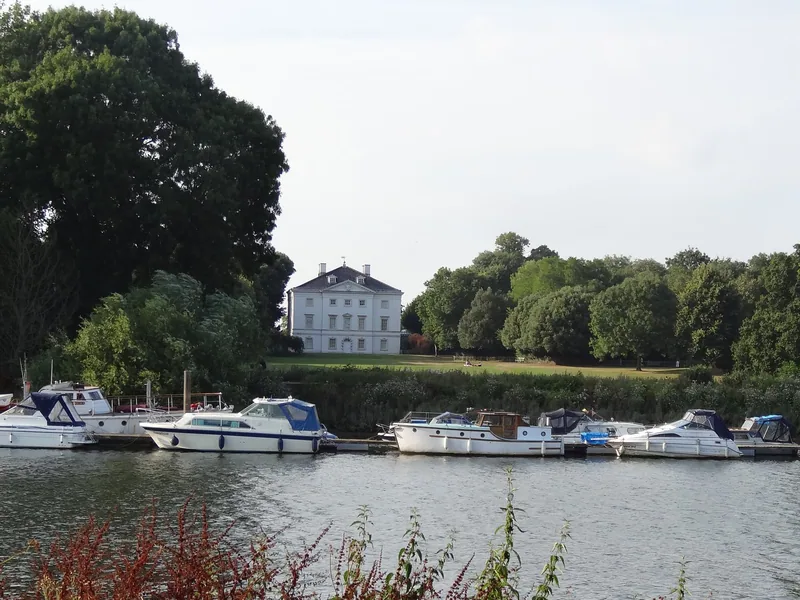
Photo: Jonathan Cardy · CC BY-SA 4.0 · Wikimedia Commons · resized
A textbook Palladian villa
The house was built to designs by Lord Herbert and Roger Morris in the English Palladian style, which took its rules from the sixteenth-century Italian architect Andrea Palladio. Historic England lists the house at Grade I and calls it an unusually instructive example of the style. If you want to see the ideas of the 1720s set out plainly in a single building, this is it.
Look at it from the river side first. It is a simple box of three main storeys, five windows wide, faced in stucco and painted the off-white that English Heritage chose to match the lead white it would originally have had. The centre three bays step forward under a pediment. The road side, to the north, is richer, with a rusticated base and four giant Ionic pilasters. The pyramid roof is topped with a lead ball.
Inside, the room the list entry singles out is the Great Room, a perfect cube of 24 feet on the first floor, and the mahogany staircase that leads to it. Compare it with Chiswick House, built in the same years by Lord Burlington a few miles downstream: Chiswick is the manifesto, Marble Hill is the lived-in version.
Inside the house today
English Heritage closed the house for a restoration project called Marble Hill Revived, which ran from 2018 to 2022, supported by a £5 million grant from the National Lottery Heritage Fund and the National Lottery Community Fund. It reopened on 21 May 2022, five days a week for seven months of the year, free; before that, its opening hours had been very limited.
The rooms have been conserved and the silks rehung, and the displays now tell Henrietta Howard's story and that of the people round her, down to her dogs. There is a fine collection of early Georgian paintings, including portraits of members of her circle. Children get a family trail and can try on hats in Henrietta's dressing room. The breakfast parlour was closed for refurbishment when we checked in November 2026; the rest of the house was open.
Leave the pushchair and the rucksack outside the rooms. Pushchairs are not allowed in the house, though English Heritage lends baby carriers and has a space to leave buggies, and it advises against backpacks because the rooms are small. A lift added during the restoration reaches the first floor, and there is one step at the main entrance with a portable ramp on request.
Photography is allowed in most areas of the house for personal use; ask at the entrance. Drones are not allowed anywhere on the site.
The garden that was put back
The garden between the house and the river was laid out with advice from Pope and from Charles Bridgeman, later royal gardener to George II. Over two centuries it vanished under grass. English Heritage has now restored its key elements from a detailed survey made in about 1749: a ninepin bowling alley, flower gardens, terraces, serpentine paths and the Sweet Walk that runs from White Lodge to the house.
Look out too for the grotto, lost for many years and found again in the 1940s, where excavations uncovered coral, Caribbean shells and an eighteenth-century floor set with flint, pebbles and knuckle bones. There is an ice house of the same period. The park now has a playground with a mini trampoline and a willow tunnel, sports pitches, two marked "silent spaces" and a sheltered Woodland Walk along its eastern edge.
The view that saved it
After Henrietta's death the house passed through her family and a series of tenants, and in 1824 it was sold, against the terms of her will. Its last resident died in 1887. In 1898 the Cunard family bought it intending to build a housing estate.
What stopped them was the view from Richmond Hill, the famous panorama of the Thames bend that artists had painted for generations. Marble Hill lies at the heart of it, and after a public campaign an Act of Parliament in 1902 protected the land. English Heritage describes it as the only English landscape view protected by Act of Parliament. Marble Hill has been a public park ever since, and the house was restored by the Greater London Council in 1965 and 1966. English Heritage took it over in 1986.
To see what the Act protected, walk up to the terrace on Richmond Hill afterwards; our guide to Richmond has the route.
Planning round the season
The calendar decides what kind of visit you get. From April to October, come Wednesday to Sunday for the house, the restored garden and the ferry, and if you want certainty on a summer weekend, book the free timed ticket online. The house opens at 10am and closes at 5pm.
From November to March the house is shut, and English Heritage's published calendar shows it closed every day until mid-March 2027. The park, the café and the outside of the house are still free and open daily, and a winter walk here is pleasant but short. Hammerton's Ferry stops after 31 October and in winter runs only on some weekends from December to February, so check its notice before relying on it. In November it does not run at all.
A winter trip will not get you inside. Several guides list Marble Hill's hours as Wednesday to Sunday without saying that applies only from April to October. If the house is the reason for your journey, come between April and October; otherwise treat it as a park walk.
Getting there and what to pair it with
South Western Railway trains from Waterloo reach St Margarets in about half an hour, and the house is about 11 minutes' walk from there. Twickenham station is a little further. Buses 33, 490, H22, R68 and R70 run along Richmond Road past the main gate. Richmond Underground station is about a mile away, a pleasant riverside walk if the weather is good. The car park has 76 spaces and charges non-members.
The Coach House Café is in the old stable block. The Food Standards Agency register lists the site's catering as rated 5 under English Heritage in January 2025, and a new caterer at the same address awaiting its first inspection (November 2026).
Marble Hill is one stop on the best free stretch of the Thames in London. Our guide to Twickenham and the Richmond riverside covers Orleans House Gallery next door and York House Gardens. Strawberry Hill House, built by Horace Walpole, one of Henrietta's younger friends, is about 25 minutes' walk south, and Eel Pie Island is between the two. Further upstream are Teddington and Hampton, and the riverside path is covered in our Thames Path guide.
Marble Hill costs nothing, but many of the houses near it do, and our page on National Trust and English Heritage passes works out when membership pays. For a second free house in west London, Boston Manor House in Brentford is a Jacobean one, open all year.
Frequently asked questions
Is Marble Hill House open in winter?
No. English Heritage opens the house from April to October only, Wednesday to Sunday and bank holidays, 10am to 5pm. From November to March it is closed, but the park and the Coach House Café stay open every day, free, so you can still see the outside of the house and walk the grounds.
Do you need to book Marble Hill House?
No. Entry is free and you can walk in during opening hours. English Heritage offers free timed tickets online, which guarantee entry, and members can book in the same way. It is worth doing on a sunny summer weekend.
Who was Henrietta Howard?
Henrietta Howard (1689–1767) was a courtier and mistress of George II when he was Prince of Wales, later Countess of Suffolk. She built Marble Hill in the 1720s as her own retreat and made it a meeting place for writers including Alexander Pope, John Gay and Horace Walpole.
How do you get from Marble Hill to Ham House?
By Hammerton's Ferry, a small passenger boat across the Thames, which runs daily from March to October and at weekends from December to February. Without it you have to go round by Richmond Bridge or Teddington Lock, a long walk.
Sources
- English Heritage - Marble Hill prices and opening times (checked November 2026)
- English Heritage - History and stories of Marble Hill (checked November 2026)
- English Heritage - Marble Hill Revived (checked November 2026)
- English Heritage - Plan your visit to Marble Hill: directions, facilities and access (checked November 2026)
- Historic England - Marble Hill House, list entry 1285673 (checked November 2026)
- Hammerton's Ferry - Services, seasons and fares (checked November 2026)
- Food Standards Agency - Food hygiene ratings search: English Heritage Marble Hill, TW1 2NL (checked November 2026)