
St Bartholomew the Great is free. There is no admission charge, no ticket desk and no booking: you walk through the Tudor gatehouse on West Smithfield, cross a small graveyard, and step into a church founded in 1123. Donations are invited, and the parish is clear that no money reaches it from either the national church or the state.
That matters, because for years visitors were asked to pay at the door, and a lot of guidebooks and printed maps still say so. The parish's own visitor page now states plainly that neither of its two churches charges for entry. If someone tells you otherwise, they are working from old information.
The church sits on the edge of Smithfield, five minutes from Farringdon station and about ten from St Paul's. Our guide to Clerkenwell as a neighbourhood places it in the wider district, and our round-up of All Hallows and the City churches puts it in a walking route with six others. What follows is the building itself: what is in it, when the doors are genuinely open, and why so many film crews keep coming back.
St Bartholomew the Great: the practical frame
- Admission
- Free. Donations invited; no ticket, no booking
- Opening hours
- 10am to 5pm, Monday through Saturday. Sundays: visitors are welcome in the gaps between services
- Sunday services
- 9am in the Lady Chapel, 11am choral eucharist, 5pm choral evensong
- Address
- The Priory Church of St Bartholomew the Great, West Smithfield, London EC1A 9DS
- Step-free entry
- The west-door route, starting at the gatehouse arch and skirting the graveyard
- Guided tours
- Private tours only, minimum party of five, booked by email with the head verger
- Founded
- 1123, by Rahere, a courtier of Henry I; 900th anniversary marked on 25 March 2023
- Time to allow
- 30 to 45 minutes, or an hour if you sit through part of a service
The neighbouring church stays open until 10pm every day of the week. St Bartholomew the Less stands within Bart's Hospital, just through the Henry VIII gate, and opens every day from 8am to 10pm. It is free as well. If you arrive at the Great after five o'clock, or on a day when it has closed for a wedding, the Less is a hundred metres away and will almost certainly be open.
The Tudor gatehouse, and the arch hiding underneath it
Most people miss the entrance. From the rotunda garden at West Smithfield, look for a narrow half-timbered upper storey sitting above a stone archway, wedged between later buildings. That timber front is Tudor. The arch beneath it is much older, from the thirteenth century, and it marks where the nave's southern doorway stood before the priory came down.
Walk through and the scale of what was lost becomes obvious. The graveyard you cross was the floor of the nave. Henry VIII's commissioners dissolved the priory in 1539, the nave came down, and the remaining estate was sold to the courtier Richard Rich. What survived was the eastern end of the monastic church, which carried on as an ordinary parish church and still is one.
So the building you enter is a fragment. That is the odd arithmetic of the place: what survives is the leftovers, and the leftovers are still one of the largest and least altered pieces of Norman work anywhere in London.
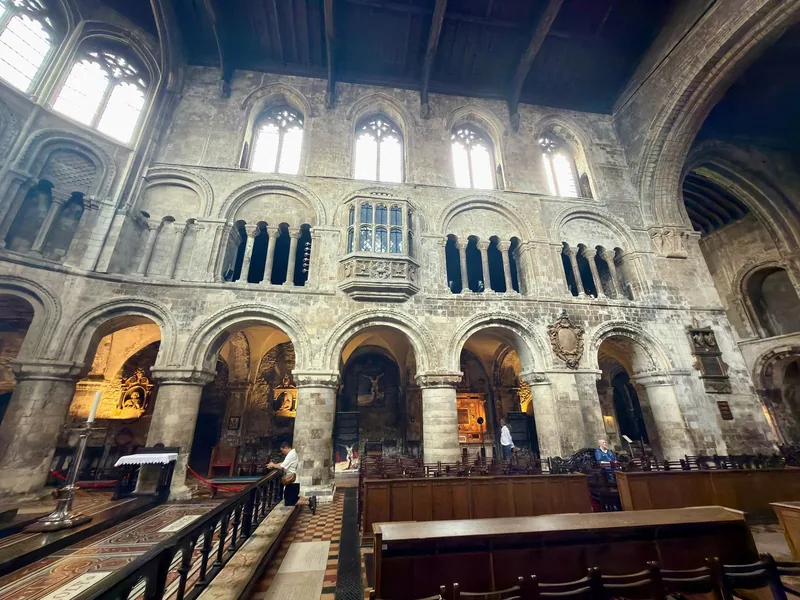
Photo: Oleg Yunakov · CC BY-SA 4.0 · Wikimedia Commons · resized
What to look for once you are inside
Give yourself a slow circuit rather than a lap. Four things repay the attention.
- The Lady Chapel at the east end. Rebuilt after a reported apparition of the Virgin Mary to one of the canons before 1180, it later left church hands entirely and spent generations in commercial use. The parish bought it back in 1885.
- The tomb of Rahere. The founder's monument stands on the north side of the sanctuary, a painted effigy under a canopy, several centuries younger than the man beneath it.
- The cloister. Reached from the south aisle, and described by the parish as one of the oldest in London. Coffee is served there after the Sunday eucharist, which is the easiest excuse to see it.
- The font. The parish records that William Hogarth was baptised in this church; he was born nearby, at Bartholomew Close, in 1697.
Two survival stories explain why any of it is still here. In 1666 the old priory walls acted as a firebreak and the Great Fire stopped short. In the Blitz, the parish records the curate, the Reverend Newell Wallbank, kicking incendiary bombs off the church roof.
Benjamin Franklin set type in the Lady Chapel
This is the detail that surprises people most, and the parish makes a good deal of it. When Benjamin Franklin arrived in London on Christmas Eve 1724, aged eighteen, the Lady Chapel was no longer part of the church. It housed the printing shop of a master printer named Samuel Palmer, and Palmer gave Franklin his first London job, as a compositor setting metal type by hand.
Franklin's own account records him setting the type for a third printing of William Wollaston's The Religion of Nature Delineated. Three hundred years later, in February 2025, the parish marked the anniversary by running a working replica of a hand press on the same floor. The original press Franklin used in London is now in the Smithsonian in Washington.
His better-known London address, where he lived for most of two decades from the 1750s, is a twenty-five minute Tube ride away and is covered in our guide to Benjamin Franklin House on Craven Street. The Smithfield connection came first, and almost nobody knows about it.
Five bells older than the Reformation
The tower holds five ringing bells cast by Thomas Bullisdon, a founder working in Aldgate between about 1500 and 1515. The reputed date is 1510, which makes them the only pre-Reformation ring of bells in the City of London, and the only set in England of more than four pre-Reformation bells by a single founder. The tenor weighs about 280kg.
They are not rung daily. The regular band rings for evensong on the first and third Sundays of the month, roughly from 4.10pm to 5pm, and practises on Thursday evenings between 6pm and 7pm. Weddings are the other occasion.
The clock is younger and has its own local connection: it dates from 1814 and was made by John Thwaites of Clerkenwell, whose firm later became Thwaites and Reed. It strikes the hours only, not the quarters, from 7am until midnight, on a bell hung in a turret on the tower roof.
Why film crews keep coming back
The interior is dark, tall, unrestored-looking and almost free of Victorian clutter, which is exactly what a camera wants. The parish keeps a list of productions filmed here. Four Weddings and a Funeral used it as itself in 1994. Elizabeth: The Golden Age dressed it as somewhere else in 2007. In Sherlock Holmes in 2009 it stood in for the crypt of St Paul's Cathedral, which is a nice trick given the real crypt is ten minutes' walk south.
More recent credits on the same list include Transformers: The Last Knight in 2017, Napoleon and What's Love Got to Do with It? in 2023, and the Netflix series Mary & George in 2024. Our guide to film and television locations across London covers the rest of the city's screen geography.
One practical consequence: filming closes the church. So do weddings, funerals, concerts and recording sessions, and the notice is often only a few days.
A closed door here is usually a wedding, not a change of hours. The church is a working parish, and it shuts at short notice for services, filming and concerts. The diary on the parish website is the only reliable place to check, and we would look the night before rather than the week before. If it is shut, walk to St Bartholomew the Less or to the churches in our City walk instead.
Sunday: the best time to come, and the worst
Sunday is the day the church is most alive and least available. Services run at 9am in the Lady Chapel, 11am for the choral eucharist with a professional choir, and 5pm for choral evensong. The neighbouring Less has its own at 10am and 5pm.
If you want the building empty and quiet, come between about 12.30pm and 4.30pm on a Sunday, or on a weekday morning. If you want to hear what the acoustics can do, come to evensong: it is free, it lasts about an hour, nobody asks whether you are Anglican, and sitting at the back is entirely normal. The eucharist and evensong are both streamed on the parish's YouTube channel, which is a fair way to judge in advance whether the music is your sort of thing. Our guide to classical music in London lists other places to hear choirs for nothing.
Access, groups and photography
For step-free entry, follow the west-door route that begins at the gatehouse arch, rather than the usual way across the graveyard. At the Less, the step-free way in is at the back of the church, opposite the Maggie's centre.
A party of at least five can book a private tour with the head verger, who has been showing people round here for years; it is booked by email through the parish office rather than online. The parish also runs free sessions for school groups, adapted by age, and lets them eat a packed lunch in the cloister.
Photography of the building is normally fine. Photographing people at prayer is not, and flash is best avoided. If a service starts while you are looking round, sit down or leave quietly by the nearest door.
How long it takes, and what to put around it
Thirty to forty-five minutes covers the church properly. That makes it a component of a morning rather than a morning in itself, and Smithfield gives you plenty to attach it to.
Five minutes north across Charterhouse Square is the Charterhouse, where the museum display and chapel are free and the historic rooms are seen on a paid tour. Five minutes west along Clerkenwell Road stands the Museum of the Order of St John in its own Tudor gatehouse, also free. Ten minutes south-west, Ely Place and St Etheldreda's make a similar pairing of gate and medieval interior.
Going the other way, Postman's Park and its wall of memorial tablets is five minutes south, and St Paul's Cathedral about ten. The remains in our guide to what is left of Roman London are mostly a short walk east, in the Square Mile. From 28 November 2026 the biggest new neighbour arrives: the London Museum opens in the Smithfield General Market building across the road, with free galleries.
For lunch, the old taverns in our guide to historic London pubs include several within a few streets. And if you are putting together a day that costs nothing at all, this church belongs on the list in our guide to free things to do in London. Farringdon, on the Elizabeth line, is the easiest way in.
Frequently asked questions
Is St Bartholomew the Great free to enter?
Yes. The parish states that there is no admission charge for either St Bartholomew the Great or St Bartholomew the Less, and asks instead for a donation towards the upkeep of the buildings. No funding reaches it from the national church or from the state. Older guidebooks that mention an entry fee are out of date.
What are the opening hours of St Bartholomew the Great?
From Monday through Saturday the church welcomes visitors from 10am to 5pm. On Sundays it is open around the services, which are at 9am, 11am and 5pm, so the middle of the afternoon is the quietest window. The building also closes at short notice for weddings, funerals, concerts and filming.
How old is St Bartholomew the Great?
It was founded in 1123 by Rahere, a courtier of Henry I, who established both the priory and the hospital next door after an illness and a vision. The parish marked exactly 900 years since the laying of the foundation stone on 25 March 2023. The building today is the eastern part of the original priory church.
Which films were shot in St Bartholomew the Great?
The parish lists Four Weddings and a Funeral (1994), Elizabeth: The Golden Age (2007), Sherlock Holmes (2009), where it played the crypt of St Paul's, Transformers: The Last Knight (2017), Napoleon and What's Love Got to Do with It? (both 2023), and the Netflix series Mary & George (2024).
Can you visit St Bartholomew the Great in a wheelchair?
Yes, by the west door. The parish directs wheelchair users to the west-door route, which starts at the gatehouse arch and avoids the steps on the normal way in. At St Bartholomew the Less there is step-free access at the rear of the church, opposite the Maggie's centre.
Sources
- Great St Bartholomew - Visit: opening times, free admission, tours and access (checked September 2026)
- Great St Bartholomew - Sunday and weekday services (checked September 2026)
- Great St Bartholomew - History of St Bart's (checked September 2026)
- Great St Bartholomew - Benjamin Franklin and the Lady Chapel printing shop (checked September 2026)
- Great St Bartholomew - The bells and clock (checked September 2026)
- Great St Bartholomew - Filming at St Bart's (checked September 2026)