
You cannot walk around Eel Pie Island. It is private property, people live on it, and the only way in is the artists' open studios, which happen twice a year, usually in early July and early December. They are free, but you need a ticket for a timed two-hour slot, and they sell out.
It lies in the river at Twickenham, tied to the Middlesex bank by one footbridge and nothing else. Where it fits among the Palladian villas and free galleries on the same stretch of water is set out on our page about the Twickenham and Richmond riverside.
This page is the practical version: how the open days work, what is on the island when they are not running, what you can legitimately see from the bridge on any ordinary Tuesday, and why the place is famous out of all proportion to its size.
Eel Pie Island at a glance
- Access
- Private. Open studios twice a year, usually early July and early December
- Open studios ticket
- Free, but booked in advance for a two-hour slot, 11:00 to 17:00
- Studios
- Twenty-one resident artists, plus working boatyards
- The bridge
- Opened 1957; a single-span concrete footbridge from Twickenham Embankment
- Any other day
- Walk onto the bridge, look, and go no further
- Nearest station
- Twickenham, South Western Railway from Waterloo, Zone 5
How the open studios actually work
The artists who rent space on the island run the open days themselves, and they are the only sanctioned way for a visitor to set foot beyond the bridge. Their own wording is unambiguous: the island is private and visitors are not allowed, except at these events.
The 2026 summer edition ran across two consecutive weekends, on 4 and 5 July and again on 11 and 12 July, from 11:00 to 17:00 each day. Entry was free but ticketed, with visitors asked to book a two-hour slot in advance. The artists are explicit that the timed slots exist to keep the day manageable for visitors and for the neighbours whose gardens you are walking past.
The winter edition normally falls in early December. Dates for each round appear on the artists' own website a few weeks beforehand rather than months ahead, so the practical advice is to check in late spring and again in October. If you are planning a trip around it, do not book flights on the strength of last year's dates.
Twenty-one artists are listed as resident. The work covers painting, printmaking, ceramics and ceramic sculpture, mosaics, fine jewellery, metalwork, photography, illustration and a certain amount of the genuinely eccentric, including someone who turns old suitcases into speakers. You can buy, and you can commission.
The island has no visitor facilities of any kind, and its residents are not staff. There is no café, no shop, no ticket office and no public lavatory on the far side of the bridge, and the studios open into a lane with people's homes and gardens along it. Use the facilities in Twickenham before you cross, keep to the lane, and do not photograph into gardens or through windows. The open days continue because they are tolerated.
What you can do when the studios are shut
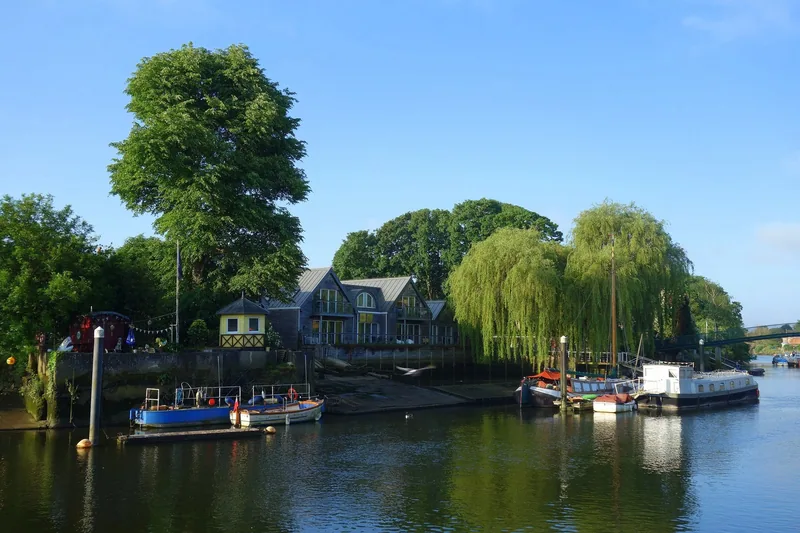
On every other day of the year the answer is: stand on the bridge. That is not nothing. Anyone may walk it as far as the island boundary, and it rises high enough for a clear view up and down this reach of the river. The boatyards, the rowing club and the backs of the houses are all visible from it.
The proper substitute is the Eel Pie Island Museum, which is on the mainland at 1 Richmond Road in Twickenham, a few minutes' walk from the riverside, not on the island at all. It opens Thursday to Sunday from 12:00 to 17:30, with last entry at 17:00, and charges £5 for a single visit or £10 for annual membership (September 2026). It covers three things: the music, the boatyards and what it calls invention and creativity. For a small volunteer-run museum it is well done, and it is the only place that assembles the whole story.
The rest of the day is the riverside. The Thames Path runs along both banks here, and our guide to walking routes along the river covers the stretch; the far bank leads towards Richmond and the hill above it.
Three islands, an inn and a great many eel pies
The shape you see now is not original. Richmond council's conservation area appraisal records that early maps show three separate islands, which became two and then one; the wooded ends at each tip were among the original separate islands, and they flooded, which is why they have never been built on and are now designated as Metropolitan Open Land.
It has been called Twickenham Ayte, Goose Eyte and Parish Ayte at various points. Licensed premises are recorded on it as early as 1743, and by 1786 an inn called the White Cross was well established. That was replaced in 1830 by something much grander, renamed the Island Tavern.
Then came the steamers. Victorian excursion boats brought day trippers down from London in large numbers, and what the trippers ate was eel pie, and enough of it that by the middle of the nineteenth century the pub had become the Eel Pie Tavern and the island had taken the name for good.
By 1893 the character had changed again: boatyards, a ferry, and the Twickenham Rowing Club boathouse. That working use has never entirely stopped, which is the island's real oddity. The artists describe their studios as sharing the place with some of the only working boatyards left on the river.
The hotel, and the four years that made it famous
The building that people mean when they say Eel Pie Island was the hotel, and its ballroom, opened in 1898 with a sprung dance floor. Between the wars it held tea dances. In the 1950s an antiques dealer named Arthur Chisnall began booking traditional jazz into it, and the names that played — Ken Colyer, Acker Bilk, Chris Barber — were the leading British players of the revival.
The footbridge, opened in 1957, is what turned a curiosity into a venue. Before it, everyone arrived by ferry. After it, a Saturday-night crowd could simply walk across.
What followed is compressed into a very few years in the early 1960s. The Rolling Stones held a residency there in 1963 that ran for about five months. John Mayall's Bluesbreakers brought a young Eric Clapton. Howlin' Wolf and John Lee Hooker both played the island. The council revoked the venue's licence in 1967, and in the period after that The Who, Deep Purple, Pink Floyd and Black Sabbath all appeared on the site. By 1969 the hotel was a semi-derelict commune. It burned down in 1971, and housing was built where it stood.
There is nothing left of it to look at. The ground the ballroom stood on is now somebody's home, and it is private. That is the usual disappointment here: people travel out expecting a music landmark and find a footbridge and a residential lane. The museum on Richmond Road is where the landmark actually is.
For where that kind of music ended up in London, our guides to live music venues and jazz in London cover the clubs that survived.
Getting there, and how long it takes
Twickenham station is the one to use, in Zone 5, reached from Waterloo on South Western Railway in a little over twenty minutes, with contactless and Oyster accepted. From the station it is about fifteen minutes on foot down through the town to the riverside Embankment, where the footbridge crosses.
Allow half a day for a worthwhile trip rather than an hour. The island itself, on an open-studios day, takes an hour to two hours depending on how much you want to talk to people; the museum takes about forty minutes; the walk and the riverside fill the rest.
| If you have | Do this |
|---|---|
| Two hours | Museum on Richmond Road, then the bridge and the Embankment |
| Half a day | Add the walk upstream to Marble Hill, or downstream towards Richmond Bridge |
| A full day, in July or December | Open studios in your booked slot, then the riverside and the far bank |
| A rugby weekend | Do not. The town is at capacity and the riverside is full |
That last row matters more than it looks. Twickenham on an international match day is a different town, as our guide to match days at the stadium explains, and an open-studios weekend that coincides with a fixture is best avoided entirely.
Why nothing ever gets delivered here
Everything on the island (building materials, furniture, a new boiler) crosses a footbridge. Richmond council operates loading and unloading restrictions at the island end, with a limit of one hour before a business has to apply for a dispensation for extra time.
That single administrative fact explains a great deal about the way the place looks: the improvised repairs, the accumulated boat parts, the absence of anything that needed a lorry. Combined with the flooding at both wooded ends, it is also why the island has stayed as it is while the rest of this stretch of the Thames has become expensive and tidy.
Making a day of it on this stretch of river
The Twickenham bank repays a full day, and very little of it costs anything. Marble Hill and Ham House sit on opposite banks within a mile; Strawberry Hill House, Horace Walpole's Gothic invention, is a twenty-minute walk south; and Richmond Park is up the hill on the far side.
Lunch is a pub matter here rather than a restaurant one, and the riverside houses fill fast on a warm afternoon. Our page on pubs on the Thames covers the stretch.
Eel Pie Island belongs to a small category of London places where the calendar decides everything, and it is worth knowing the others before you make a special journey. The Open House Festival in September opens several hundred buildings that are normally shut. The brewery arches on our page about the Bermondsey beer mile are closed for two days of every week. And some places, like the sundial junction described on our page about Seven Dials and Neal's Yard, are open permanently but only make sense at certain hours. Small museums follow the same pattern all over the city, as our selection of the best small museums in London shows. Check the days before you travel, not after.
Frequently asked questions
Can you visit Eel Pie Island?
Only during the artists' open studios, which take place twice a year, normally in early July and early December. Entry is free but requires a ticket for a timed slot booked in advance. At all other times the island is private and residents ask visitors not to cross beyond the bridge.
When are the Eel Pie Island open studios in 2026 and 2027?
The July 2026 weekends were the 4th and 5th and the 11th and 12th, running 11:00 to 17:00. A December edition normally follows. Dates are published on the artists' own website a few weeks in advance rather than a year ahead, so check in autumn for the winter round and in spring for the summer one.
Is there anything left of the Eel Pie Island Hotel?
No. The hotel burned down in 1971 and houses stand on the site, which is private. The story is told instead at the Eel Pie Island Museum on Richmond Road in Twickenham, which is open Thursday to Sunday and charges £5 for a single visit.
How do you get to Eel Pie Island from central London?
Trains run from Waterloo to Twickenham on South Western Railway, a little over twenty minutes, and the station is in Zone 5. From there it is about fifteen minutes on foot through the town to the Embankment. The footbridge to the island leaves from there. Contactless and Oyster are valid on the train.
Are there still boatyards on Eel Pie Island?
Yes. The island has been a working boatyard site since the late nineteenth century and the artists who rent studios there describe sharing the place with some of the last working boatyards on the Thames. They are businesses rather than attractions, so they are not open to visitors.
Sources
- Eel Pie Island Artists - about the island and open studios (checked September 2026)
- Eel Pie Island Artists - resident artists (checked September 2026)
- Eel Pie Island Museum - visiting, hours and admission (checked September 2026)
- London Borough of Richmond upon Thames - Twickenham Riverside Conservation Area appraisal (checked September 2026)
- London Borough of Richmond upon Thames - loading and unloading restrictions, Eel Pie Island (checked September 2026)
- London Museum - Twickenham's Eel Pie Island (checked September 2026)