
Southwark Cathedral stands between Borough Market and the river at the south end of London Bridge. It is free to walk into, open every day, and it is the oldest church building of its size in this part of London: there has been a church on the site since at least 1086, and the stonework behind the high altar is early 13th century. Most of the people queueing for cheese fifty metres away never go in.
It is a working cathedral, not a museum, and that shapes the visit. Services and events close parts of the building at predictable times of day, which is why it is worth arriving at the right hour rather than simply turning up. Our guide to Southwark and Bankside covers the surrounding streets and mentions the cathedral in passing; this page is about getting the visit itself right.
The short version: come on a weekday morning, walk the retrochoir, find John Gower's painted tomb and Lancelot Andrewes's, and then eat in the refectory rather than fighting for a table in the market.
Southwark Cathedral at a glance
- Address
- London Bridge, London SE1 9DA
- Entry
- Free; donations welcome
- Open
- Monday to Saturday 9am to 6pm; Sunday 8.30am to 5pm
- Best times for sightseeing
- Monday to Friday 9am to 5pm; Saturday 9.30am to 3.45pm and 4.30pm to 5pm; Sunday 12.30pm to 3pm and 4pm to 5pm
- Guided tour
- 60 minutes, 11am on advertised dates; £9 adult, £7 concession, under-10s and carers free (September 2026)
- Cafe
- Monday to Friday 9am to 5pm; Saturday 8am to 5pm; Sunday 9.30am to 4pm
- Nearest station
- London Bridge (Jubilee and Northern lines, National Rail), two minutes
- Tower or crypt charge
- None. There is no tower climb and no paid crypt
Why there is no admission charge, and no tower to climb
Visitors who have just paid to go up the dome at St Paul's often expect the same arrangement here. There is none. Southwark charges nothing at the door, there is no ticket desk, and the tower is not open to the public. What the cathedral sells instead is guided tours, and asks for donations.
That makes it one of the most substantial free buildings in central London, and it is a genuinely different experience from a ticketed cathedral: people come in to pray, to sit down, to shelter from the rain and to look at the tombs, all at once. Our list of free things to do in London has more in the same vein.
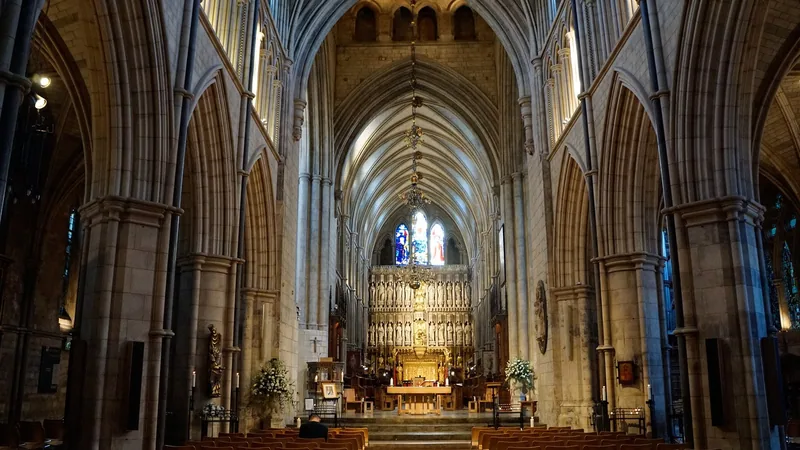
Photo: JFVoll · CC BY-SA 4.0 · Wikimedia Commons · resized
When not to come
The cathedral publishes recommended visiting times, and they are not the same as its opening hours, because services restrict access to parts of the building. The gap between the two is where visitors get frustrated.
| Day | Building open | Recommended for sightseeing |
|---|---|---|
| Monday to Friday | 9am to 6pm | 9am to 5pm |
| Saturday | 9am to 6pm | 9.30am to 3.45pm, then 4.30pm to 5pm |
| Sunday | 8.30am to 5pm | 12.30pm to 3pm, then 4pm to 5pm |
On top of that, the cathedral closes entirely for funerals, concerts and talks, usually for two or three hours, and it publishes those closures on its own restricted access page. Two examples from the current list: Saturday 26 September 2026, closed to visitors from 1.15pm to 3.30pm for a talk in the nave, and Thursday 8 October 2026, closed from 1pm to 4pm for a funeral. Check the list the day before if you are travelling specially.
Every hour, on the half hour, everything stops for two minutes. Between 10.30am and 4.30pm a day chaplain leads a short prayer, and visitors are asked to stand still where they are and may join in the Lord's Prayer in their own language. It lasts about two minutes. If you did not know it was coming it can feel abrupt; if you did, it is one of the nicer things about the place.
What to look at, in the order you meet it
Come in through the north door from the Millennium Courtyard, which is the way most people arrive from the market, and work anticlockwise.
- John Gower's tomb, in the nave. Gower was a court poet, a friend of Chaucer, and lived at the priory at the start of the 15th century. His effigy rests its head on three of his own books, and the colours are original in feel if not in paint.
- The Shakespeare monument and window. William's brother Edmond was buried in the church in 1607, along with the playwright John Fletcher and the theatre owner Philip Henslowe. The church was the parish church of the Bankside theatre world, which is why so many of them are here.
- The retrochoir, the low aisled space behind the high altar. This is the oldest substantial part of the building and the reason people call Southwark the earliest Gothic church interior in London. The cathedral itself does not make that claim in print, so treat it as a strong tradition rather than a settled fact, but stand in it and you will see why the claim gets made.
- Lancelot Andrewes's tomb, by the high altar. Andrewes is the only Bishop of Winchester buried here, in 1626, and he helped oversee the translation of the King James Bible.
- The Harvard Chapel. John Harvard was baptised in this church on 29 November 1607, and left half his estate and his library to the college in Massachusetts that took his name. The chapel has a window by the American artist John La Farge, paid for by a Harvard graduate, showing the Baptism of Christ.
Outside in the churchyard there is a carved granite boulder from Connecticut. It commemorates Sachem Mahomet Weyonomon of the Mohegan, who came to London in 1735 to petition George II for the return of his people's land, died of smallpox before he could present the petition, and was buried here because the City would not bury him inside its own boundary. The memorial was unveiled in 2006.
The guided tours, and which one to pick
Volunteer guides, many of whom also work as City of London or Greenwich guides, run a 60-minute Cathedral Highlights tour at 11am on advertised dates. Tickets are £9 for an adult and £7 concession, with under-10s and carers free (September 2026). You meet at the Welcome Desk, reached through the Millennium Courtyard.
At the same price there are specialist tours on a rotating basis, and for a second visit they are the better buy:
- Light and Colour, on the stained glass, which covers 19th and 20th-century work including Comper, Lawrence Lee and Leifur Breidfjord.
- Bards, Poets and Playwrights, on Gower, the Bankside theatre crowd and Dickens.
- Women of Southwark, on Octavia Hill, Isabella Gilmore and the benefactors who funded relief in south London.
- Mission and Ministry, a spiritual tour of the building from the 12th century onwards.
Dates are published on the cathedral's own booking listings rather than on a fixed weekly timetable, so check before you plan around one.
Free choral music, most days of the week
Southwark keeps a full English cathedral music tradition and nobody pays to hear it. The pattern to know:
| Service | When |
|---|---|
| Choral Evensong | 5.30pm Monday, Tuesday, Wednesday and Friday, and some Thursdays |
| Choral Evensong | 4pm Saturday |
| Choral Eucharist | 11am Sunday |
| Choral Evensong | 3pm Sunday |
| Weekday Eucharist | 12.45pm, with Midday Prayer at 12.30pm |
Evensong lasts about 45 minutes, you may arrive and leave quietly, and nobody expects you to be Anglican or to join in. Times change at short notice, so the cathedral's own services calendar is the one to trust. For the rest of the city's choral options, see our guide to classical music in London.
Eating here instead of in the market
The cathedral's cafe occupies part of the 2000 extension on the north side, and it opens earlier than almost anything else in the complex: 8am on Saturdays, 9am on weekdays, 9.30am on Sundays. On a Saturday, when Borough Market is close to impassable, being able to sit down with coffee fifty metres away is worth knowing about. Our guide to museum and gallery cafes covers the same trick elsewhere in London.
The shop is open Monday to Friday 10am to 4.30pm, Saturday 10am to 5pm and Sunday 11am to 3pm. There is also a small churchyard and herb garden, and a resident cathedral cat called Hodge who has his own page on the cathedral website and is entirely real.
Getting in while the building works are on
The usual route to the north door has changed. Construction at Minerva House, opposite the cathedral, means the approach to the main entrance is being re-signed periodically while the work goes on. Allow extra time. For step-free access, leave London Bridge station by the Tooley Street exit, follow the route under London Bridge past Glaziers Hall, and you will reach the north side of the cathedral.
London Bridge station, on the Jubilee and Northern lines and the mainline network, is two minutes away; our guide to London's main railway stations explains how it connects. Our accessible London guide has more on this part of the South Bank.
What to put either side of it
An hour here fits neatly between the market and the river. The Old Operating Theatre Museum is three minutes east, up a spiral staircase in a church garret. Shakespeare's Globe is a twelve-minute walk west along the river, and Tate Modern a couple of minutes beyond it. HMS Belfast is moored five minutes east, and the Shard is directly above the station.
If you are making a day of London's churches, the Byzantine interior of Westminster Cathedral is a very different thing and equally free, and the cluster of small free churches in the Square Mile is covered in our guide to All Hallows by the Tower and the City churches. The crossing of the river itself has its own history: see the bridges of London.
Frequently asked questions
Is Southwark Cathedral free to enter?
Yes. There is no admission charge and no ticket desk, and donations are welcome. It is open Monday to Saturday 9am to 6pm and Sunday 8.30am to 5pm, though parts of the building are restricted during services and the cathedral occasionally closes for funerals and events.
How old is Southwark Cathedral?
The first written reference is to a minster in the Domesday Book of 1086, and the church was refounded as an Augustinian priory in 1106. The retrochoir behind the high altar is early 13th century. It only became a cathedral in 1905, when the diocese of Southwark was created.
Is Shakespeare buried at Southwark Cathedral?
No. William Shakespeare is buried in Stratford-upon-Avon. His brother Edmond was buried in this church in 1607, as were the playwright John Fletcher and the theatre owner Philip Henslowe. There is a reclining monument to William with a stained-glass window above it.
Can you climb the tower at Southwark Cathedral?
No. Unlike St Paul's, Southwark has no tower climb, no paid crypt and no galleries open to visitors. Everything the public can see is at ground level, which makes it one of the more accessible historic churches in central London.
How much is a guided tour of Southwark Cathedral?
£9 for an adult and £7 concession, with children under 10 and carers free (September 2026). The Cathedral Highlights tour lasts 60 minutes and starts at 11am on advertised dates, meeting at the Welcome Desk through the Millennium Courtyard. Specialist tours on stained glass, literature and the women of Southwark cost the same.
Sources
- Southwark Cathedral - Visitor Information (checked September 2026)
- Southwark Cathedral - Restricted Access and Closures (checked September 2026)
- Southwark Cathedral - Public Tours (checked September 2026)
- Southwark Cathedral - Regular Services (checked September 2026)
- Southwark Cathedral - Our History (checked September 2026)
- Southwark Cathedral - American Connections (checked September 2026)