
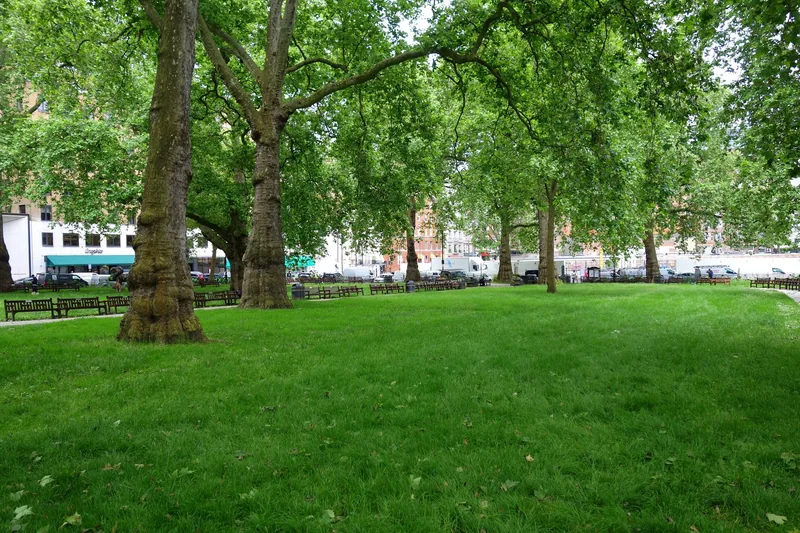
The plane trees in Berkeley Square were planted in 1789, according to Westminster City Council, which makes them among the oldest in Mayfair. The little stuccoed building under them is a former pump house of about 1800 with a Chinese-style tent roof, listed in its own right. And the quietest free seats in Mayfair are not in Berkeley Square at all: they are four minutes away in Mount Street Gardens.
Mayfair has four garden squares and two hidden gardens, all free, all open from 8am, and all locked at a closing time the council changes through the year. None of them takes more than ten minutes to look at. Together they make a forty-minute walk that is the cheapest thing you can do in the most expensive square mile in Britain.
Our guide to Mayfair and St James's covers the shops, the arcades and the hotels. This page is about the gardens: the dates, the listings, the benches and the hours.
Mayfair's gardens at a glance
- Cost
- All free, no bookings
- Opening
- 8am, seven days a week
- Closing
- Westminster's seasonal calendar: 4.30pm from late October to mid-February, 9.30pm from mid-May to the end of July
- Berkeley Square
- Registered Grade II, 1.02 hectares. Planes planted 1789. Address 45 Berkeley Square, W1J 5AS
- Grosvenor Square
- Registered Grade II, 1.88 hectares, the largest
- Quietest
- Mount Street Gardens, W1K 2TH, Green Flag winner every year since 2007
- Dogs
- Allowed in all of them, unlike the Soho squares
The plane trees, and the date the council stands behind
Westminster's own description of Berkeley Square Gardens is short and says the thing worth knowing: the London planes around it "are amongst the oldest to be found in Mayfair, planted in 1789". That is 1789, not 1889 and not "the eighteenth century": a specific year, from the authority that owns the trees.
What it gives you in practice is scale. These are among the few London planes anywhere in central London that have had two hundred and thirty years to grow, and they are very large indeed. The council's own word for the effect is dappled: the square is open and airy rather than dense, and on a hot afternoon it is several degrees cooler under them than on Berkeley Street.
Berkeley Square's other distinction is national: the register of parks and gardens kept by Historic England carries it at Grade II, registered on 19 April 1990, over 1.02 hectares. Hanover Square and Mount Street Gardens are not on that register at all, which is a reasonable guide to which of Mayfair's gardens is the historically important one.
The building in the middle is a pump house
Almost everyone walks past the small white structure at the centre of Berkeley Square without working out what it is, and the answer is better than the guesses. Historic England lists it as the "Shelter in Centre of Berkeley Square Garden", Grade II since 24 February 1958, and describes it as a former pump house of about 1800.
The list entry is worth having in your head as you look at it: a rectangular stuccoed block with no windows, the water tank on top crowned with an urn finial, and a chinoiserie tent roof sweeping out on all sides to form a verandah carried on slender iron pillars. A Chinese-style roof over a water tank, in 1800, in Mayfair. It is the oddest thing in the square and it has been protected for nearly seventy years.
Two of London's best-loved gardens are built over machinery. Berkeley Square's centrepiece hides a water tank; the hut in Soho Square hides an electricity substation; and Brown Hart Gardens, ten minutes away, is a paved garden laid on the roof of one. The pattern is not a coincidence: a garden was the polite way to cover a utility.
The nightingale did not happen
There is no evidence that a nightingale ever sang in Berkeley Square, and the square is a poor place for one. Nightingales want dense scrub and low cover to sing from; Berkeley Square is mown grass under high mature trees, surrounded on all four sides by traffic. Nothing in Westminster's description of the gardens, or in the register entry, mentions the bird.
The song, written in 1939, came first and invented the bird, which is the ordinary way round for this sort of thing. Various accounts add that the nightingale people remember hearing was actually a recording; we could not find a source for that, and we would rather tell you it is unverified than repeat it as fact. What is true is that the square is genuinely quiet on a weekday morning, which is presumably why the lyric works.
If birdsong in central London is what you are after, the scrubbier corners of St James's Park and Green Park and the northern edge of Kensington Gardens are the places to try, ten minutes' walk away in either direction.
Mount Street Gardens, the quietest free seats in Mayfair
If you want to sit down in Mayfair and hear nothing, this is where to go, and it is not a square. Mount Street Gardens is a long enclosed garden behind Mount Street, hemmed in on all sides by the backs of buildings, so almost no traffic noise reaches it. Westminster describes large London planes, formal lawns, ornamental bedding and benches along the paths, and the council notes that it has won a Green Flag award every year since 2007.
The reason it is so enclosed is that it used to be a graveyard. It is a former parish burial ground, closed in 1854 after an Act of Parliament prohibited burials in central London on public health grounds. The high walls of the houses around it are what a closed graveyard leaves behind, and they are also the reason it is silent.
It has step-free access, it allows dogs, and it is about four minutes from the west side of Berkeley Square by way of Mount Street. For an hour with a sandwich and a book it beats every other garden in W1.
Brown Hart Gardens: a garden on a substation roof
Ten minutes north of Berkeley Square, off Duke Street, is the strangest of the group. Brown Hart Gardens is a raised stone terrace with planting on it, and underneath is an electricity substation.
Historic England's list entry, Grade II since 1 December 1987, is filed under the substation rather than the garden: "London Electricity Board Sub Station", also known as the Duke Street Transformer Station. It was built in 1904 and 1905 by C. S. Peach and Balfour for the Grosvenor Estate, in Portland stone and Edwardian Baroque, and the entry calls it "an architecturally tasteful disguise for the sunken sub-station". The stone-paved terrace is surrounded by balustrades, with domed and columned pavilions at the east and west ends, and the whole thing is raised over a rusticated arcade of lunettes whose job is to light the machinery below.
It is a proper viewing platform at first-floor height in the middle of Mayfair, which is a rare thing. Note that it is estate land rather than a council garden, so it does not appear on Westminster's list and its hours are posted at the steps rather than set by the council's calendar.
Grosvenor Square and Hanover Square
Grosvenor Square is the biggest garden in Mayfair at 1.88 hectares, registered at Grade II in October 1987. It is more lawn and less shade than Berkeley Square, which makes it better in April and worse in July, and it carries a set of memorials rather than ornaments. It is also the one to walk to if you want space rather than atmosphere.
Hanover Square, just south of Oxford Street, is the smallest and the most formal, with clipped hedges round the outside. Its bronze statue of William Pitt the Younger is by Sir Francis Legatt Chantrey and has stood at the southern end since 1831, which makes it the oldest thing in any of these gardens by some distance. Westminster City Council did not own the garden until 1997, and says the square was started in about 1717 and named for the new king, George I, Elector of Hanover.
Hanover Square is the one to use if you are shopping: it is two minutes from Bond Street and from the Elizabeth line entrance to Bond Street station on its eastern side, and it is the nearest bench to the top of New Bond Street.
The gate times, and the November problem
All of these gardens except Brown Hart Gardens run on the same Westminster calendar, which steps the closing time up and down through the year and applies borough-wide.
| Period | Gates close |
|---|---|
| End of British Summer Time to 15 February | 4.30pm |
| 16 to 28 or 29 February | 5.30pm |
| 1 March to the start of British Summer Time | 6pm |
| Start of British Summer Time to 31 March | 7.30pm |
| 1 to 30 April | 8pm, then 8.30pm from the 16th |
| 1 to 15 May | 9pm |
| 16 May to 31 July | 9.30pm |
| 1 to 31 August | 9pm, then 8.30pm from the 16th |
| 1 to 30 September | 8pm, then 7.30pm from the 16th |
| 1 to 15 October | 6.30pm |
| 16 October to the end of British Summer Time | 6pm |
The clocks went back on Sunday 25 October 2026, and since the following day the gates have shut at 4.30pm, as they will until the middle of February. That is the November problem: for nearly four months Mayfair's gardens are locked before the shops shut, and a winter afternoon here is spent on the pavement or indoors. Opening is 8am throughout, which for once is genuinely useful, because Mayfair at eight in the morning is as quiet as it ever gets.
What is listed around Berkeley Square
The square's west side is the reason architectural historians come. Number 44 is listed at Grade I, and so are numbers 45 and 46. Number 47 is Grade II*, and numbers 35, 41, 42, 43, 49, 50 and 51 are Grade II. Three Grade I houses on one side of one square is unusual anywhere in London.
The east side is largely twentieth-century offices, which is why the square feels lopsided: the good half is behind you as you sit. Our page on London's blue plaques explains how to read the other kind of marker you will see on these houses, and London's grand hotels covers the buildings at the Piccadilly end.
Forty minutes, five gardens
Start at Hanover Square, at the Oxford Street end, and work south and west. Down Hanover Street and Brook Street to Grosvenor Square, which takes about eight minutes and passes Handel Hendrix House. From the north-east corner of Grosvenor Square it is five minutes up Duke Street to Brown Hart Gardens and the steps up onto the terrace.
Back down Duke Street and west along Mount Street brings you to Mount Street Gardens in about eight minutes, which is where to sit. Then east along Mount Street and Charles Street to the south-west corner of Berkeley Square, another eight minutes, arriving under the oldest trees at the end rather than the beginning.
That is about forty minutes of walking and nothing spent. Our guide to walking in London explains when this sort of route beats the Tube, which in Mayfair is almost always. If you want to keep going, Savile Row and Jermyn Street are south of Berkeley Square, afternoon tea is the obvious way to spend what you have saved, and there is a whole day of free things to do in London if you would rather not.
The other great cluster of London garden squares is in Bloomsbury, and their closing times are set by a different borough on a different calendar: our page on Bedford Square and the Bloomsbury squares has that table.
Frequently asked questions
How old are the plane trees in Berkeley Square?
Westminster City Council says they were planted in 1789, which makes them among the oldest London planes in Mayfair. They are very large, and on a hot day the square is noticeably cooler under them than the streets around it. The garden itself is on the national register of parks and gardens at Grade II.
What is the little building in the middle of Berkeley Square?
A former pump house of about 1800, listed at Grade II since 1958. Historic England describes a stuccoed windowless block with the water tank on top surmounted by an urn finial, under a chinoiserie tent roof swept out on all sides as a verandah on slender iron pillars. It is the oldest structure in the garden.
Did a nightingale really sing in Berkeley Square?
There is no evidence that one did, and the square, with mown grass under mature trees and traffic on all sides, is not the habitat a nightingale wants. The song dates from 1939 and invented the image. The often-repeated claim that the bird people heard was a recording is one we could not verify from any source.
Where is the quietest free place to sit in Mayfair?
Mount Street Gardens, a former parish burial ground closed in 1854, hidden behind Mount Street and enclosed by buildings on every side so that almost no traffic noise reaches it. It has benches along its paths, large London planes, step-free access, and a Green Flag award every year since 2007.
What time do Mayfair's gardens close?
On Westminster's seasonal calendar, which changes roughly every fortnight: 9.30pm from mid-May to the end of July, 7.30pm in late September, 6pm in the second half of October and 4.30pm from the end of British Summer Time until mid-February. They all open at 8am, every day of the year.
Sources
- Westminster City Council - Square gardens, including Berkeley Square and Hanover Square (checked September 2026)
- Westminster City Council - Parks, including Mount Street Gardens (checked September 2026)
- Westminster City Council - Opening hours, disabled access and dog friendly parks (checked September 2026)
- Historic England - Shelter in centre of Berkeley Square garden, list entry 1357211 (checked September 2026)
- Historic England - London Electricity Board sub station, Brown Hart Gardens, list entry 1219965 (checked September 2026)
- Historic England - Berkeley Square, registered park and garden 1000516 (checked September 2026)
- Historic England - Grosvenor Square, registered park and garden 1000807 (checked September 2026)
- GOV.UK - When do the clocks change (checked September 2026)