
Handel Hendrix House joins two addresses on Brook Street in Mayfair: the Georgian house where George Frideric Handel lived for 36 years, and the top-floor flat where Jimi Hendrix lived for nine months in 1968 and 1969. One £14.50 ticket covers both, and the live music that comes with it is the reason to plan the day around a particular hour.
The coincidence is genuine and slightly absurd. Handel took 25 Brook Street in 1723, wrote a great deal of his best-known music there and died in the house in 1759. Two hundred and nine years later, Hendrix moved into the flat at the top of number 23, next door. Neither man chose the street because of the other. The museum simply owns both.
What makes the place work as a visit is that it does not pretend the two halves are the same kind of thing. You walk from a restored Georgian rehearsal room into a late-sixties bedsit with a record collection, and the change of century lands physically.
Handel Hendrix House at a glance
- Address
- 25 Brook Street, Mayfair, London W1K 4HB
- Open
- Wednesday to Sunday, 10:00 to 17:00. Last entry 16:00. Closed Monday and Tuesday
- Adult ticket
- £14.50 (September 2026), covering both houses
- Children
- 12 and under free within a family group of up to six; 13–17 £5.00; students £10.50; carers free
- Included
- Both historic residences, all exhibitions, Thursday talks, Sunday tours and the twice-monthly live music
- Nearest station
- Bond Street, a short walk with step-free access; Oxford Circus is also close
One ticket, two houses, and children go free
Admission is £14.50 for an adult and there is no separate charge for either residence; the ticket lets you walk between them. Students pay £10.50 and 13 to 17-year-olds £5.00. Children of 12 and under go in free as part of a family group, which is capped at six people in total.
For a family of two adults and two children under 12, that is £29 in all, which is cheap by central London standards and much cheaper than most Mayfair attractions. Carers are admitted free with the person they are supporting. National Art Pass and Historic Houses members also go free, but cannot book in advance: show the card at reception. Groups of 10 to 20 get 10% off each ticket, and larger groups should email the house first.
The live music is not an extra ticket. Talks, the Sunday tours and the twice-monthly "Baroque and Roll" sessions are all covered by general admission. Only the evening Handel's Salon recitals, Saturday Guitar Day and the children's concerts are sold separately.
What is included with admission, and when it happens
This is the detail that changes the visit, and most people miss it. Alongside the rooms, the standard ticket includes a running programme:
- Talks every Thursday at 14:00.
- Guided tours on selected Sundays at 14:00.
- Live music (the "Baroque and Roll" sessions) roughly twice a month.
- Family activities at intervals through the year.
Because last entry is 16:00, a Thursday or a Sunday arrival at about 13:15 gives you time to see the Hendrix flat first and then sit down for the talk or the tour. Check the house's What's On page for the exact dates, because the music sessions do not fall on fixed days.
Ticketed events on top of admission include Handel's Salon, a chamber recital series held in the rooms themselves; Saturday Guitar Day; and an interactive concert series aimed at young children. For the wider picture of where to hear this repertoire in London, see our guide to classical music in London.
Handel's house: the rehearsal room is the point
Handel House occupies four floors of number 25. The restored rooms include his bedroom and, more importantly, the dining room, which was not really a dining room at all: this is where he rehearsed his singers and instrumentalists, tried out new work and gave informal performances for friends and neighbours. Standing in it tells you something that no concert hall can, namely how small a space the first audiences for this music occupied.
A restoration campaign called the Hallelujah Project has brought back the kitchen on the lower ground floor and the front and back parlours at street level, and a new exhibition, The Hallelujah House: Inside Handel's HQ, opened on 17 September 2026 to explain what the house was as a working operation: part home, part rehearsal studio, part business address for a composer who ran his own opera company. Further rooms in the adjoining house hold temporary exhibitions on Handel's Georgian London, his legacy and the baroque instruments his music was written for.
The Hendrix flat, and the staircase that reopened
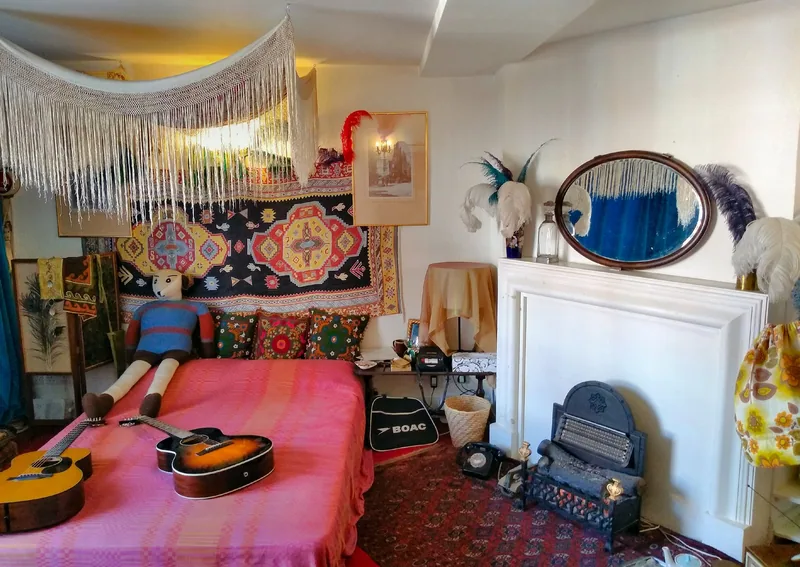
Hendrix lived on the upper floor of 23 Brook Street from July 1968 to March 1969. The main room — where he slept, entertained, rehearsed, wrote and gave a great many interviews — has been restored to how it looked, down to the records on the shelf and the fabric draped over the ceiling.
Around it, a permanent exhibition places him in the musical and social world of 1960s London: who he played with, what he listened to, and how a guitarist from Seattle became a fixture of the West End club scene within months of arriving. Newer rooms cover his legacy and his performances, including a display of Hendrix posters that once belonged to Freddie Mercury. The flat's own staircase, closed to visitors for years, has been reinforced and now forms part of the route, which means you climb up to the flat the way he did. A current exhibition, Hendrix in London, is included with admission.
If the sixties London angle is what draws you, our guides to live music venues and the Abbey Road crossing cover the other places on that trail.
Do the Hendrix flat first if you are short of time. It is at the top of number 23 and the climb is easier before an hour of standing in the Georgian rooms. It also makes the jump between the two centuries feel sharper in that direction.
How long to allow, and when it is quiet
Ninety minutes covers both houses at a reasonable pace. Two hours is comfortable if a talk or a music session falls during your visit. The house is small and the rooms are modest, so at busy moments you may be waiting for a group to move on.
The quietest times are weekday mornings soon after opening at 10:00. Weekends are busier, particularly when Oxford Street shopping has driven people indoors. Because the last entry is at 16:00, a full hour before closing, late-afternoon arrivals are the commonest mistake here; a 16:15 walk-up will be turned away.
Getting to Brook Street, and access
Bond Street station is a few minutes away and the museum describes it as offering step-free access, which makes it the easiest approach for anyone with a pushchair or heavy bags. Oxford Circus is a slightly longer walk. The Oxford Tube coach from Oxford stops at Marble Arch, about fifteen minutes away on foot.
The museum offers step-free, level access into the building for wheelchair users, and there is accessible parking on Grosvenor Street. The historic interiors themselves run over several floors of two joined Georgian houses, so if reaching particular rooms matters, call 020 7495 1685 before you travel and ask exactly what can be reached. Our guide to step-free transport in London covers the journey; the house itself will tell you about the rooms.
Where it fits in a Mayfair day
Brook Street sits between Bond Street and Grosvenor Square, so this is one of the few free-standing sights in an area otherwise given over to shopping and offices. Our Mayfair and St James's guide covers the streets around it, and Bond Street shopping the commercial side.
Ten minutes north, the Wallace Collection in Manchester Square is free and holds the kind of French painting and furniture Handel's patrons were buying. Twenty-five minutes south, Benjamin Franklin House on Craven Street is the other surviving home of an 18th-century celebrity in central London, and the two make a good pairing for anyone interested in Georgian lives rather than Georgian architecture.
For something on the same street scale but further east, the Charles Dickens Museum is the fullest of London's writer's houses. And if the concerts here whet your appetite, our guides to free live music and the Royal Albert Hall cover the scale-ups. If Brook Street is shut on the day you are free, the alternatives are set out in our piece on the capital's small museums. Oxford Street is five minutes north if you need somewhere to go afterwards in the rain.
Is it worth the detour?
The honest answer depends on whether you arrive on a day with something happening. Seen cold, on a quiet Friday with no talk and no music, this is two sets of restored rooms that a brisk visitor could cover in fifty minutes. Seen on a Thursday afternoon with a talk running, or on one of the Baroque and Roll days, it becomes something better: a house where the music that was made in it is played in it.
Book it if
- You can time your arrival for a Thursday talk, a Sunday tour or a live music session
- You have children under 12, who go free and turn this into one of Mayfair's cheapest outings
- Baroque music or 1960s rock means something to you, ideally both
- You want an hour indoors between Bond Street and Oxford Street that is not a shop
Leave it if
- You are arriving after 16:00, when the door closes to new visitors
- Stairs are a problem and nobody has confirmed what you can reach
- It is Monday or Tuesday
- You expect instruments, manuscripts and guitars in quantity; the collections are modest and the rooms are the exhibit
Frequently asked questions
Does one ticket cover both Handel's house and Hendrix's flat?
Yes. A general admission ticket gives access to both residences, all the exhibitions in them, and the talks, tours and live music that form part of the standard programme. Only the evening recitals, Saturday Guitar Day and the ticketed children's concerts cost extra.
How much does Handel Hendrix House cost?
In September 2026 an adult paid £14.50, a student £10.50 and a 13 to 17-year-old £5.00. Children aged 12 and under go free as part of a family group of up to six people, and carers accompanying a visitor are admitted free.
Which days is Handel Hendrix House open?
Wednesday to Sunday, 10:00 to 17:00, with last entry at 16:00. It is closed on Mondays and Tuesdays. The hour between last entry and closing catches a lot of visitors out, so aim to arrive by mid-afternoon at the latest.
How long did Jimi Hendrix live on Brook Street?
From July 1968 to March 1969, in the flat on the top floor of number 23. The main room has been restored to how it looked while he was there, and a permanent display sets him in the context of London's music scene at the time.
Is the museum suitable for children?
Under-12s go free, which helps, and there are family activities and an interactive concert series aimed at young listeners. The rooms themselves are quiet and mostly to be looked at rather than handled, so it works best for children who already have some interest in music.
Sources
- Handel Hendrix House - Visit Us (checked September 2026)
- Handel Hendrix House - What's On (checked September 2026)
- Handel Hendrix House - Explore the Museum (checked September 2026)
- Handel Hendrix House - Discover (checked September 2026)