
The Crossrail Place Roof Garden is a free public garden on top of the building that holds Canary Wharf's Elizabeth line station, under a long timber-lattice roof that keeps most of the rain off. You do not need a ticket or a booking; you walk up from the station or the shops below. Its planting is split into an eastern and a western half, a design idea taken from the Greenwich meridian.
The building, Crossrail Place, sits in the water of the North Dock. Its lower floors are shops and restaurants, and the garden occupies the top level, opened on 1 May 2015, seven years before the first Elizabeth line trains stopped underneath. Our Canary Wharf guide covers the estate around it, and the overview of London's roof gardens and free terraces compares it with Sky Garden and the rest. This page is about the garden itself: what grows there and why, how the roof works, how to reach it, and what the meridian story does and does not mean.
Crossrail Place Roof Garden at a glance (checked November 2026)
- Price
- Free. No ticket or booking
- Opening hours
- The estate's website blocks our research tools, so we could not read current hours. Published descriptions give dawn to dusk; check canarywharf.com before a special trip
- Where
- Top level of Crossrail Place, above Canary Wharf Elizabeth line station, North Dock, E14
- Opened
- 1 May 2015
- Design
- Building and roof by Foster + Partners; garden by the landscape architects Gillespies, planting with Growth Industry
- Roof
- Timber lattice with air-filled ETFE plastic cushions; 310 metres long (Foster + Partners, 2015) or 300 metres (Gillespies)
- Heating
- None. Covered overhead, but open to the outside air
- Step-free
- Canary Wharf Elizabeth line station is step-free, as are all Elizabeth line stations
A garden of the old trade routes
The idea behind the planting is the West India Docks. Many of the species come from countries that the docks' trading ships visited in the 19th century, and Gillespies describes the garden as a tribute to the age of plant exploration, when ships brought exotic species back to Britain. You walk through it on a paved walkway between the beds, with the timber roof overhead.
The contractor that built it, Blakedown Landscapes, records what went in over 32 weeks: more than 600 cubic metres of topsoil, 70 mature trees, 100 tree ferns and 15,000 shrubs. All of it grows in about one metre of soil, kept alive by a bespoke irrigation system, which is shallow for trees and explains why the planting leans towards ferns, shrubs and smaller trees rather than big canopy species.
The tree ferns, imported from Australia and New Zealand, are what most people remember. Bamboos and plants from China and Japan grow at the eastern end; ferns and plants from the Americas at the western end.
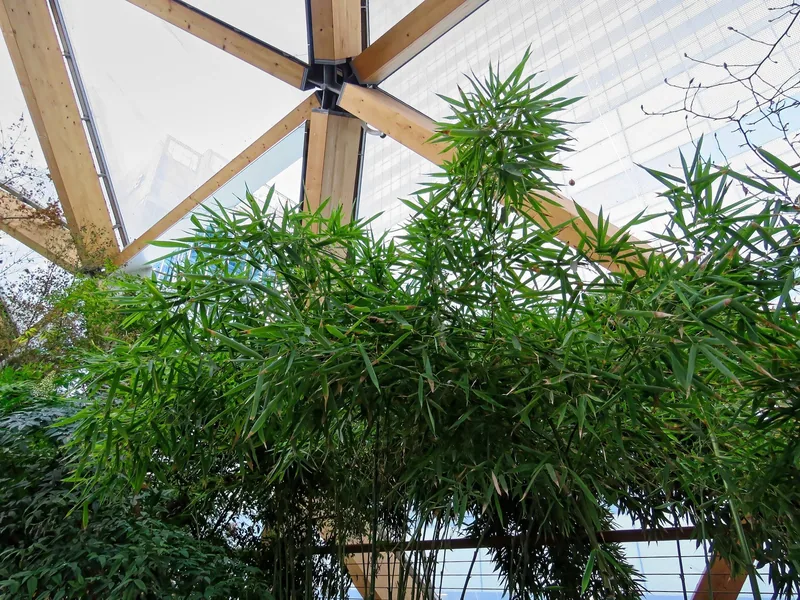
Photo: Acabashi · CC BY-SA 4.0 · Wikimedia Commons · resized
East and west, and where the meridian really is
Gillespies says the garden "is located on the Prime Meridian", and that the line inspired dividing the space into two hemispheres. That is a design story, not a survey. By map coordinates, Canary Wharf Elizabeth line station lies about 1.2 kilometres west of the Greenwich meridian, which runs north from the Royal Observatory across the river further east. The garden is planted as if the meridian ran through it: eastern-hemisphere plants at one end, western at the other, meeting in the middle.
If you want to stand on the real line, you have to go to Greenwich. The Meridian Courtyard at the Royal Observatory is closed while the Observatory is shut for building work (the whole site since 2 November 2026). Our page on Greenwich while the Royal Observatory is closed explains what you can still see there.
The roof, and what the weather does to a visit
The roof is the reason to come in bad weather. Triangular cushions of ETFE, a tough transparent plastic, are set into a timber lattice that wraps the whole building. Gillespies says the roof is partly open in the centre, so light and rain reach the plants, and the garden is not sealed off from the outside air. The result is shelter, not warmth: on a cold, windy day it feels much like being outside under a big umbrella.
Light rain does not spoil it; strong wind is less pleasant. Canary Wharf is an office district, so expect the benches to be busiest at weekday lunchtimes and the garden quietest at weekends, when the estate empties.
The cheapest dry hour in Canary Wharf. If you are killing time before an Elizabeth line train to Heathrow or a meeting nearby, the garden costs nothing, has benches under cover and is a short walk from the platforms. The shops and cafés on the floors below are the place to buy a coffee first.
Getting up there from the station or the street
Canary Wharf is on the Elizabeth line branch to Abbey Wood. The station is below the dock, the shopping floors are above it, and the garden is the top level: follow the roof garden signs from the ticket hall and go up through the Crossrail Place building. Gillespies also describes bridges leading up to it from street level. With the signs to follow, it is a few minutes from the ticket gates.
From the Jubilee line station or the DLR, allow five to ten minutes' walk north across the estate to the North Dock. If you come by DLR, the front seat of a driverless train gives the best approach to the towers.
The estate is private land open to the public, and the garden can close early or in part for events, which Gillespies' design deliberately allows for with small amphitheatre spaces.
How long to spend, and what it is not
Twenty to forty minutes is enough. The garden is long and narrow, and a slow walk from one end to the other, with a stop on a bench, is the whole visit. It is not a botanic garden: there are no glasshouses, no guided route and no heated tropical house. For that, go to Kew, and go soon, because the Palm House at Kew closes for several years in 2027. The Barbican Conservatory is the closest equivalent in central London: also on a roof, also free, but heated, glazed, and open only on set days with a timed ticket.
What Crossrail Place does well is be there when you need it: free, sheltered, quiet on a weekend and on the way to somewhere else.
Putting it into a Docklands half-day
The garden fits easily with the other things on the Isle of Dogs. The London Museum Docklands, in an old sugar warehouse at West India Quay, is about seven minutes' walk away across the water and tells the story of the docks whose trade the planting refers to. Further south, our Isle of Dogs guide covers the riverside walk to Island Gardens and the foot tunnel to Greenwich, and east along the river, Trinity Buoy Wharf has London's only lighthouse.
For lunch, the floors underneath are full of chain restaurants, and our guide to where to eat in Canary Wharf sorts them by price. If you want to stay in the area, staying in Canary Wharf explains the weekday and weekend price swing.
Frequently asked questions
Is the Crossrail Place Roof Garden free?
Yes. There is no charge, no ticket and no booking. You walk up through the Crossrail Place building from the Elizabeth line station or the shops below, during the garden's opening hours.
What are the opening hours of Crossrail Place Roof Garden?
Published descriptions from the garden's designers and award bodies give dawn to dusk, sometimes later. We could not read the current hours on the Canary Wharf estate website in November 2026, so check canarywharf.com before a special journey, especially in winter.
Is the garden really on the Greenwich meridian?
No. The designers say the meridian inspired the east-west split in the planting, but by map coordinates the garden is about 1.2 kilometres west of the line. The actual meridian is marked at the Royal Observatory in Greenwich, which is closed for building work.
Is Crossrail Place Roof Garden good in the rain?
Yes, for light rain. Most of it is under the timber-and-plastic roof, so you can walk round it dry. It is not heated or enclosed, so on a cold or windy day it is only a little more comfortable than outdoors.
Sources
- Gillespies - Crossrail Place Roof Garden, Canary Wharf (checked November 2026)
- Blakedown Landscapes - Crossrail Place Roof Garden, ten years on (checked November 2026)
- European Garden Heritage Network - European Garden Award 2018: Crossrail Place Roof Garden (checked November 2026)
- Dezeen - Foster's Crossrail Place roof garden opens at Canary Wharf, April 2015 (checked November 2026)
- Transport for London - Canary Wharf Elizabeth line station location data (checked November 2026)