
The Palm House is the great curved iron-and-glass hothouse at the centre of Kew Gardens, finished in 1848 and still full of tropical rainforest plants. It is open with an ordinary Kew ticket for the rest of this winter, but Kew is emptying it for a restoration that takes it out of use for several years, so the next few months are the last chance to see it planted.
Kew's plan, as announced in October 2026, is to close the building in February 2027 to move the last plants out, open it again for a short spell in summer 2027 so visitors can walk through the empty structure, and close it fully for building work in the autumn. The dates, as read in November 2026, are in the box below. Our guide to Kew Gardens covers the rest of the site, tickets and the other glasshouses; this page is about the Palm House alone: what the building is, what is happening to it, and how to fit it into a visit before it goes.
The Palm House at a glance (checked November 2026)
- Built
- 1844 to 1848. Richard Turner, iron founder and engineer of Dublin, with Decimus Burton as architect
- Listing
- Grade I (Historic England list entry 1262670), inside the Kew World Heritage Site
- Size
- 362 feet (about 110 metres) long; 67 feet (about 20 metres) high at the centre
- Entry
- Included in the Kew Gardens ticket; no separate charge
- Off-peak adult ticket (1 November to 31 January)
- £17 online, £20 at the gate; children 4 to 15 £2 online
- Kew opening hours, 12 November 2026 to 3 January 2027
- 10am to 3.15pm
- Closure timetable announced October 2026
- Closes February 2027 for the final plant removal; reopens empty for a few months in summer 2027; closes fully for restoration in autumn 2027
- Length of the works
- Three to four years (Kew, October 2026); earlier reports in 2025 said about five
- Nearest station
- Kew Gardens (District line and Mildmay line), 500 metres to Victoria Gate
What the building actually is
Historic England's list entry describes the Palm House as an iron and glass structure with a roof curved throughout: a tall central chamber with a double curved roof over a "nave" and "aisles", rounded apses at each end, a glass barrel-vaulted entrance in the middle of each long side and a gallery running round the interior. The entry quotes a verdict that it is one of the boldest pieces of 19th-century functionalism in existence. It was listed in January 1950.
The credit is usually given to Decimus Burton, but the list entry names Richard Turner, the Dublin iron founder, as the designer and Burton as the architect. Turner borrowed his methods from the shipyards, and the curved wrought-iron ribs, shaped much like the frame of a hull laid keel-up give the building its long, smooth curves. Kew and its architects give the date of construction as 1844 to 1848; when you see "1844" on one page and "1848" on another, both are describing the same building.
In front of the main door is the Palm House Pond, whose retaining wall is itself listed, and along the terrace stand the Queen's Beasts, stone copies of the heraldic animals made for the 1953 coronation. Walk round to the far side before you go in. The west front, facing the pond and the long vista towards the Thames, is the view that appears on most photographs.
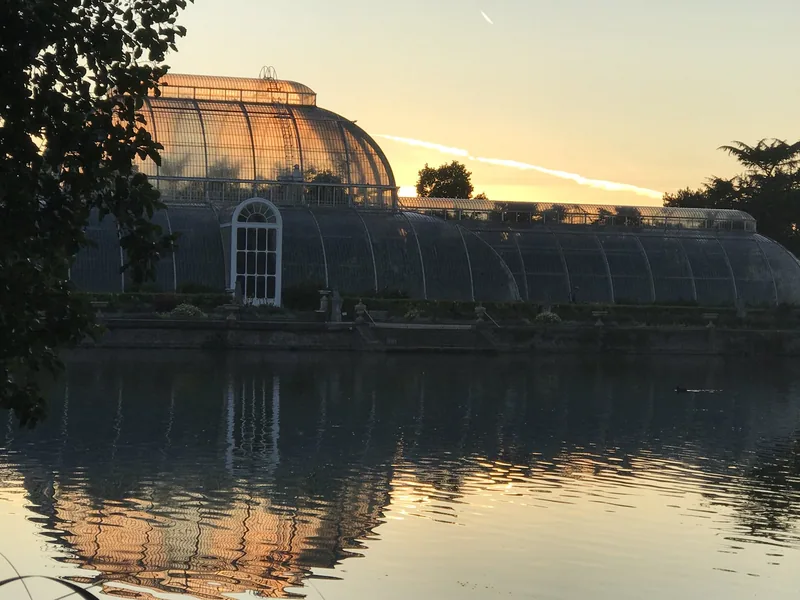
Photo: Fiona Walsh · CC BY-SA 4.0 · Wikimedia Commons · resized
Inside: heat, the gallery and the oldest pot plant
The Palm House holds Kew's tropical rainforest collection, kept at about 20 degrees Celsius all year round. Kew says it holds more than 1,000 tropical and subtropical species, including plants that are threatened or already extinct in the wild. The one to look for is an Eastern Cape giant cycad, which arrived at Kew in 1775, seventy years before the building was put up, and which Kew calls the oldest pot plant in the world.
Climb the white spiral staircase to the gallery. From up there you are level with the crowns of the palms and can see the shape of the ironwork, which is almost invisible from the floor behind the leaves. The gallery is also where the heat and humidity are worst, and on a cold day your glasses and camera lens will mist up the moment you step in from outside. Give them a minute.
The gallery stairs are the only way up. The upper walkway in the Palm House is reached by narrow spiral staircases. Kew's accessibility guidance says the Palm House takes wheelchairs but not mobility scooters, and the stairs put the gallery out of reach of both. The ground-floor path goes all the way round.
The basement aquarium you may read about
Older guidebooks and some websites describe a Marine Display, an aquarium of seaweeds and coastal habitats, in the basement under the Palm House. Do not plan a visit around it. We could not find any current Kew information saying it is open, secondary sources report that it closed in 2019, and the published restoration design describes the basement as plant room, heating and irrigation space and working areas for the horticulturists, reached by a new staff lift. If Kew reopens a public display there, it will say so on its Palm House page.
Why the Palm House has to close
The building was last renovated in the 1980s, and Kew says the hot, wet climate it exists to provide has been slowly damaging it ever since. It is also one of the largest energy users on the site: Kew's head of estates projects has said that keeping it at tropical temperature takes around 15 per cent of all the gas Kew burns.
The project's architects, Hugh Broughton Architects, say the scheme has planning and listed building consent. The work includes repairing the iron structure, replacing the glass (the architects put the number of panes at 16,500; press reports of Kew's announcements say 16,000), sealing it with clear silicone gaskets to cut heat loss, and replacing gas heating with low-carbon systems such as heat pumps. Inside there will be a new circular gathering space at the centre and viewing spaces at the north and south apses. Outside, William Nesfield's Victorian garden layout is to be restored, an oval path round the building reinstated, and a double ramp added on the west side for step-free access.
Kew has also built two new glasshouses, one temporary and one permanent, to hold the plants while the work goes on, and has said that some trees were too tall to move and had to be felled.
The cost, and why the dates may still move
The estimate was about £60 million when the plans were submitted in July 2025. By October 2026 Kew was quoting £66 million, with about half raised from grants, philanthropists and donors, and it launched its largest-ever public appeal to raise more. The National Lottery Heritage Fund awarded a £240,000 development grant in March 2026, with up to £10 million more possible at the next stage.
Kew's own wording has always made the start of construction conditional on funding. For a visitor that has one practical consequence: the February 2027 closure for plant removal is part of the move, not of the building work, so it is the date to plan around even if the main works slip. If you are travelling in early 2027, check the Palm House page on kew.org before you go.
From February 2027 a Kew ticket may not include the Palm House at all. Kew's other big glasshouses, the Temperate House and the Princess of Wales Conservatory, are not part of this project, so the gardens remain worth a visit. But if the Palm House is the reason you are going, go before February 2027 (checked November 2026).
The empty Palm House in summer 2027
Kew has said that, once the plants are out, it will reopen the building for a few months in summer 2027 so that visitors can see the whole structure empty, which nobody has been able to do since it was first planted. Details of how this will work, including whether it needs a separate booking, had not been published in November 2026. Expect it to be popular with anyone interested in Victorian engineering, and expect it to be hot: the glass will still be there even when the palms are not.
The Waterlily House next door
The small glasshouse just north-west of the Palm House is the Waterlily House, built in 1852, probably also by Burton, to show off the giant Amazon waterlily, then a recent sensation. It is listed Grade II and its circular pond, more than 10 metres across, has held lilies whose pads grow to over three metres. It is part of the same restoration project.
Sources disagree on its timetable, so here are both. Reports of Kew's 2025 announcements said both glasshouses would close when the renovation began in 2027. The project architects say work on the Waterlily House has already started and is due to finish in January 2027. In practice that means it is closed now, and the giant lilies are not on show there this winter. The same Victoria waterlily grows in the wet tropical zone of the Princess of Wales Conservatory, which is where to see it.
Fitting the Palm House into a winter visit
In the short days of midwinter the gardens close at 3.15pm (dates in the box above), so the light is gone by mid-afternoon. Come in by Victoria Gate, the closest to Kew Gardens station, and the Palm House is the first big building you reach, about five minutes' walk inside. Doing it first is the right order in winter: you warm up, you see it while there are fewer people, and you can then decide how much of the cold garden you want. Forty minutes is enough for the floor and the gallery; our page on how long Kew takes plans the rest of the day around it.
On a £10 Tuesday the arithmetic is very good: a couple pays £20 (or £22 with Kew's suggested donation) for two hours under glass. The £10 Tuesdays are a seasonal offer in Kew's off-peak calendar, so check the tickets page for whether one falls in your week. The evening light trail, Christmas at Kew, needs its own separate ticket.
Kew is on the District line towards Richmond and on the Overground's Mildmay line. Kew notes that the station's westbound platform is not step-free. If you want more Victorian glass the same week, the Barbican Conservatory is the opposite kind of hothouse: concrete, 1980s and in the middle of the City.
Nearby, if you have a full day
The National Archives are a leafy ten minutes from Kew Gardens station, on the opposite side from the gardens. Across the river, Syon Park has its own iron-and-glass Great Conservatory, which is older than the Palm House, although Syon opens only from March to October. The Chiswick and Kew neighbourhood guide has the village, the pubs and the walk along the Thames, and a short bus ride north of the river takes you to Gunnersbury Park, a free Rothschild estate with a museum in the mansion.
Frequently asked questions
When does the Palm House at Kew close for restoration?
Kew's October 2026 timetable closes it in February 2027 for the final removal of plants, reopens it empty for a few months in summer 2027, and closes it fully for building work in autumn 2027. Funding and building contracts can move these dates, so check kew.org before visiting in 2027.
How long will the Palm House be closed?
Kew said in October 2026 that the restoration is expected to take three to four years. Reports in 2025, when the plans were submitted, said about five years. Either way, a reopening is unlikely before about 2030.
Do you need a separate ticket for the Palm House?
No. Entry is included in the standard Kew Gardens ticket, which from 1 November to 31 January costs £17 online for an adult. There is no separate charge for any of the glasshouses.
Is the Marine Display under the Palm House still open?
We found no current Kew information saying it is open, and secondary sources report that it closed in 2019. The restoration plans describe the basement as plant room and working space for the gardeners rather than a public display.
Who designed the Palm House?
Historic England's list entry names Richard Turner, an iron founder and engineer from Dublin, as designer, with Decimus Burton as the architect. It was built between 1844 and 1848 and is listed Grade I.
Sources
- Historic England - The Palm House, Royal Botanic Gardens Kew, list entry 1262670 (checked November 2026)
- Historic England - Water Lily House, Royal Botanic Gardens Kew, list entry 1251633 (checked November 2026)
- Hugh Broughton Architects - The Palm House Project (checked November 2026)
- Museums Association - Kew awarded £5m for Palm House renovation (checked November 2026)
- ianVisits - Kew Gardens to offer rare visits inside its emptied Palm House, 6 October 2026 (checked November 2026)
- Royal Botanic Gardens, Kew - Tickets (checked November 2026)
- Royal Botanic Gardens, Kew - Opening and closing times (checked November 2026)