
The National Archives at Kew is free, you do not need to book, and you do not need a reader's ticket to get in. It opens Tuesday to Sunday and is closed every Monday. Without a ticket you can see the exhibitions, use the visitor computers, read in the library and sit in the grounds; with one, which is free, you can order original government documents out of the store.
This is the United Kingdom's government archive: a thousand years of official paper, from medieval Chancery rolls to files declassified last year. It is a working research building, not a museum, which is why people assume they are not allowed in. They are. Children are welcome and there is a café.
One thing to be clear about first. You cannot see Domesday Book. The National Archives holds it, and its own research guide says the original "can no longer be consulted except in very rare circumstances". If Domesday is your reason for coming, change your reason.
The National Archives: the practical frame
- Price
- Free, no booking to enter
- Building hours
- Tuesday and Thursday 9am-7pm; Wednesday, Friday and Saturday 9am-5pm; Sunday 11am-4pm. Closed Monday
- Reading rooms
- Tuesday to Saturday from 9.30am, closing 7pm on Tuesday and Thursday and 5pm otherwise. Closed Sunday and Monday, and on the Saturday before every bank holiday Monday
- Reader's ticket
- Free, valid three years, age 16 or over. Two forms of identity needed
- Address
- Kew, Richmond TW9 4DU. Sat nav TW9 4AD, access via Bessant Drive
- Nearest station
- Kew Gardens (District and Mildmay lines), 0.5 miles
- Car park
- £2.50 up to two hours, £4.50 up to four, £7 over four. Free for Blue Badge holders
What you can do with no ticket at all
Walk in off Bessant Drive and, without registering, you have the run of:
- The exhibition gallery. Free, and properly done.
- The Research and Enquiries Room and Library, on the first floor. Free visitor computers give you the digitised records, the research guides, the Discovery catalogue, and free on-site access to Ancestry and Findmypast. If you pay for those at home, that alone can justify the journey.
- The reference library: over 75,000 items including books, periodicals, directories and maps, plus more than 300 digital resources, strong on the British Empire, the Commonwealth and the former colonies. The 1,000-plus rare books do need a ticket.
- The Start Here and Research Enquiries desks. Staff whose job is to work out which records might answer your question. Start Here also issues a certificate of attendance if you sign the diary.
- The grounds, the quiet spaces, the café and the shop. Two lakes with swans, a paved terrace and a small Pocket Park.
Free Ancestry and Findmypast is the best-value thing at Kew. The visitor computers give free access to the National Archives' partner sites, and you need no ticket and no appointment to use them. For family history on a budget, a Tuesday or Thursday at Kew buys nine and a half hours of subscription searching for the price of the fare.
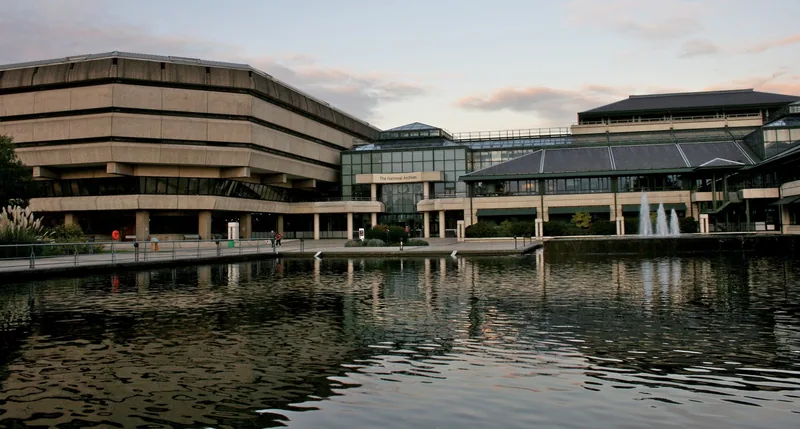
Photograph by Mike Peel (www.mikepeel.net) · CC BY-SA 4.0 · Wikimedia Commons · resized
The day that catches people out
Monday. The building is shut every Monday, and on every English bank holiday, which rules out many long weekends.
The second catch is that the reading rooms keep different hours from the rest of the building and are closed on Sundays: a Sunday visit, 11am to 4pm, gets you the exhibition, the café and the shop and nothing from the store. The third costs people a whole trip: the reading rooms also close on the Saturday before each bank holiday Monday.
At Christmas 2026 the building shuts from 24 to 28 December inclusive, reopens from 29 to 31 December with early closing on the 29th and 31st, and is shut again on 1 and 2 January 2027.
Domesday, and the other famous things you cannot order up
Domesday Book is a survey of landed property in England ordered by William the Conqueror at Christmas 1085 and carried out the following year. The National Archives holds it as series E 31, in two volumes: Great Domesday, and the smaller Little Domesday covering Norfolk, Suffolk and Essex. It is in Latin, and the original is not produced for readers. The Archives directs you to the printed and digital facsimiles instead, including the Editions Alecto colour facsimile, which can be searched and downloaded from the catalogue for a fee.
Two other things before you get your hopes up. Domesday does not cover the City of London, or Winchester, Northumberland, Durham or much of the north-west, so a Londoner looking for their own street will not find it. And where a record has been digitised, filmed or fiched, you generally cannot order the original at all: you get the surrogate, and you have to make a written case if the copy will not do.
What is actually on show
One main exhibition at a time, plus rolling displays. In autumn 2026 all are free.
| Display | Dates | Price |
|---|---|---|
| Revolution 250: America's Independence Story 1763-1783, marking 250 years since the Declaration of Independence | 24 June to 29 November 2026 | Free |
| Hamilton at The National Archives - costumes from the West End production | 10 June to 29 November 2026 | Free |
| Stories Unboxed - one remarkable document put on display each month | Through 2026 | Free |
| The Cabinet Table - a replica table and documents from past prime ministers | Permanent | Free |
The gallery keeps its own hours, opening at 10am rather than 9am from Tuesday to Saturday. Paid extras: a curator's tour of Revolution 250 at £15 from 18 September to 13 November 2026, behind-the-scenes tours of the repositories at £20 from 24 September to 17 December 2026, and family activities at £3 to £5 a session. Prices read on nationalarchives.gov.uk in September 2026.
Stories Unboxed is the display to check before travelling: it changes monthly, and is the closest the Archives comes to putting one famous document in a case.
Getting a reader's ticket
You need one only for the document reading rooms. It is free, lasts three years, and requires you to be 16 or over. Register online, watch a short video on handling documents, then collect the card from the Start Here desk. The part that goes wrong is the identification: bring two separate documents, one proving your name and carrying your signature, one proving your address.
- Name and signature: passport, driving licence, bank or credit card, national identity card, forces or warrant card, Blue Badge driver's pass, or an expired reader's ticket. It must be the original: photographs, scans and printouts are refused.
- Address: a utility bill, bank or credit card statement, council tax or HMRC statement, a passport or licence with an officially entered address, a Home Office permit to stay, or a pension or benefits letter. Bills and statements must be less than six months old.
Two rules trip up overseas visitors. An electronic proof of address is accepted only where the issuing body supplies it that way, and if you use one your proof of name must be photographic. And if you live abroad, the identification should show your permanent home address, not your hotel.
Ordering documents, and the salt mine in Cheshire
Entry is free and unbooked, but a reading-room seat is not. Each reader is given a specific seat and desk, and the Archives recommends booking in advance, particularly over the summer. Booking is a free four-step online process covering one person only; you cannot bring somebody who has not booked, unless they have a duty of care for you.
The important number is four working days. A large part of the collection, including most records that have been digitised, is not at Kew at all. It is held at DeepStore, in the Winsford salt mine in Cheshire, and has to be brought to London. Order at least four working days before you travel or it may not be there. If you have booked a date but not chosen your documents, you can add the references up to four working days beforehand, with an email reminder 24 hours before that cut-off; miss it and the booking is cancelled.
On the day you can order up to three documents at a time from the visitor computers, and most on-site orders take up to an hour to arrive. On-site ordering stops before the reading rooms close: 4pm on Tuesday and Thursday, 3.30pm otherwise. There is a bulk-order visit for anyone wanting 20 to 40 documents from one series.
Photography is allowed and camera stands can be requested when you order. Microfilm and microfiche need no ordering: the drawers sit next to the readers. Lockers are free, and coats, bags and food must go in them.
Return your documents ten minutes before the reading room closes. The Archives states this as a rule, not a courtesy: on a Wednesday or Friday, everything goes back by 4.50pm.
Getting to Kew, and the signpost that is wrong
Kew Gardens is the station you want: half a mile, a leafy ten minutes, on the District and Mildmay lines. Our guide to the District and Circle lines covers the western branches, where people go wrong; trains for Richmond serve Kew Gardens, those for Ealing Broadway and Wimbledon do not.
Do not follow the signs from Kew Bridge station. The Archives says plainly that the signposted pedestrian route from Kew Bridge is incorrect, and directs walkers along the A205 Mortlake Road or the Thames Path instead. Kew Bridge also has no step-free access and a large gap between train and platform.
Kew Gardens station has exit ramps from both platforms but no lifts and no step-free interchange between them, so if you need step-free access the Archives recommends the R68 bus from outside Richmond station, which runs from Hampton Court via Richmond and terminates at the entrance. Otherwise: the 110 to Mortlake Road near Kew Green is a ten-minute walk, the 65 to Kew Road near Victoria Gate fifteen, and the 237 or 267 to Kew Bridge twenty. No bus links the Archives with Kew Gardens station; the station office on the eastbound side will help you call a taxi, and you should ask for Bessant Drive.
Cyclists are on National Cycle Route 4 beside the Thames Path, with sheds on site, though no bicycle can come inside. The site is in the Ultra Low Emission Zone. Accessible bays sit at the rear entrance about 60 metres from the door with a drop-off point alongside; if they are full, the main car park is about 200 metres away on level ground. Our guide to step-free transport in London explains how to check a station before you set out.
Eating, and the rest of the day
The café and coffee bar open 9am to 5pm on Tuesday and Thursday, 9am to 4pm on Wednesday, Friday and Saturday, and 11am to 3pm on Sunday. The operation trades as The Original Maids of Honour at the Bessant Drive address and holds a food hygiene rating of 4, inspected in October 2025. No food or drink in the reading rooms, which is what the free lockers are for.
Kew Gardens is next door, but be warned: the botanic gardens are a full day and a paid ticket, and stacking them on to an archive visit means doing both badly. Our guide to Chiswick and Kew suggests better combinations, and Richmond is two stops further on for somewhere to eat.
Is it worth coming if you are not researching anything?
Yes, on two conditions: that there is an exhibition on you care about, and that you treat the visitor computers as the main event. An hour with a free Ancestry subscription and a member of staff who knows the catalogue will get most people further into their family history than a week at home.
If what you want is famous documents in glass cases, the right building is the British Library's Treasures gallery. For London's own story, London Museum opens at West Smithfield on 28 November 2026.
Two of our own pages lean on the Kew holdings. The police files and Home Office correspondence behind the real history of the Whitechapel murders are here, in the MEPO and HO series, which is worth knowing before you book a Ripper walking tour; so is much of the paperwork of the Royal Arsenal at Woolwich. And since it costs nothing to enter, it belongs on any list of free museums in London.
Frequently asked questions
Do I need a reader's ticket to visit The National Archives?
Not to get in. Entry to the building, the exhibitions, the library, the Research and Enquiries Room, the visitor computers, the café and the grounds is free and needs no ticket. You need a free reader's ticket only for the document reading rooms, and you must be 16 or over to have one.
Can you see the Domesday Book at Kew?
No. The National Archives holds Domesday Book but says the original can no longer be consulted except in very rare circumstances. It points readers to printed and digital facsimiles instead, including a colour facsimile that can be searched and downloaded through its catalogue for a fee.
What days is The National Archives open?
Tuesday to Sunday, closed every Monday and on all English bank holidays. The building opens at 9am Tuesday to Saturday and 11am on Sunday, closing at 7pm on Tuesday and Thursday, 5pm on Wednesday, Friday and Saturday, and 4pm on Sunday. The reading rooms are closed on Sundays and on the Saturday before each bank holiday Monday.
How far in advance do I need to order documents?
At least four working days. Many records, including most digitised ones, are stored offsite at DeepStore in the Winsford salt mine in Cheshire and have to be brought to Kew. On the day you can order up to three documents at a time from the visitor computers, and they take up to an hour to arrive.
How do I get to The National Archives by public transport?
Take the District line or the Mildmay line to Kew Gardens and walk about ten minutes. Kew Gardens has ramps from both platforms but no lifts, so if you need step-free access take the R68 bus from outside Richmond station, which terminates at the entrance. Ignore the signposted walking route from Kew Bridge: the Archives says it is wrong.
Sources
- The National Archives - Opening times and closure dates (checked September 2026)
- The National Archives - Getting here, car park charges and accessible routes (checked September 2026)
- The National Archives - Reader's tickets and accepted forms of identity (checked September 2026)
- The National Archives - Booking a visit to view original documents, and DeepStore (checked September 2026)
- The National Archives - Research and Enquiries Room and Library (checked September 2026)
- The National Archives - Domesday Book research guide (checked September 2026)
- The National Archives - What's on: exhibitions, displays and tour prices (checked September 2026)
- Food Standards Agency - food hygiene rating for The Original Maids of Honour, National Archives, Bessant Drive TW9 4DU (checked September 2026)