
A food hall is a room with a dozen or more independent kitchens around the edge, one or two bars, and long shared tables in the middle. You order at whichever counter you want, pay there, and carry the tray to a table nobody has reserved. There is no waiter, no booking and no service charge, which is why they solve the problem of six people who cannot agree on a cuisine.
London has about a dozen serious ones now, and they are not interchangeable. Two are open from half past seven in the morning; one is really an evening drinking venue with food attached; one is a shipping-container yard; and several close much earlier on a Sunday than people expect. The differences matter more than the trader lists, which change constantly.
This page is about the format: what it costs, what goes wrong, and which hall suits which evening. Our guide to London's food markets covers the outdoor and daytime end of the same trade, and the department store food halls are a different animal entirely, dealt with below.
The halls at a glance
- Most central
- Seven Dials Market, Earlham Street WC2H 9LX, and the Oxford Street hall at 9 Holles Street W1G 0BD
- Earliest opening
- Canary Wharf, 25 North Colonnade E14 5HD, from 07:30
- Latest
- Canary Wharf to midnight on Thursday and Friday; the Elephant and Castle market to 01:00 at weekends
- Best for a group with children
- Seven Dials Market or Boxpark Croydon: more space, more variety, no bookings
- No service charge
- Anywhere in this article. You pay at the counter
- What it costs
- £10 to £16 for a main dish, £6 to £9 for a drink (our estimate, September 2026)
What a food hall is, and three things it is not
It is not a food court. A shopping-centre food court holds branches of national chains; a food hall holds independent kitchens, usually on short leases, often the first fixed site of a business that started on a market stall. The turnover is high and that is the point: the operator changes the line-up to keep it interesting.
It is not a department store food hall either. The rooms at Harrods and Selfridges are grocery halls with counters selling fish, cheese and chocolate to take away, with some places to sit; our comparison of Harrods or Selfridges explains what each is good for, and London's department stores covers the rest. Those are shops. A food hall is a place to have dinner.
And it is not a market. Borough Market sells ingredients as well as cooked food, trades in daylight and closes on Mondays; a food hall trades in the evening, seven days a week, and sells almost nothing you could take home and cook.
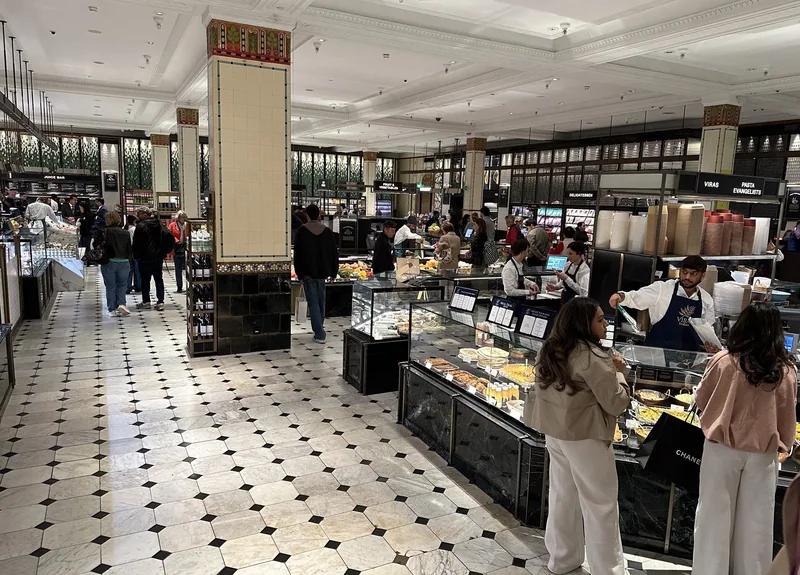
Photo: APK · CC BY 4.0 · Wikimedia Commons · resized
How the money and the seating work
Five practical rules apply in every hall in London.
- You pay stall by stall. Six people will produce six transactions. Card and contactless are standard and several counters no longer take cash.
- There is no service charge. Card machines sometimes offer a tip; nobody expects one at a counter. Our guide to tipping in London explains where it is expected instead.
- Drinks come from the hall's own bar, not from the food counters, and that is where the operator makes its margin. A pint or a glass of wine runs £6 to £9.
- Seating is first come, first served, and the bottleneck is not the food. At 19:30 on a Friday you may queue twenty minutes for a table and two minutes for a curry. Send someone to sit down before anyone orders.
- Free tap water is available on request at the bar. Every premises in England licensed to sell alcohol has to provide it where it is reasonably available.
Claim the table first, then split up and order. This is the single trick that makes a food hall work for a group. One person holds a table while the others queue at different counters, and everybody eats at roughly the same time. Doing it the other way round means standing about with a tray going cold while somebody circles the room.
The halls, one by one
Opening hours below were read on the operators' own sites in September 2026. Individual counters keep their own hours and often stop serving food before the bar closes.
| Hall | Address | Hours (September 2026) |
|---|---|---|
| Seven Dials Market | Earlham Street, WC2H 9LX, Covent Garden | Mon and Tue 12:00-22:00; Wed to Sat 11:00-23:00; Sun 11:00-21:00 |
| Victoria | 191 Victoria Street, SW1E 5NE | Mon and Tue 08:00-22:00; Wed to Sat 08:00-23:00; Sun 08:00-21:00 |
| Oxford Street | 9 Holles Street, W1G 0BD, behind John Lewis | Mon and Tue 11:00-22:00; Wed to Sat 11:00-23:00; Sun 11:00-20:00 |
| Paddington | 1 Paddington Square, W2 1DL | Mon and Tue 08:00-22:00; Wed to Sat 08:00-23:00; Sun 09:00-21:00 |
| Canary Wharf | 25 North Colonnade, E14 5HD | Mon and Tue 07:30-22:00; Wed 07:30-23:00; Thu and Fri 07:30-00:00; Sat 08:00-23:00; Sun 08:00-21:00 |
| Centre Point | 101-103 New Oxford Street, WC1A 1DB | Daily; check on the day |
| Battersea Power Station | Boiler House, first floor, SW11 8DD | Daily; check on the day |
| Bishopsgate | 135 Bishopsgate, EC2M 3TP | Weekday-led; shorter at weekends |
Seven Dials Market is the one to choose if you have one evening. It sits in a former banana warehouse off Earlham Street, three minutes from Covent Garden, it is run by the street-food organisation Kerb, and it describes itself as holding 21 traders and two bars across two floors. It is the most central, the busiest and the loudest, and it takes no bookings for small groups.
Victoria and Paddington are the two that open at eight in the morning, which makes them genuinely useful before a train: both are inside two minutes of their stations, both do coffee and breakfast, and both are far better than a station concourse. Canary Wharf opens earlier still and stays open to midnight on Thursdays and Fridays; see our guide to Canary Wharf for the surrounding towers.
Oxford Street, behind John Lewis, is the answer to a shopping day, with the important caveat that it does not open until 11:00 and closes at 20:00 on a Sunday. Centre Point, at the top of Charing Cross Road, is closer to a group of separate restaurants under one roof than to a market, and it is the smartest of the set.
Bishopsgate, a minute from Liverpool Street, is an Italian hall: a supermarket, several counters and a restaurant together, rated 5 for hygiene in January 2026. It runs on the office week, so it is at its best at Thursday lunchtime and at its quietest on Sunday; our page on eating near Liverpool Street covers the alternatives on that side of town.
The Elephant and Castle hall, which works differently
The large covered market on Newington Causeway at Elephant and Castle is the one hall in London that is genuinely a night out rather than a meal. It has more than forty traders, a garden, several bars, and it stays open to 01:00 on Friday and Saturday. Our food markets guide carries its full timetable; the short version is that it opens daily from midday and closes later than any other hall in this article.
It is also the most likely of all of them to be too loud to talk in after nine o'clock. Go early if you want a conversation and late if you do not.
Boxpark, Pop Brixton and the container yards
A separate format grew up alongside the halls: shipping containers stacked into a yard, with kitchens in some and shops in others, and the seating outdoors or under an awning. It is cheaper to build and much colder in January.
Boxpark now has four London sites. The original is on Bethnal Green Road in Shoreditch. Boxpark Croydon, at 99 George Street next to East Croydon station, is the largest and the most food-led, with more than twenty registered kitchens including Afghan, Jamaican, Greek, Vietnamese and Himalayan; several were inspected in August and September 2026. It doubles as a screen venue for football, which changes the atmosphere completely on a match day; see our guide to Croydon. There are also sites on Olympic Way at Wembley, useful before a stadium event, and at Buck Street Market in Camden.
Pop Brixton, at 49 Brixton Station Road, is the community-run version: containers around a yard, a mix of kitchens and small businesses, and a much more local crowd than the halls in the centre. Our guide to Brixton covers the market halls next door, which are a third thing again.
Canopy Market, under the West Handyside Canopy behind King's Cross, is a weekend market rather than a hall, and worth checking rather than assuming.
A food hall is the cheapest way to feed a group with four different diets. One person can eat a momo, another a vegan burrito, another a plate of Jamaican curry goat, and nobody has to compromise or read a menu aloud. Our pages on vegan and vegetarian London and Nepalese and Himalayan food both point at counters inside these halls.
What a food hall actually costs
A main dish at a counter runs roughly £10 to £16, a side £4 to £6 and a drink £6 to £9. Two people eating one dish each with a drink come to about £40 to £50, which is a little less than a casual restaurant and a little more than a market stall. Those are our estimates for September 2026, read from counter boards.
Where a hall beats a restaurant is on the extras: no cover charge, no service charge, no bread you did not order, and no obligation to buy drinks from the same place you bought the food. Where it loses is on quantity: sharing three dishes between two, which is the cheap way to eat at a market, is harder when each dish comes from a different till. Our guide to eating cheaply in London has the genuinely low-cost options.
What goes wrong
Four things, consistently.
Noise. These are hard-surfaced rooms with bars in them. After about 20:30 on a Friday, several are too loud for a conversation across a table, and none of them has a quiet corner.
Seating at peak. The tables fill before the counters do. Weekend evenings between 19:00 and 21:00 are the worst hour in every hall in London.
Food arriving at different times. Six counters cook at six speeds. If it matters that everybody eats together, agree on two counters rather than six.
Allergies. Small counters work in tight spaces with shared equipment, and the person serving may not be the person who wrote the recipe. Every business must tell you which of the fourteen regulated allergens are in a dish, but ask at the counter before you order rather than at the table afterwards.
For families, the noise and the space cut both ways: nobody minds a child moving about, and nobody can hear you either. Our guide to London with kids has more on eating out as a family, and eating alone in London explains why a shared table is one of the easiest places in the city to eat by yourself.
Frequently asked questions
Do you need to book a food hall in London?
No, and most do not take bookings for small groups at all. Larger parties can sometimes reserve a table, usually with a minimum spend. The practical answer at a busy hour is to send one person to claim a table while the rest queue at the counters.
Is there a service charge in a food hall?
No. You order and pay at each counter, so there is nothing added to a bill at the end. Card machines occasionally offer a tip and nobody expects one. Since October 2024 employers in Britain have had to pass any tips on to staff in full.
Which London food hall is best?
Seven Dials Market off Earlham Street, for most visitors: the most central, the widest choice and open until 23:00 from Wednesday to Saturday. Choose the Victoria or Paddington halls if you want breakfast before a train, Canary Wharf if you want a late Thursday, and Boxpark Croydon if you want the cheapest.
Are London food halls open on Sundays?
Yes, all of them, but they close earlier. The Oxford Street hall shuts at 20:00 on a Sunday, Seven Dials and Victoria at 21:00. That is a trading decision rather than a legal one: the six-hour Sunday limit applies to large shops, not to places selling food to eat on the premises.
Is a food hall cheaper than a restaurant?
Slightly. A main dish at a counter is roughly £10 to £16, against £16 to £25 in a casual restaurant, and there is no service charge. The saving shrinks once you buy drinks from the hall's bar, which is where the operator makes its money.
Sources
- Food Standards Agency - Food hygiene rating search (checked September 2026; used to confirm that each hall named here is trading at the address given and to check the counters mentioned)
- Food Standards Agency - The Food Hygiene Rating Scheme (checked September 2026)
- Food Standards Agency - Allergen guidance for food businesses (checked September 2026)
- legislation.gov.uk - Licensing Act 2003 (Mandatory Conditions) Order 2014, the free tap water requirement (checked September 2026)
- GOV.UK - Tips at work: what employers must do with tips and service charges (checked September 2026)
- Opening hours and price bands were read on the hall operators' own websites and counter boards in September 2026. We do not link to those sites, because a food hall is a collection of market traders and several such domains have changed hands; the domains are recorded in our editorial notes.