
A British pub runs on a set of customs nobody writes down: whose turn it is to pay, which chair not to sit in, what the bell means, and why on a Tuesday night forty people are sitting in silence filling in an answer sheet. None of it is difficult. All of it is invisible until somebody explains it.
Our guide to pub etiquette for visitors covers the mechanics of ordering, the drink measures and the law on age and smoking. This page is about the social machinery: the quiz, the round, the games, the lock-in and the long half-hour after the bell. It is written for someone who has never spent an evening in one.
The short version: buy a round if you are in a group, join the quiz if there is one, do not move a stranger's coat, and leave when the staff start stacking chairs.
An evening in a pub, in order
- Arriving
- Find a table first, then order at the bar. Bags and coats on chairs hold a table; this is respected
- Rounds
- One person pays for everyone, and each person takes a turn. In a group of six that is six drinks a time
- Quiz night
- Usually a Monday, Tuesday or Wednesday, starting around 20:00 and running about two hours
- Teams
- Commonly capped at six people. Two is enough. Phones are not allowed
- Last orders
- Announced, often with a bell, at a time set by that pub's own licence
- Drinking-up
- A short period after the bar closes to finish what you have. Not a legal right in itself; the licence sets it
- Lock-ins
- Rare now, and an offence for the licensee rather than for you
The quiz: what actually happens
A pub quiz is a general knowledge competition run by the pub, usually by one person with a microphone, on a fixed weeknight. It exists because Monday to Wednesday are dead trading nights and a quiz fills them. That is worth knowing, because it tells you what the evening is for: the pub wants forty people buying drinks for two hours, not a serious test.
The format is remarkably consistent across London.
- You put a team together and pay a small entry fee per person at the bar. The money usually goes into the prize.
- You invent a team name. These are traditionally puns, often about whatever is in the news. Nobody expects a good one.
- A picture round is handed out at the start to work on between the spoken rounds: faces, logos, close-up photographs of objects.
- Six to eight rounds of about ten questions follow, read out twice. Common themes are music, sport, geography, history, film and a "connections" round where the answers share something.
- Sheets are swapped with another team for marking at the halfway point and at the end. This is the part that makes strangers talk to each other.
- A tie-break settles a draw, almost always a "nearest to" question with a number for an answer.
Two mechanisms are worth understanding. Many quizzes have a joker: once in the evening you may nominate a round to count double, and you must do it before that round is read out. And many have a rollover jackpot, a single hard question whose prize grows week by week until somebody gets it, which is why regulars turn up on a wet Tuesday in February.
Turn up forty minutes before the quiz starts, not five. A quiz night fills the pub, tables are taken from about seven for an eight o'clock start, and at many pubs you must register the team and pay at the bar before the first round. Arriving on time means standing up all evening with your sheet on a window ledge. It also means missing the one round of drinks that gets bought before the room goes quiet.
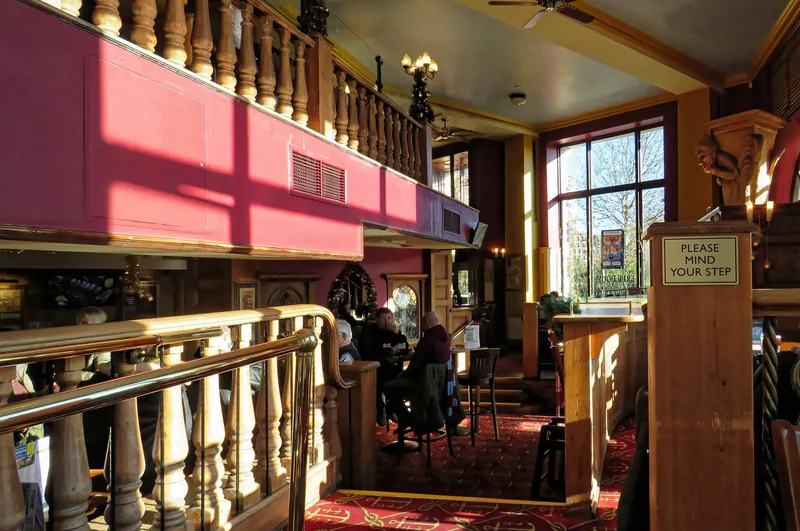
Photo: Acabashi · CC BY-SA 4.0 · Wikimedia Commons · resized
Joining a quiz as a visitor
Two people can enter. You will lose, cheerfully, because the winning teams are six locals who have done this every week for four years and one of them is a retired history teacher. That is not a reason to stay away: a quiz is by a distance the easiest way for a stranger to spend an evening in a British pub without knowing anyone, which our page on solo travel in London makes the case for more generally.
Ask at the bar whether you can join an existing team. In most pubs somebody will find room for you, particularly on a quiet night. Say you are visiting; the round on British television from the 1970s will be explained to you at length and with some pity.
Phones stay in pockets. This is the one rule that is enforced, and a team seen looking things up is simply disqualified from that round. The prize is usually the pot of entry money, a bar tab, or a bottle of something; a few pubs give the last team a booby prize, which is often more fun to win.
A quiz that tests knowledge is treated as a competition of skill rather than as gaming, which is why the Gambling Commission's limits on stakes and prizes for pub poker and bingo do not bite on it. Those limits are real for other pub games: card games and bingo in a pub are tightly capped, which is why you will not find a serious poker night in one.
The round, and the arithmetic nobody mentions
Buying in rounds means one person pays for everyone's drink, and the next person pays for the next. It is the default in any group, and it exists because it saves four people queueing separately at a crowded bar.
The arithmetic is the part that catches visitors. The last figure published in the Office for National Statistics average-price series, for January 2025, put a pint of draught lager at £4.83 across the United Kingdom; central London is well above the national average. In a group of six that makes a single round a substantial sum, and six rounds an evening that nobody planned.
The conventions that manage this are simple and entirely acceptable to use:
- Opt out at the start. "I'll get my own" said as the group sits down is normal and nobody thinks anything of it. Said after three free drinks, it is not.
- Split into smaller rounds. Two or three people buying for each other inside a larger group is common and avoids the problem entirely.
- Take your turn even on soft drinks. Your round will cost less than everyone else's, and you are still in the system. Our page on drinking without alcohol covers how normal that has become.
- If you must leave before your turn, buy early. Say "I'll get this one, I have to go after it" and the matter is closed.
- Use a kitty for a long evening. Everyone puts in the same amount at the start and the money sits on the table. Common among groups who drink at different speeds.
Running a tab, leaving a card behind the bar, is offered in many pubs and is the easy option for a group, but it hides the total until the end. Our page about using cards and cash in London covers the payment side, and tipping in London the rest.
Darts, dominoes and the games on the wall
Pub games are older than the pub quiz by centuries and several survive in London, usually in the older and less renovated rooms.
Darts is the common one. The standard game is 501: you start at 501, subtract what you score, and must finish exactly on a double. The line you throw from is called the oche, and it is marked on the floor at a fixed distance. You do not walk in front of someone who is throwing, and you do not touch another player's darts. Our guide to darts and snooker in London covers the professional version, which fills arenas.
Pool tables work on "winner stays on": the winner keeps the table and the next challenger plays them. You join the queue by putting a coin on the edge of the table, in line behind any coins already there. Taking someone else's turn by ignoring the coins is a genuine offence against pub order.
Dominoes and cribbage survive in a handful of pubs, mostly played by older regulars, and both are exempted from the usual stake limits on pub gaming. Bar billiards and shove ha'penny are rarer still and worth a detour if you see a table.
The machine flashing in the corner is not a pub game in this sense. Fruit machines and quiz machines pay cash prizes, are regulated gambling, and are a different proposition entirely.
The lock-in, and whether it still happens
A lock-in is the old practice of the landlord closing the doors at closing time and continuing to serve the people already inside. It belongs to the era before 2005, when every pub in England had to stop selling at eleven o'clock and a lock-in was the only way to carry on.
Since the Licensing Act 2003 came into force, each pub sets its own hours through its licence, so a pub that wants to trade until one in the morning applies to do so. That has made the lock-in largely unnecessary and correspondingly rare, particularly in London, where late licences are common.
The legal position is worth stating plainly. Selling alcohol outside the hours on the licence is carrying on an unauthorised licensable activity, which is an offence under section 136 of the Act, punishable by up to six months' imprisonment or a fine. The offence is committed by the person selling, not by the customer drinking. The old device of the landlord giving drinks away to "private guests" is exactly the sort of arrangement licensing officers have heard before.
If you find yourself in a lock-in, you are free to leave. Being inside a pub after hours is not an offence you commit, but you are in a closed building whose doors may be bolted, and you cannot buy a drink from a legal point of view no matter what is happening at the bar. Ask to be let out and you will be. Do not let it wreck your plans for getting home: our guide to the Night Tube explains which lines run late on Friday and Saturday.
The bell, and the half hour after it
Closing a pub is a ritual with stages, and reading them saves the awkwardness of being asked to leave.
First, the kitchen closes, typically an hour or more before the bar, and the food menus are taken away. Then a bell is rung or an announcement is made for last orders, which is the final chance to buy. A second call, traditionally "time", means the bar has shut. After that comes drinking-up time, a short period to finish what is in front of you, set by the pub's licence rather than by a national rule.
The signals that the end is near are consistent: the music gets louder, then stops; staff start collecting glasses from occupied tables; the lights come up. When the lights go up, finish and go. Nobody will be rude about it and everybody will expect you to move.
The local, and how to be a stranger in one
A "local" is the pub a person drinks in habitually, usually the nearest good one to their home. In a genuine local there will be one or two people at the bar who are there most evenings and who are, in effect, furniture. There may be a particular stool or corner that is understood to be someone's.
Nobody will introduce themselves to you at a table, and this is not unfriendliness. The bar is where conversation happens: standing at it, waiting to be served, is the one position in a British pub where a stranger starting a conversation is entirely normal. Our guide to British etiquette for visitors covers the wider habit of reserve, and British words and slang decodes some of what you will hear.
Charity raffles and meat raffles appear on the bar in some pubs, particularly on Sundays: you buy a strip of tickets, numbers are drawn later, and somebody goes home with a joint of beef. Join in. It costs almost nothing and it is the fastest way to be treated as part of the room.
Picking the right pub for the evening you want
London pubs specialise more than they appear to. A pub with screens showing sport is loud on a match day and empty otherwise. A pub with a serious kitchen, of the kind described in our guide to gastropubs in London, will seat you at a table and hand you a menu. A pub with twelve keg lines is aimed at people who want to talk about beer, which our page on craft beer and brewery taprooms covers. A pub with none of those is the one to choose for a quiet evening and a conversation.
The old rooms are a category of their own and our guide to historic pubs in London picks out the ones worth the journey, while our pub walks link several into an afternoon. For a garden rather than a bar, see beer gardens in London. And if the pub closes before you are ready, London nightlife covers what comes next.
One last suggestion. A team that has spent the day in the British Museum will be no better at the quiz than anybody else, but it will have a far better story for the history round, and the quizmaster will enjoy it. Our page on comedy clubs in London covers the other kind of pub back room, which is where a great many British comedians start.
Frequently asked questions
How does a pub quiz work in Britain?
You form a team, pay a small entry fee at the bar and invent a team name. A quizmaster reads six to eight rounds of about ten questions, with a picture round handed out at the start. Teams swap sheets to mark each other's answers, and a tie-break settles a draw.
Can visitors join a pub quiz?
Yes. Two people can enter as a team, and if you ask at the bar, an existing team will usually make room for you. Phones are banned, and using one gets your team's round discounted. The entry fee is small and generally goes straight into the prize.
What is a round of drinks and do I have to buy one?
In a group, one person buys drinks for everybody and each person takes a turn. It is expected but not compulsory: saying "I'll get my own" when you sit down is entirely normal. What is frowned on is accepting several drinks and leaving before your turn comes.
Is a pub lock-in legal?
No. Selling alcohol outside the hours on a pub's licence is an offence under section 136 of the Licensing Act 2003, carrying up to six months' imprisonment or a fine. The offence falls on the licensee rather than the customer. Lock-ins are also rare now, because pubs can apply for late hours instead.
What happens after last orders in a British pub?
The bar stops selling and a short drinking-up period follows, set by that pub's licence rather than by a national rule. Staff collect glasses, the music stops and the lights come up. When the lights go up, finish your drink and leave; nobody will be impolite about it.
Sources
- legislation.gov.uk - Licensing Act 2003, section 136: unauthorised licensable activities (checked September 2026)
- GOV.UK - Alcohol licensing guidance (checked September 2026)
- Gambling Commission - Pubs and clubs toolkit: gaming in alcohol-licensed premises (checked September 2026)
- Office for National Statistics - RPI average price, draught lager per pint (series CZMS) (checked September 2026)
- GOV.UK - Weights and measures: specified quantities for beer, cider, wine and spirits (checked September 2026)