
A gastropub is a pub where the kitchen, not the bar, decides how the place runs. You can usually tell within thirty seconds: the menu is written out fresh that day, the wine list is longer than the lager list, and somebody wants to know whether you have booked. A pub that merely serves food has a laminated menu and a microwave.
The word was coined in London in the early 1990s and the form was invented here. The Eagle on Farringdon Road, which opened in 1991, is generally credited with it: a scruffy pub where a chef cooked serious Mediterranean food to order and you still queued at the bar for it. Everything since has been a variation on that idea. Our guide to traditional British food covers the dishes; this page is about the kind of place, what it costs and how to get a table.
For the meal most people come to a gastropub for, our page on the Sunday roast explains what should be on the plate. Here we deal with what it costs when a real kitchen cooks it, and why the good ones are sold out by Wednesday.
Telling one from the other
- A gastropub
- Menu changed daily or seasonally, often handwritten. Kitchen hours shorter than bar hours. Bookings taken for some or all tables
- A pub that does food
- Fixed printed menu, food all day, order at the bar with a table number, no bookings
- Kitchen hours
- Typically 12:00-15:00 and 18:00-22:00, with a gap. The bar stays open through the afternoon
- Sunday
- Roast served from midday, usually until it runs out. Many kitchens close mid-afternoon on Sunday
- Set lunch
- The bargain. The Bull & Last in Kentish Town lists two courses at £20 and three at £25 on weekdays (September 2026)
- The top end
- The Harwood Arms in Fulham, London's only Michelin-starred pub, lists two courses at £64 and three at £79 (September 2026)
- Booking
- Essential for Sunday. Often impossible for bar seats, which stay first-come
What actually separates the two
The difference is not price, and it is not whether the room has been redecorated. It is how the food is produced.
- The menu changes. A gastropub kitchen buys what is good and writes the menu around it. The Eagle chalks its board up twice a day, five minutes before service begins.
- Everything is cooked to order. This has a consequence diners find odd: dishes from the same table arrive at different times, because they were started at different times. At the Eagle you are told plainly to eat yours when it turns up.
- The kitchen is small. Two or three chefs producing a meal a minute at lunchtime is normal, which is also why service stops dead at three o'clock.
- The bar still works as a bar. This is the test that matters. If you cannot walk in and buy a pint without eating, it is a restaurant with a pub sign on it.
That last point is worth being firm about. A great many London places described as gastropubs are restaurants that kept the old building. A pub with a dining room, like the Marksman on Hackney Road or the Canton Arms in Stockwell, keeps both functions running in the same room, and the front of the house is still somewhere to stand with a drink.
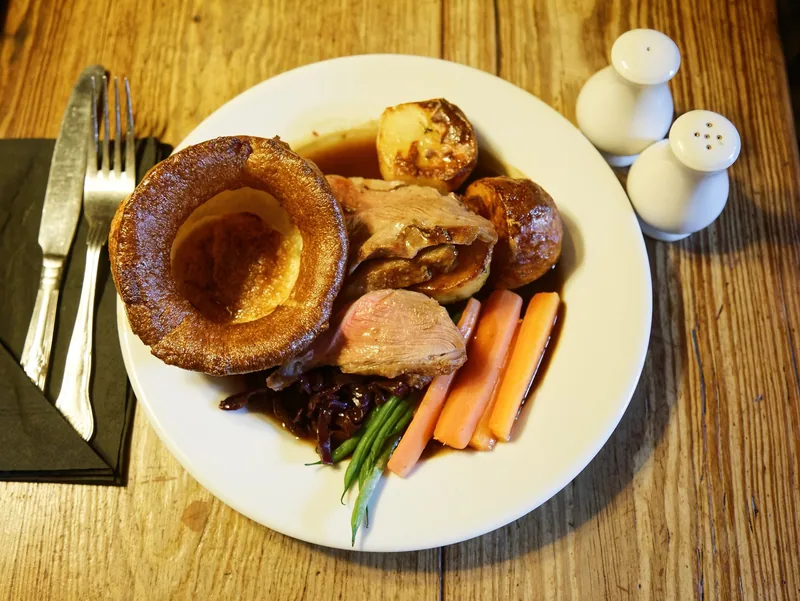
Photo: Acabashi · CC BY-SA 4.0 · Wikimedia Commons · resized
Whether to book, and how
The honest answer is that it depends on which part of the pub you want, and most booking systems do not make this clear.
Many gastropubs split the room. Dining tables are bookable; bar tables and stools around the edge are not, and are held for people who walk in. The Eagle takes reservations only for its larger tables, of between five and ten people, and by telephone rather than online; the rest of the seating is described as free seating, which means you ask the staff how to get some.
A few rules that hold across London:
- Sunday needs booking, and early in the week. A good pub roast sells out. Monday or Tuesday for the following Sunday is not excessive.
- Weekday lunch rarely does. Walking in at midday on a Tuesday almost always works, and the set menu is cheapest then.
- Check the kitchen hours, not the pub hours. The Marksman's bar runs to midnight, but its kitchen closes at three and reopens at six. Turning up at half past four gets you a drink and nothing else.
- Ring rather than click for awkward requests. Groups, buggies, dogs and allergies are all handled better by a person, and many of these pubs answer their own phone at fixed times of day.
Sunday evening is the dead spot. A large number of London gastropub kitchens close on Sunday afternoon and do not reopen, and some pubs shut entirely in the early evening; the Eagle's bar closes at five on a Sunday. If you have arrived in London on a Sunday and want a proper pub dinner, check the pub's own page for that day's hours before you set out, because the general opening times shown by search engines are frequently the weekday ones.
What a gastropub roast costs, and what you get for it
Pub roasts in London cover an enormous range. At the bottom are the chain pubs described in our guide to London's chain restaurants, where a roast is cheap, reliable and portioned by machine. At the top are kitchens sourcing whole animals and dry-ageing the beef themselves.
What the money buys in a good pub is mostly in three places: the meat, which will be a named breed or a named farm rather than simply "beef"; the potatoes, which should be roasted in fat and ordered separately in some pubs; and the gravy, which should be made from the roasting tray rather than a powder. A Yorkshire pudding comes with beef by tradition, and the better kitchens give one with everything because people complain otherwise.
Two verified reference points for September 2026. The Bull & Last in Kentish Town publishes a weekday set menu at £20 for two courses and £25 for three, rising to £25 and £30 at dinner. The Harwood Arms in Fulham, which describes itself as the only Michelin-starred pub in London, serves two courses at £64 and three at £79, with roasts available all day on Sunday. Between those two figures sits everything else. Check each pub's own menu page, because these change several times a year.
The London gastropubs worth knowing about, by area
This is deliberately not a ranked list, because the best one is whichever is near where you are and has a table.
Clerkenwell and Farringdon. The Eagle, at 159 Farringdon Road, is still working and still doing the thing it invented. Its kitchen runs 12:00 to 15:00 and 18:30 to 22:30 from Monday to Saturday and lunchtime only on Sunday. Our guide to Clerkenwell covers an area that has more good food per street than anywhere else in the City fringe.
Hackney and the east. The Marksman at 254 Hackney Road was the first London pub to be named Michelin's pub of the year, and it serves roasts every Sunday. See our guide to Shoreditch for the surrounding streets.
North London. The Bull & Last sits at the Highgate Road edge of Hampstead Heath and is the classic walk-then-eat pub; the Drapers Arms and the Pig and Butcher in Islington are within a few streets of each other. Our page on Kentish Town and Archway covers the first.
South of the river. The Anchor and Hope on The Cut in Waterloo is one of the most influential kitchens in this category, and the Canton Arms in Stockwell was opened in 2010 by two of the people who worked there. Both belong to a small independent group rather than a chain. Our guide to the South Bank covers the first, which is a short walk from the theatres.
West. The Harwood Arms in Fulham is the one with the star, and its cooking is built around game and wild food rather than around pub classics. Booking is not optional. Our page on Michelin-starred restaurants in London explains what the award means and does not mean.
The set lunch is the way into an expensive kitchen. Several serious pub kitchens run a fixed-price menu at lunchtime from Monday to Friday, at a fraction of the evening price and cooked by the same people in the same kitchen. It is the single best value in London restaurant eating, it needs no special knowledge, and you can usually walk in. Our guide to eating cheaply in London has the other routes.
How to order, and what the bill will look like
In most gastropubs a member of staff takes your order at the table, which is the opposite of the system explained in our guide to ordering at a British bar. Where the pub runs both systems, food is ordered at the table and drinks may be either.
Expect side dishes to be priced separately. Potatoes, greens and extra Yorkshire puddings are often not included in a roast, and two or three sides added to four roasts changes the total substantially. Ask what comes with the plate before adding anything.
A discretionary service charge, usually somewhere between ten and fifteen per cent, appears on the bill in most gastropubs and on almost none in ordinary pubs. It is optional, and the law since October 2024 requires an employer to hand over every penny of it to the people who worked for it. Our guide to tipping in London covers the rules.
Drinking in a gastropub
The wine list is usually the giveaway. A pub kitchen that has thought about food has normally thought about wine, and the lists tend to be short, unfamiliar and better value than a restaurant's. Several of these pubs pour wines you will not find elsewhere in London; our guide to wine bars in London covers the specialists.
The beer varies more. Some gastropubs keep cask ale seriously; others have reduced the bar to two taps and a fridge. If a well-kept pint matters to you, our page on craft beer and brewery taprooms is a better guide to where to find one, and the pubs in our guide to riverside drinking are chosen for the view rather than the kitchen.
Dietary requirements, children and dogs
Small kitchens have less room to improvise than large ones, and some say so openly: the Harwood Arms states on its own site that it cannot accommodate vegans, and that it cannot guarantee safety for guests at risk of anaphylaxis because of cross-contamination in its kitchen. That is unusually honest rather than unusual, and it is why you should ask when booking rather than on arrival. See vegan and vegetarian London and gluten-free eating in London.
Children are generally welcome at lunchtime and on Sunday, and less so on a Friday evening when the pub reverts to being a pub. Many of these places have no high chairs and very little space for a buggy; ring and ask. Our family guide to London has more.
Dogs are usually allowed in the bar and not in the dining room, which in a one-room pub means the rule depends on how busy it is. For a table outdoors instead, see beer gardens in London.
Frequently asked questions
What is a gastropub?
A pub where the kitchen sets the tone: a menu that changes regularly, food cooked to order, shorter kitchen hours than bar hours, and often table service for food. The term was coined in London in the early 1990s, and the Eagle on Farringdon Road is generally credited with starting the form in 1991.
Should I reserve a table at a London gastropub?
For Sunday lunch, yes, and several days in advance. For a weekday lunch, rarely. Many gastropubs reserve only their dining tables and keep bar seating for walk-ins, and some take bookings only for larger groups and only by telephone.
How much is a Sunday roast in a London gastropub?
The range is wide. A weekday set menu at the Bull & Last is £20 for two courses and £25 for three, while the Harwood Arms charges £64 for two courses and £79 for three (September 2026). Most pub roasts sit between those figures. Side dishes are often charged separately, so check what is included.
Can I just have a drink in a gastropub?
In a genuine one, yes: the bar still works as a bar and you can stand at it without eating. If you cannot, the place is a restaurant in a former pub. Bar areas usually keep some unreserved seating for exactly this reason.
How can I tell a gastropub from a pub that serves food?
A fixed printed menu available all day, food ordered at the bar with a table number and no bookings taken usually means a pub that serves food. A menu that changes, a wine list, separate kitchen hours and a reservations system usually means a gastropub. Neither is better; they are different evenings.
Sources
- The Harwood Arms, Fulham - menus and prices (checked September 2026)
- The Eagle, Farringdon - address, kitchen and bar hours, booking policy (checked September 2026)
- Marksman Public House, Hackney Road - opening and kitchen hours (checked September 2026)
- The Bull & Last, Kentish Town - set lunch and dinner prices (checked September 2026)
- Canton Arms, Stockwell - history and group pubs (checked September 2026)
- GOV.UK - Tips at work (checked September 2026)