
The George Inn is open every day: 11am to 11pm Monday to Wednesday and on Sunday, and 11am to midnight from Thursday to Saturday, with food served until 10pm. Walking into the yard to look at the galleries is free and you do not have to buy anything. Go before noon, because from about five o'clock the yard is shoulder to shoulder.
It stands in its own yard off the east side of Borough High Street, three minutes from London Bridge station. The National Trust owns it and leases it to Greene King, so it is a working pub that happens to be a grade I listed building. Our guide to London's historic pubs places it among the other survivors and our Southwark and Bankside guide explains why Borough High Street had a dozen inns like it.
This page is about the building: which parts are original, what the railway company took away, what is in the cellar, and how to see it without standing in a crowd.
The George Inn at a glance
- Address
- The George Inn Yard, 77 Borough High Street, Southwark, London SE1 1NH.
- Hours
- 11am to 11pm Monday to Wednesday and Sunday; 11am to midnight Thursday to Saturday. Kitchen 11am to 10pm daily (operator's own listing, read September 2026).
- Cost
- Free to walk into the yard. Pub prices inside.
- Listing
- Grade I, list entry 1378357, first listed 2 March 1950.
- Owner
- The National Trust since 1937; leased to Greene King.
- Hygiene rating
- 5, inspected 29 April 2026 (Food Standards Agency register).
- Station
- London Bridge, about three minutes on foot.
- Dogs
- Welcome.
What "galleried" means, and why only one is left
A coaching inn was built as a hollow square. Carriages came in through an arch off the street into a yard; the ground floor held the bars, kitchens and stabling; and the bedrooms on the upper floors were reached not from an internal corridor but from open wooden balconies running along the inside face of the building. Those balconies are the galleries. A servant walked along the outside of the building to reach your room.
Hundreds of London inns were built this way. The National Trust's own note on the building says that the Second World War accounted for many of the other survivors, and fire and railway building took most of the rest. The George is what is left, and it is only a fraction of what stood here.
Historic England's list entry is precise about which fraction. The present building is the south range of an inn that was ranged around a quadrangle. The company that Historic England names as the Great Eastern Railway came to use part of the inn as offices, acquired the whole site from Guy's Hospital, and pulled the north range down in 1874. What you stand in front of today is one side of a courtyard that once had four.
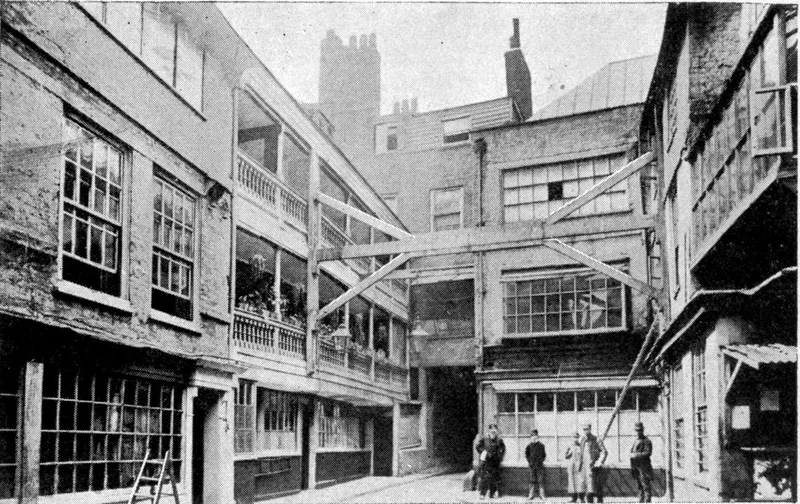
The galleries only run along the western half of the front. Look at the building from the middle of the yard: the left-hand portion has two tiers of gallery, the right-hand portion is a nine-window brick range with no gallery at all. They are two phases of the same building, not one design.
Reading the front of the building
The galleried half has the lower tier carried on beams that project from the wall and the upper tier on wooden Doric columns. The wall behind the galleries is partly brick and partly exposed timber frame, and there are windows on both levels that open onto the gallery rather than the street. At the eastern end of the galleried section there is a staircase.
The brick half to the right is limewashed, with bands marking each floor. The windows are a deliberate muddle, because they were replaced piecemeal over two centuries: flush eighteenth-century sashes, sliding sashes, casements, and windows with stone mullions and transoms that are older than any of them. Historic England reads these as remnants of an earlier phase of building. Three storeys, with dormers in the roof above.
There is no ticket, no guide and no interpretation board. The yard is the exhibit, which is why the hour you choose matters so much.
Inside: the staircase, the panelling and the cellar
The interior is more interesting than a first drink suggests, and most of it is listed in its own right.
- An early eighteenth-century staircase, reset as a dogleg around 1730, with barleytwist and column-on-vase balusters and a heavy twisted newel post at the bottom.
- Panelled ground-floor rooms: fielded panelling, a moulded dado and a bolection-moulded overmantel above the fireplace in the front right room, plainer straight-cut panelling behind it, and an early nineteenth-century marble fireplace in the front left.
- Three panelled rooms on the first floor, one with another early nineteenth-century fireplace.
- An eighteenth-century common-rafter roof in the attic, with halved collars.
- A seventeenth-century plank door down to the cellar, and in the cellar itself reused medieval beams and squared stonework in the left-hand side wall that Historic England describes as possibly medieval in origin.
The cellar is not open to the public, and neither is the attic. What you can see is the ground floor, the yard and, if the upstairs rooms are in use, the first-floor bars.
How old is it really?
Three dates get quoted and they mean different things. The inn on this site existed at least by the sixteenth century, which Historic England states as a historical note. The National Trust says the original George Inn was destroyed by fire in 1676, the fire that swept along Borough High Street. Historic England dates the present fabric simply to the seventeenth century, without giving a rebuilding year, so the widely repeated "1677" is the traditional account rather than a statutory fact. Treat the building as a post-fire rebuild of the 1670s and you will not be wrong.
The Shakespeare stories attached to this yard are worth treating with more suspicion. Shakespeare died in 1616 and everything you can see here was built after 1676, so no part of this structure ever saw him. The Dickens connection is better documented: the National Trust records that Charles Dickens visited the site when it was a coffee house, and the inn appears in Little Dorrit. Our page on the Charles Dickens Museum covers his London properly.
No part of this building is old enough for the Shakespeare stories. The inn that stood here in his lifetime burned in 1676. If a walking tour tells you he drank in this room, it is telling you about the site, not the timber.
When to come, and what the yard is like
The yard has a completely different character at three points in the day, and only one of them lets you see the building.
| Time | What it is like |
|---|---|
| 11am to 12.30pm, any day | Nearly empty. You can stand in the middle of the yard, look up at both tiers of gallery and take a photograph without people in it. |
| 12.30pm to 2.30pm, weekdays | Lunch. Tables taken, the bars busy, the yard usable. |
| From about 5pm, Monday to Friday | Full. The yard packs with office workers from the surrounding blocks and there is standing room only. Impossible to see the architecture. |
| Saturday and Sunday afternoon | Busy with visitors rather than workers, and busier in fine weather than in rain. |
Winter is the underrated season here. On a cold Tuesday in January the yard is empty, the bars have fires lit, and the low-ceilinged rooms make more sense than they do in July. Our guide to London's beer gardens covers the outdoor-drinking season properly; this is the one courtyard that is arguably better out of it.
Eating and drinking here
The kitchen serves standard British pub food and runs until 10pm every day. The National Trust's own advice is to book ahead, and that is sound for a weekend lunch or any evening. Booking is through the operator rather than the Trust.
The food is not the reason to come. Judge it as the meal you have while sitting in a grade I building, and no higher. If you want the cooking to match the building, our guide to traditional British food and our page on the Sunday roast are better starting points, and Borough Market is seven minutes north for lunch. Our page on where to eat near London Bridge has the walk-by-walk alternatives, including what to do on a Monday when the market is quiet.
If you are new to ordering in a British pub, you queue at the bar, pay when you order and carry your own drinks; our guide to pub etiquette covers the rest, including what to do about tipping.
Getting in, and the honest position on access
The entrance is an archway off the pavement on the east side of Borough High Street, roughly opposite the end of the market. It is easy to walk past: look for the yard rather than a pub front, because there is no frontage on the street at all.
The National Trust's own record for the property lists disabled access as not available, and it does not claim an induction loop or an audio guide either. The yard is cobbled, the thresholds are raised and the interior doorways are low and narrow. A wheelchair user can get into the yard from the pavement and see the galleries, which is the best part; the galleries themselves and the upper rooms are reached only by the historic stair. London Bridge station is step-free and three minutes away.
What to put around it
Half an hour covers the George. Build the rest of the morning from things within ten minutes: Southwark Cathedral is free and five minutes north, the surviving inn-yard entrances further down the High Street still carry their names on the wall, and Shakespeare's Globe is eleven minutes towards the river.
If old pubs are the point of your day rather than a stop on it, our page on historic pub crawls has four routes that include this one, and two of our other single-pub pages take the same approach in different parts of town: the Seven Stars behind the law courts, which shuts at the weekend, and the one-room pub on Britton Street in Clerkenwell, which has changed its name.
Frequently asked questions
Is the George Inn free to visit?
Yes. The yard is open to the street and you can walk in, look at the galleries and leave without buying anything. There is no admission charge and no ticket, because it is a pub rather than a museum. The National Trust owns the freehold but does not run it as a paid visitor attraction.
What time does the George Inn open?
It opens at 11am every day. It closes at 11pm from Monday to Wednesday and on Sunday, and at midnight from Thursday to Saturday. The kitchen serves from 11am to 10pm daily. These were the operator's published hours in September 2026; check before a special journey.
Why is the George Inn the last galleried inn in London?
Because the others were destroyed. Fire took many, the Second World War took several survivors, and railway building took the rest, including three of the George's own four ranges. Historic England records that the north range was demolished in 1874 by the railway company that had bought the site from Guy's Hospital.
Did Shakespeare drink at the George Inn?
Not in this building. An inn stood on the site in his lifetime, but it burned down in 1676, sixty years after his death, and everything standing today was built after that. The documented literary connection is Charles Dickens, who knew the site as a coffee house and mentioned the inn in Little Dorrit.
When is the George Inn quietest?
Between 11am and about half past twelve on any day, and all day on a cold weekday in winter. From five o'clock on a weekday the yard fills with people from the surrounding offices and you will not be able to see the building at all, let alone find a seat.
Sources
- Historic England - The George Inn, 77 Borough High Street, list entry 1378357, grade I (checked September 2026)
- National Trust - George Inn, London (checked September 2026)
- Food Standards Agency - food hygiene ratings register, The George Inn, 75-77 Borough High Street SE1 1NH, rated 5 (checked September 2026)
- Planning (Listed Buildings and Conservation Areas) Act 1990 (checked September 2026)